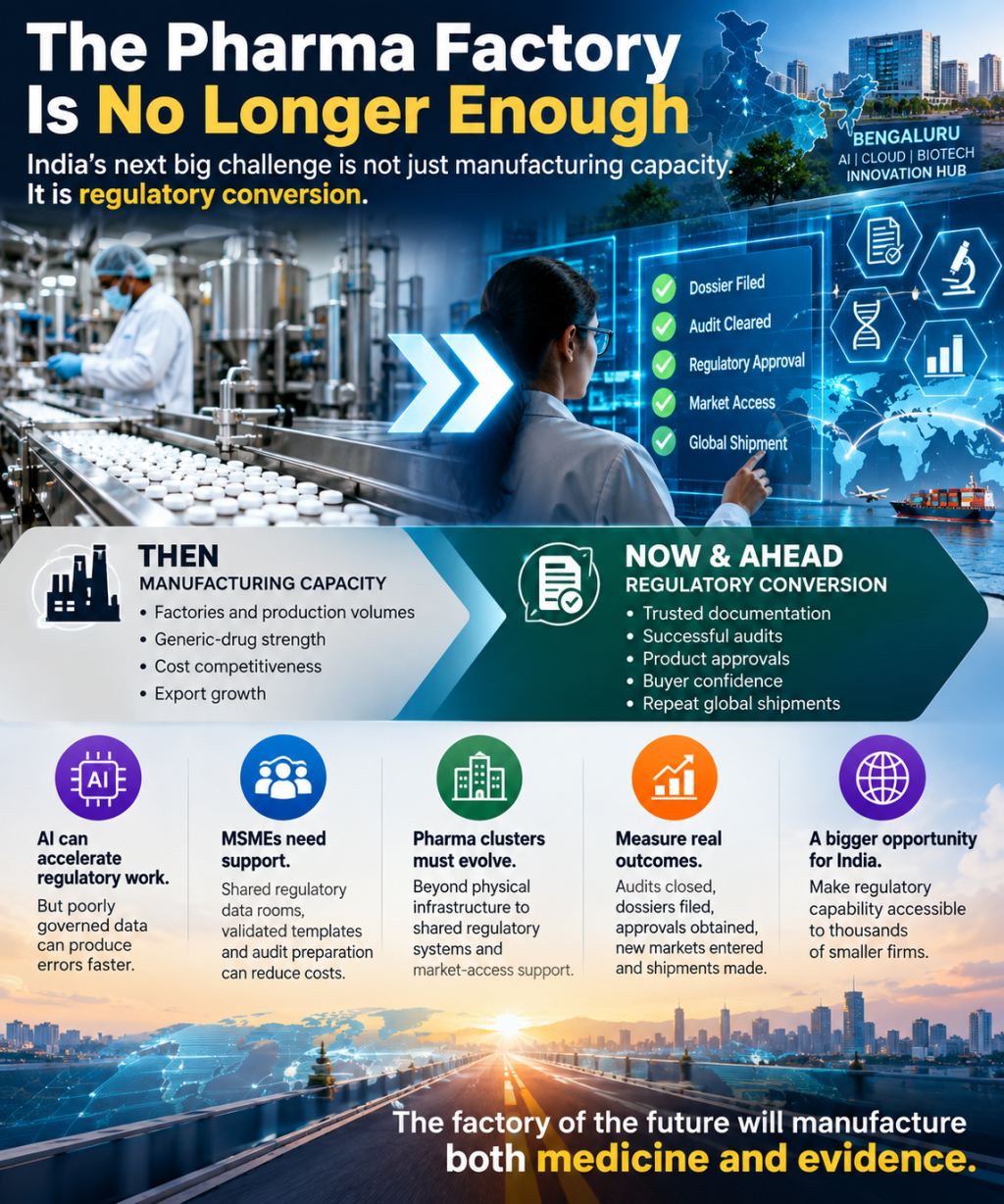
A Quiet Week Can Reveal a Bigger Change — Sometimes the absence of a major policy announcement is more useful than another headline. India’s pharmaceutical and biotechnology sector has spent decades thinking about industrial strength largely through factories, installed capacity, production volumes and exports. That model created enormous capabilities. But the next competitive battle may be very different. Increasingly, the question is not simply whether India can manufacture a medicine. The harder question is whether a company can convert scientific and manufacturing capability into a product that satisfies regulators, passes audits, wins buyer confidence and reaches a regulated market repeatedly.
From Manufacturing Capacity to Regulatory Conversion — This is a major historical transition. India’s pharmaceutical rise was built first around process chemistry, generic medicines, affordable manufacturing and scale. Over time, GMP compliance, bioequivalence, pharmacovigilance, traceability and increasingly complex regulatory requirements became part of the competitive equation. The next stage could make data itself part of the production system. A batch may physically leave the factory, but commercially it cannot travel very far without the documentation, validation, evidence and regulatory confidence surrounding it. In that sense, the future pharmaceutical factory has two production lines: one manufactures the medicine; the other manufactures trusted evidence about the medicine.
Bengaluru Is a Signal, Not Yet an Outcome — The opening of a new life-sciences Innovation Hub in Bengaluru in September is interesting precisely for this reason. The centre is designed around AI, cloud technologies, analytics and digital tools supporting advanced therapies, including gene, cell and tissue treatments. Its stated scope stretches from research and process optimisation to manufacturing and regulatory readiness. But a technology centre should not automatically be counted as pharmaceutical innovation. A building is not a breakthrough. An AI platform is not a drug approval. A digital dashboard is not an export order. These are inputs whose economic value emerges only when they shorten development cycles, improve compliance, reduce errors, accelerate regulatory submissions or help products reach patients and markets.
The Coming Digital Paradox — AI could make pharmaceutical compliance dramatically more efficient, but it can also make bad systems fail faster. If source data are inconsistent, records poorly structured, validation weak or responsibility unclear, automation can reproduce errors at enormous speed. The industry therefore faces an uncomfortable possibility: digitalisation without data discipline may increase regulatory risk rather than reduce it. The real investment is consequently not merely AI. It is AI plus validated data, traceability, cybersecurity, interoperability, human accountability and regulatory understanding.
The MSME Problem Is Different — Large pharmaceutical companies can maintain regulatory departments, international consultants, specialised software systems and teams familiar with multiple markets. A smaller manufacturer may have strong technical production capability but struggle with the expensive final kilometres between factory readiness and market acceptance. Preparing dossiers, responding to observations, maintaining regulatory intelligence, documenting deviations, validating processes and understanding buyer-specific requirements impose substantial fixed costs. For an MSME producing relatively small volumes, those costs are spread across fewer products and fewer markets. This creates a new form of industrial inequality: two firms may possess similar manufacturing capability but radically different capacities to convert that capability into regulated sales.
The Pharma Cluster Must Become a Regulatory Platform — This is where cluster development needs to change. Historically, pharmaceutical clusters were often understood through land, laboratories, effluent-treatment facilities, testing infrastructure and common physical services. These remain important, but tomorrow’s cluster may need shared regulatory infrastructure just as urgently. A modern pharma cluster could maintain secure regulatory-data rooms, validated documentation templates, common regulatory intelligence, audit-preparation services, digital quality systems, training facilities and specialised market-access teams. Instead of every small company repeatedly buying the same knowledge from outside consultants, part of that knowledge could become shared economic infrastructure.
The performance indicators would also have to change. Counting seminars, technology centres, training programmes and participating companies tells very little about competitiveness. Better questions are harder: How many regulatory observations were successfully closed? How many dossiers were filed? How much did approval time fall? How many MSMEs entered a regulated market for the first time? How many buyer audits converted into commercial orders? How many approved products generated repeat shipments? Cluster policy should increasingly measure conversion rather than participation.
From Consultant Dependency to Shared Capability — There are two possible futures. In the more inclusive one, interoperable digital systems, common standards and shared regulatory platforms reduce the fixed cost of entering sophisticated markets. Smaller companies gain access to capabilities previously affordable mainly to large firms. Pharma clusters become knowledge networks in which regulatory learning spreads across enterprises.
The other future is less attractive. Proprietary software, fragmented databases and increasingly complicated compliance systems could make smaller manufacturers more dependent on consultants, technology vendors and large corporations. Digitalisation would then modernise the industry without democratising capability. MSMEs would remain manufacturers while higher-value regulatory intelligence, market access and data ownership accumulated elsewhere.
The New Competitive Geography of Pharma — This transformation could also change the geography of pharmaceutical competitiveness. The strongest clusters of the future may not necessarily be those with the largest number of factories. They may be places where manufacturing, clinical knowledge, biotechnology, digital engineering, regulation, universities, testing institutions and global market intelligence interact continuously. Bengaluru’s technology ecosystem therefore matters not simply because another centre has opened there, but because the boundaries between pharmaceuticals, biotechnology, software, AI and data engineering are becoming increasingly difficult to separate.
India’s broader trade performance also provides useful context. Total merchandise exports reached US$43.81 billion in August 2026, while estimated merchandise-and-services exports reached US$82.68 billion. Yet national export growth does not automatically solve the micro-level problem of converting individual pharmaceutical capabilities into sustainable regulated-market business. Aggregate export numbers can rise while individual MSMEs remain outside the most demanding and valuable markets.
The Factory of 2035 May Produce Evidence as Intensively as Medicine — This may be the most important structural change ahead. Pharmaceutical competitiveness will increasingly depend on the ability to connect molecule, process, factory, data, regulator, buyer and patient through one trusted information chain. AI will probably accelerate parts of that chain, but technology cannot substitute for institutional discipline.
India already possesses manufacturing depth. Its next advantage must come from reducing the distance between the factory gate and regulatory acceptance. That requires treating regulatory knowledge, validated data and market-conversion capability as industrial infrastructure rather than administrative overhead.
The pharmaceutical cluster of the future therefore may look surprisingly different from the industrial estates of the past. Its most valuable common facility may not be another building or machine. It could be a trusted digital and regulatory system that allows hundreds of smaller firms to prove what they can do, obtain approvals faster and convert production capability into repeat global business.
The next pharmaceutical race will not simply be about who can make the medicine.
It will increasingly be about who can make the evidence travel with it.
Pharma #Biotechnology #PharmaMSME #PharmaClusters #AI #RegulatoryAffairs #DigitalHealth #Manufacturing #Exports #MSME #Innovation #India


Leave a comment