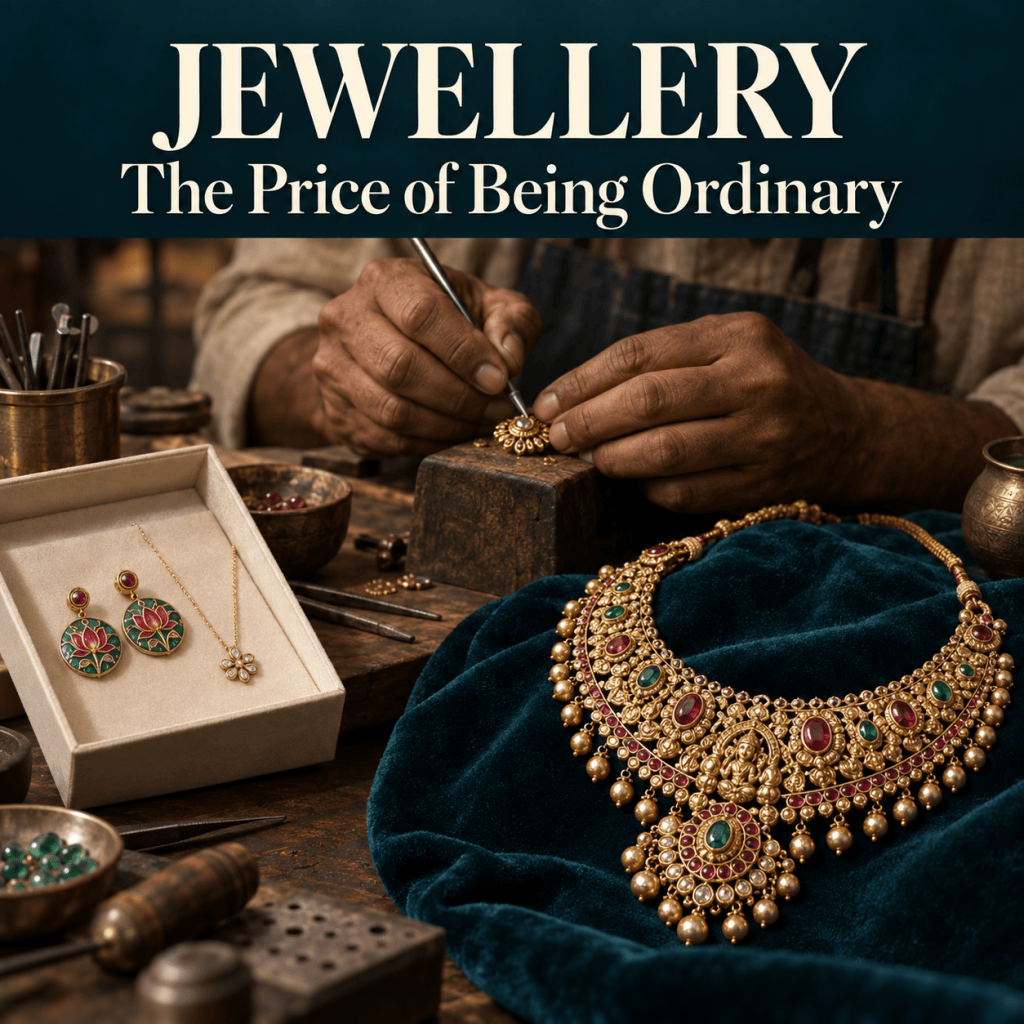
A jewellery market can sparkle while becoming harder to enter. More spending does not necessarily mean more buyers, and stronger retail sales do not automatically create opportunities for every producer. For Indian heritage jewellery exporters, the dangerous assumption is that a rich craft tradition will find its own customers. Heritage can open a conversation. It cannot, by itself, close a sale.
MarketWatch reported on 15 September 2026 that Macy’s and Kohl’s had identified jewellery as a comparatively strong category. Its coverage also described interest in affordable personalised purchases alongside conspicuous luxury. These are useful signals from particular retailers and market segments. They are not evidence of established demand for Indian heritage jewellery, nor proof that every price category is growing. The opportunity deserves a test, not a warehouse full of assumptions.
An old object meets a different buyer. Jewellery has long carried several kinds of value: adornment, savings, family memory, social standing and ceremonial meaning. In India, these functions often sit within the same piece. An ornament can belong to a marriage, a region and a household balance sheet at once. Its significance is understood through relationships and customs that need little explanation locally.
Exporting removes much of that familiar context. A buyer encountering a piece on a phone screen may know nothing about its technique or cultural background. The producer sees generations of skill. The buyer first sees a shape, a price and a delivery promise. The commercial task is to connect those two worlds without reducing the craft to a decorative label.
This is where many heritage propositions become weak. They explain where an object comes from but leave unanswered why someone should wear it, gift it or pay more for it. A long history is valuable only when the present product gives the customer a reason to care.
The middle is not dead; unclear value is vulnerable. It would be premature to turn a retail signal into a sweeping declaration that middle-priced jewellery has no future. Consumers do not remain permanently inside one spending category. The same person may buy inexpensive earrings for everyday use and save for a distinctive anniversary gift. Occasion, confidence and personal meaning can change the budget.
The problem is the indistinct offer: too expensive for an easy purchase, yet insufficiently convincing for a considered one. A seller cannot solve this simply by lowering or raising the price. The product needs a clear role in the buyer’s life.
For Indian exporters, two separate collections offer a useful starting experiment. An accessible collection should make choosing and gifting easy, with wearable designs, dependable finishing and understandable care instructions. A premium collection should justify closer inspection through workmanship, material clarity, distinctive design and dependable service. Both require quality. Their difference lies in the promise being made and the evidence needed to support it.
Affordable must not become a polite word for underpaying the artisan. If a lower selling price is achieved only by squeezing labour, the exporter is consuming the craft’s future to finance today’s order. Better affordability can come from simpler designs, fewer variations, shared components and more efficient packaging. Preserve the skill while reducing avoidable complexity.
A heritage premium must reach the maker. Premium positioning has its own uncomfortable question: who receives the premium? An artisan’s story may help sell an expensive piece while the artisan remains a low-paid, replaceable supplier. That arrangement turns cultural identity into marketing material without strengthening the people who sustain it.
A credible heritage business should improve repeat orders, payment predictability and recognition for makers. Provenance should connect a product to a real workshop and process, with consent where people’s identities are used. It should also distinguish what is genuinely known from what merely sounds attractive. Handmade, traditional, rare and sustainable are different claims; none should be treated as a substitute for evidence.
Material disclosure must be equally plain. Customers should understand the metal, any plating and the nature of the stones. Accurate photographs should show scale, surfaces, clasps and how the piece sits when worn. Beautiful images attract attention; honest images help prevent disappointment. For a small exporter, avoiding a preventable return can matter more than winning an extra click.
Count the margin after the journey. Revenue is an incomplete measure of export success. A piece can sell at an impressive price and leave little after packaging, freight, selling fees, customer acquisition, returns and applicable import charges. A second order placed on the same terms can multiply the mistake.
Every proposed price should therefore be tested against the full route to the customer. Accessible gifts and premium pieces need separate calculations because their packaging, selling effort and service expectations may differ. A business should know how much room remains when a shipment costs more than expected or a buyer requests a replacement.
Where tariff treatment or implementation is uncertain, quotations should identify the assumptions behind the price, its validity period and how changes in import charges will be handled. The purpose is commercial clarity. An exporter who silently absorbs every change may protect the order while destroying its viability. Equally, a buyer should not discover an unexpected cost only after committing to a purchase.
The next advantage may be verifiable individuality. Looking ahead, digital design tools could make attractive jewellery concepts easier to produce and copy. If that happens, visual novelty alone may become a weaker defence. A small workshop will need more than a pattern that looks different for a few weeks.
One possible response is a closer relationship between the object and its buyer: controlled personalisation, documented making, repair support and small collections that develop a recognisable design language. Technology could help retain production records and customer preferences. But a digital record is useful only when its contents are reliable. A polished product page cannot compensate for inconsistent workmanship.
India’s opportunity is to make living craft relevant to contemporary use. That may mean adjusting weight, fastening, dimensions or colour combinations while retaining the technique that gives the object character. Tradition need not be frozen to remain meaningful. It needs makers who can earn enough to keep adapting it.
Let a paid order challenge the story. The immediate priority should be a limited commercial test: two clearly positioned collections, a manageable number of designs and buyers willing to pay. Measure which pieces sell without heavy discounting, what questions customers ask, why products return and whether buyers reorder. Small paid trials reveal weaknesses that compliments and social-media attention often conceal.
The supplied brief identifies no sufficiently material Canadian or Mexican development to justify an immediate strategy change. That is a reason to retain the present approach provisionally, not to assume those markets behave like the United States. Each requires its own evidence on buyers, channels and viable delivered prices.
The future of Indian heritage jewellery exports will depend on how well cultural depth becomes everyday usefulness and commercial trust. A modestly priced piece can offer that. An expensive piece can fail to do so. The real danger is asking the customer to pay for a distinction the business has never made clear.
#IndianJewellery #HeritageExports #MSMEs #Artisans #ExportStrategy
 "Connecting communities, empowering nations: Unifying the Regional and Global Economy ."
Leave a comment