When Geography Returns to Globalisation
For almost three decades, globalisation created the impression that geography was becoming less important. Goods could be designed in America, manufactured in Asia, assembled somewhere else and sold across the world. Containerisation, large ports, cheap shipping and digital supply-chain systems made distance appear manageable. The dominant business question became simple: where can something be produced most cheaply? But beneath this apparently borderless economy remained an uncomfortable geographical reality. A very large part of world trade still moves through a relatively small number of narrow maritime passages. The digital economy may operate through clouds, but the physical economy still travels through canals, straits and ports.
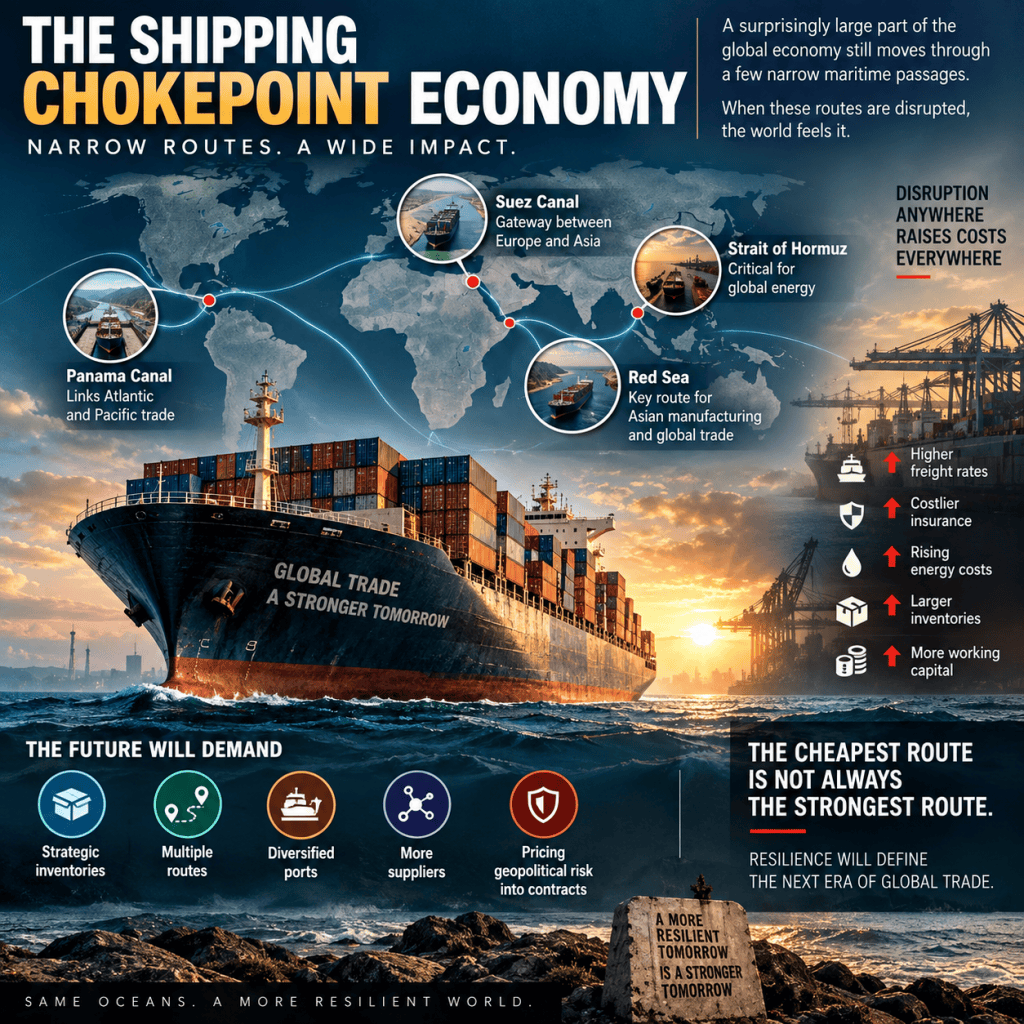
The old geography never disappeared — Maritime chokepoints are not a new feature of economic history. Control over sea routes shaped empires long before modern globalisation. The Suez Canal transformed the connection between Europe and Asia. The Panama Canal changed trade between the Atlantic and Pacific. The Strait of Hormuz became strategically critical with the rise of the petroleum economy. The Red Sea and Bab el-Mandeb became essential links between Asian manufacturing, Middle Eastern energy and European consumption. What changed during modern globalisation was not the importance of these passages, but the enormous volume of economic activity that became dependent upon their continuous functioning.
Efficiency quietly created vulnerability — The modern supply chain was built around reducing inventory, shortening production cycles and lowering logistics costs. Just-in-time production became a symbol of managerial efficiency. Warehouses were treated as unnecessary costs. Companies increasingly depended on components arriving almost exactly when required. This worked extremely well when shipping routes were predictable. But efficiency and resilience are not the same thing. A supply chain designed to remove every spare day, spare supplier and spare inventory buffer can become remarkably fragile when geopolitics, conflict, drought, accidents or extreme weather interrupt transportation.
The lesson is uncomfortable. The cheapest supply chain in normal times may become the most expensive supply chain during disruption.
A narrow passage can now create a global economic shock — Consider what happens when movement through a major maritime corridor becomes difficult. Ships may have to travel thousands of additional kilometres. Fuel consumption rises. Delivery times lengthen. Freight rates can increase. Marine insurance becomes more expensive. Containers and vessels remain occupied for longer periods, reducing effective shipping capacity. Importers require additional working capital because goods remain in transit for more days. Manufacturers may carry larger inventories to protect themselves against delayed inputs. The original disruption may occur thousands of kilometres away, yet its economic consequences can eventually appear in the price of electricity, fertilizer, chemicals, machinery, automobiles, food, clothing and consumer products.
This is why the shipping chokepoint economy is much bigger than shipping.
Hormuz, Suez, the Red Sea and Panama represent different kinds of vulnerability — The Strait of Hormuz demonstrates energy concentration. The Suez-Red Sea route demonstrates the vulnerability of Europe-Asia merchandise trade. Panama demonstrates another emerging risk: climate and water constraints affecting infrastructure that global commerce assumed would always remain available. These are different problems, but they reveal the same structural weakness. Global trade has become enormously sophisticated while remaining physically concentrated.
And there is another danger. Several disruptions do not have to happen simultaneously to transform corporate behaviour. Repeated smaller disruptions can be enough. Once companies believe that uncertainty is permanent rather than temporary, they begin redesigning supply chains.
The next logistics revolution may be about redundancy rather than speed — For decades companies asked how inventory could be reduced. Increasingly they may ask how much inventory is necessary for survival. They asked which shipping route was cheapest. They may increasingly ask which alternative route remains available if the cheapest one closes. They concentrated purchases with efficient suppliers. They may now deliberately maintain second and third sourcing options even when those suppliers cost slightly more.
This represents a profound change in business economics. Redundancy, once regarded as inefficiency, is becoming a form of insurance.
Companies may consequently maintain strategic inventories of critical components, negotiate multiple freight routes, diversify ports, establish regional warehouses and move some production closer to final markets. Logistics departments may also become more strategically important inside corporations because transportation risk is increasingly connected with geopolitical risk.
Geopolitics will enter the price of a product — The future landed cost of an imported product may increasingly contain an invisible geopolitical premium. Companies will not calculate only factory price plus freight plus tariff. They will have to consider route reliability, insurance exposure, expected delays, inventory requirements, political instability, sanctions risk and the possibility of sudden diversion.
Contracts themselves may evolve. Buyers and suppliers could increasingly negotiate clauses covering extraordinary freight increases, route changes, delivery delays and geopolitical disruption. Financial markets and insurers may develop more sophisticated instruments for pricing logistics risk. Artificial intelligence may continuously analyse vessel movements, weather systems, port congestion, conflicts and political signals to recommend alternative supply routes before disruption becomes severe.
The supply chain of the future could therefore behave less like a fixed pipeline and more like a constantly adjusting network.
India should look at the map differently — For India, this transformation creates both vulnerability and opportunity. India depends heavily on maritime trade and imported energy, while its export ambitions require reliable connections with Europe, North America, the Middle East, Africa and East Asia. A disruption affecting western maritime routes can therefore influence both imported inputs and export competitiveness.
But geography can also become an advantage. India sits close to some of the world’s most important east-west shipping routes. Its long coastline gives it the possibility of developing multiple gateways rather than depending excessively on a few ports. Ports, coastal manufacturing zones, multimodal logistics, warehousing, shipbuilding, ship repair, container availability and freight services should therefore be seen as part of industrial strategy rather than simply transport infrastructure.
The next generation of industrial clusters may need to be designed around logistics resilience as much as production efficiency.
MSMEs face the hidden danger — Large corporations can maintain inventories, negotiate long-term freight contracts and diversify suppliers. Smaller firms often cannot. A sudden increase in freight cost or an additional two weeks of transit can lock up working capital that an MSME simply does not possess. Shipping disruption therefore creates an unequal economic burden.
Cluster institutions could become important risk-sharing mechanisms. Common warehouses, consolidated freight purchasing, shared export logistics, digital shipment monitoring, alternative supplier databases and collective insurance arrangements could allow smaller firms to obtain some of the resilience normally available only to large companies.
This may become a new purpose of cluster development: not merely reducing production costs, but collectively managing uncertainty.
The cheapest route may no longer be the best route — The deepest change is philosophical. Globalisation was built around optimisation. The emerging world economy is being reorganised around optionality. Businesses will increasingly pay something today to avoid losing everything tomorrow.
That means the future factory may have more than one supplier. The future exporter may use more than one port. The future shipping contract may contain geopolitical contingencies. The future warehouse may hold more inventory than conventional efficiency models recommend. And governments may invest in ports and corridors that appear redundant under normal conditions but become strategically priceless during disruption.
The twentieth-century economy treated transport largely as a cost to minimise. The twenty-first-century economy may increasingly treat logistics as a strategic capability.
The great paradox is that an increasingly digital, automated and AI-driven global economy may become more conscious of physical geography than it has been for decades. Satellites can track every ship. Algorithms can optimise every container. Artificial intelligence can forecast congestion. But technology cannot digitally replace the Strait of Hormuz, widen a canal overnight or remove thousands of kilometres from an alternative sea route.
Globalisation is therefore not ending. It is becoming geographically conscious.
And perhaps the most important question for future competitiveness will no longer be simply where a product can be manufactured most cheaply.
It will be whether that product can still reach the customer when the shortest route suddenly disappears.This theme also connects strongly with your recent arguments on strategic redundancy, the death of the cheapest supplier, economic security, critical minerals and carbon competitiveness. Together, they point toward a larger idea: future competitiveness will increasingly be measured by the ability to continue operating under disruption, not merely by efficiency during normal conditions.
#GlobalTrade #Shipping #SupplyChains #Logistics #MSME #India #Exports #Geopolitics #Manufacturing #ClusterDevelopment


Leave a Reply