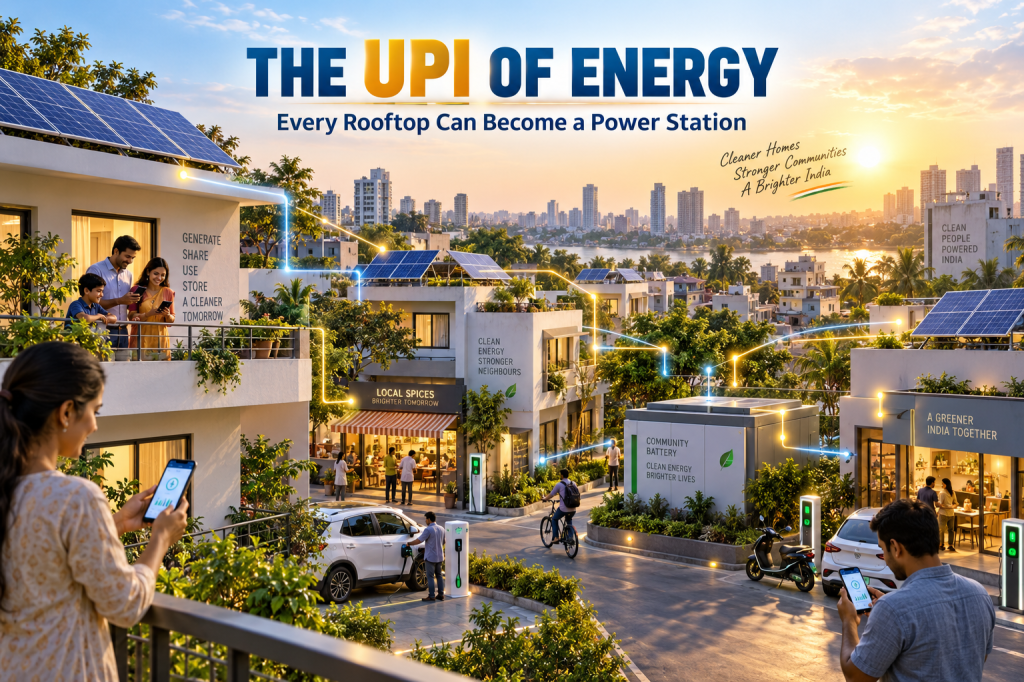
For more than a century, electricity has moved in one direction. A large power station produces it, a transmission network carries it, a distribution company supplies it, and the consumer pays the bill. The household stands at the final end of the system. It consumes electricity but has little influence over its production, price or movement.
That architecture is beginning to change. The future of electricity may resemble the transformation already created by UPI in financial transactions. UPI did not produce money. It created a trusted digital system through which millions of people could exchange even the smallest amounts instantly. The next energy revolution may do something similar. It may allow households, shops, factories, farms and electric vehicles to exchange small units of electricity through a common digital network.
The important idea is not that UPI itself is energy. The deeper idea is that India needs a UPI-like infrastructure for energy.
From packaged energy to invisible electricity
People have long purchased energy in small and visible packages. A family buys an LPG cylinder. A roadside business buys charcoal. A farmer purchases diesel for a pump. These transactions are understandable because the energy is measured, packaged, owned and paid for.
Electricity developed differently. It arrived through a wire and was supplied by a regulated utility. Consumers generally could not choose where it came from, sell it to another consumer or negotiate its price. When grid electricity was unreliable, families and enterprises bought generators and produced power privately, usually by burning diesel. This created energy independence, but in an expensive and polluting form.
Solar panels, smart meters, batteries and electric vehicles are now breaking this old division between producer and consumer.
The consumer is becoming a prosumer
A house with rooftop solar is no longer only an electricity consumer. During the day, it may generate more power than it requires. A home battery can store the surplus. An electric vehicle adds another large storage device that remains unused for much of the day.
The same household can therefore perform four roles. It can produce electricity, consume electricity, store electricity and sell electricity.
India is already moving towards this decentralised base. By 19 March 2026, more than 26 lakh rooftop solar systems had been installed under PM Surya Ghar, with nearly ₹17,968 crore released as central financial assistance. This remains only an early stage in a country with hundreds of millions of electricity connections, but the direction is important. Electricity generation is gradually moving from distant power stations towards rooftops, farms, institutions and industrial premises.
The word consumer may consequently become outdated. The emerging participant is a prosumer, someone who both produces and consumes power.
The neighbourhood may become an energy market
Imagine a residential colony in which one house generates surplus solar electricity at noon. The adjoining house needs additional power to charge an electric vehicle. A nearby shop requires electricity for refrigeration. Instead of sending all surplus power to the distribution company at a fixed rate, a digital platform could match the local seller and buyer.
No separate wire would necessarily be required between the houses. Electricity could continue to flow through the distribution network, while smart meters and a digital settlement system calculate who supplied what, who consumed it and how much should be paid.
The physical grid would remain essential, just as the banking system remained essential after UPI. But the grid would no longer be only a delivery mechanism. It would also become a marketplace.
Transactions could be extremely small. A household might sell ten units in the afternoon, buy five units after sunset and allow part of its vehicle battery to support the neighbourhood during the evening demand peak. Millions of such transactions could take place automatically.
India’s power-sector planning is beginning to recognise possibilities such as peer-to-peer energy exchange, rooftop-solar integration and battery-as-a-service models. Yet recognition of the idea is much easier than building a fair national market.
The birth of millions of energy entrepreneurs
The real economic importance of this transition lies beyond cheaper electricity. It could create an entirely new layer of decentralised enterprise.
Some households will simply sell surplus solar power. Others may invest in larger rooftop systems. Apartment associations could operate shared batteries. Rural entrepreneurs could build solar-powered cold-storage facilities. Farmers could sell surplus power from solar pumps. Local enterprises could aggregate electricity from hundreds of small producers and offer it to commercial consumers.
New businesses will be required for installation, maintenance, metering, billing, forecasting, battery management, energy auditing, equipment recycling and cybersecurity. MSMEs could manufacture mounting structures, smart controllers, inverters, charging systems, cables and specialised power electronics. Cluster-level energy companies could combine the generation and demand of hundreds of small factories.
An industrial cluster could eventually function as an energy community. One factory may have unused rooftop space, another may operate mainly at night, while a third may possess battery capacity. A digital platform could coordinate them and reduce the cluster’s collective electricity cost.
This is where the energy transition can become an entrepreneurship transition.
The EV will not remain only a vehicle
An electric vehicle is usually described as a cleaner mode of transport. That description is incomplete. It is also a mobile battery.
Most private vehicles remain parked for long periods. If vehicle-to-grid technology develops at scale, an EV could charge when solar electricity is abundant and return a controlled amount of energy when demand and prices rise. The owner could earn from the battery’s flexibility while retaining enough charge for travel.
A city with one million electric vehicles could possess an enormous distributed storage reserve. Instead of constructing every unit of storage as a separate utility-scale project, part of the requirement could be met through batteries that people have already purchased for mobility.
However, this model must account for battery degradation, consumer consent, charger compatibility, warranties and emergency mobility needs. A household will not participate merely because the technology exists. The income must exceed the cost and inconvenience.
The danger of mistaking a metaphor for a market
The UPI comparison is powerful, but electricity is not money. Money can move digitally without affecting the stability of the banking network every second. Electricity must be generated and consumed in continuous physical balance. A sudden mismatch can damage equipment and destabilise the grid.
Local energy trading therefore requires more than an attractive mobile application. It needs smart meters, reliable communication, accurate forecasting, cybersecurity, settlement rules, voltage management and clear responsibility for network losses.
It also raises difficult questions. Who will maintain the local distribution network if prosperous consumers increasingly generate their own electricity? Who will pay for universal service in poorer or remote areas? Can one household freely sell electricity to another, or must the transaction pass through the distribution licensee? Who is responsible when a meter, battery or algorithm produces an incorrect settlement?
Most importantly, digital access must not create a new form of energy inequality. Wealthier households can afford rooftops, solar panels, batteries and electric vehicles. Tenants, low-income families and people living in congested settlements may have none of these assets. If policy is poorly designed, the energy market could reward people who already possess property while leaving others to bear a growing share of grid costs.
The distribution company must evolve, not disappear
The future should not be presented as a conflict between households and distribution companies. Even in a decentralised system, somebody must maintain wires, transformers, substations, safety systems and emergency supply.
The distribution company of the future could become a neutral network and market operator. It could earn transparent charges for carrying electricity, balancing local supply, verifying transactions and providing backup power. Its revenue model would shift from simply selling more units towards managing a more intelligent network.
This transition will be institutionally difficult. Distribution companies carrying financial losses may see peer-to-peer trade as a threat to revenue. Regulators may hesitate to allow millions of small sellers into a system designed around a limited number of generators. States may adopt incompatible rules. Without common standards, India could create isolated experiments rather than a national energy market.
UPI succeeded because it combined public digital infrastructure, interoperable standards, simple participation and low transaction costs. A comparable energy system will need the same institutional clarity, but with much stronger engineering safeguards.
Energy inclusion must come before energy speculation
There is also a risk that energy trading becomes another speculative digital market. The purpose should not be to turn every family into a power trader staring at changing prices. Technology should automatically optimise buying, selling and storage within limits chosen by the household.
The first objective must remain reliable and affordable energy. Trading is a means, not the destination.
Community ownership could make the model more inclusive. Housing societies, village institutions, women’s groups, producer organisations and MSME associations could jointly own solar and storage assets. People without suitable rooftops could purchase a share in a neighbourhood project. Local energy markets could then distribute income more widely instead of merely rewarding individual asset owners.
From power consumers to economic citizens
The first electricity revolution connected homes to the grid. The second expanded generation and improved access. The third will allow people to participate in the energy economy itself.
A rooftop may become a productive asset. An EV may become a source of income. A battery may become part of local infrastructure. A village may become an energy cooperative. An industrial cluster may become its own balancing community.
But technology alone will not produce this future. India will need interoperable smart meters, affordable finance, consumer protection, open digital protocols, cybersecurity standards and regulations permitting small producers to trade without overwhelming complexity. It will also need a fair way to pay for the grid that everyone continues to depend upon.
The real breakthrough will come when buying or selling one unit of clean electricity becomes almost as simple as transferring one rupee. At that point, electricity will no longer be something that merely arrives at the consumer’s home.
It will become something the citizen can produce, store, exchange and build an enterprise around.
EnergyTransition #RenewableEnergy #RooftopSolar #ElectricVehicles #EnergyEntrepreneurship #MSME #DigitalInfrastructure #SmartGrid #CleanEnergy #India


Leave a comment