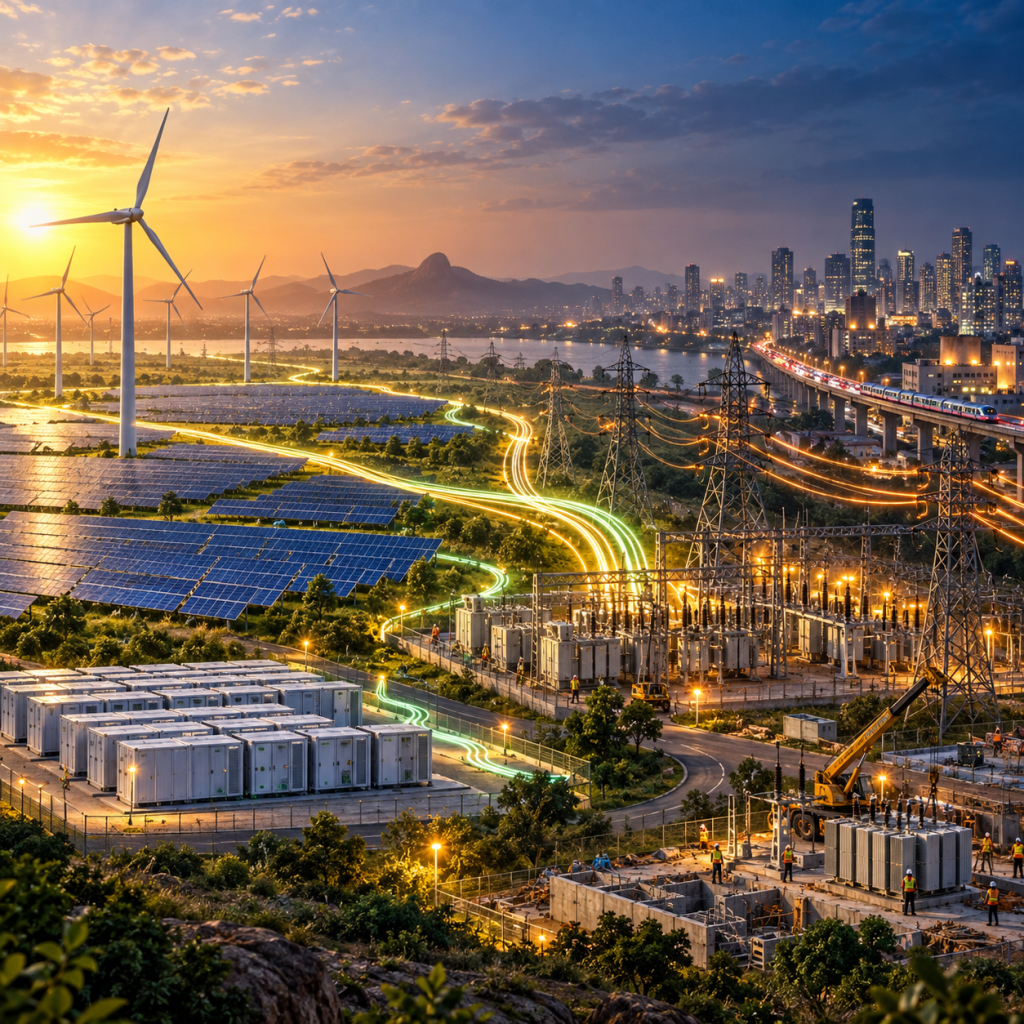
The real energy transition begins after installation
For many years, India measured its renewable-energy success through installed capacity. Every new solar park, wind farm and rooftop system added another impressive number to the national target. Installed capacity was politically visible, easy to announce and useful for attracting investment. But electricity systems do not operate on capacity alone. A solar panel may exist for twenty-five years, but its economic value depends on when it generates, whether the grid can accept its electricity, where the power is needed and whether it can be supplied when demand is highest.
August 2026 may therefore represent a more important milestone than another capacity announcement. Renewable electricity generation from solar, wind and small hydro increased by 42.1 per cent over the previous year to 35.14 billion kilowatt-hours. Total electricity generation rose by 11.6 per cent to around 180 billion kilowatt-hours. Renewables consequently supplied nearly one-fifth of total generation during the month. This was actual electricity entering the system, not capacity waiting on paper. Yet coal generation also continued to rise because severe heat increased cooling demand while weak rainfall reduced hydropower availability.
The numbers reveal both the success and the unfinished architecture of India’s energy transition. Renewable output is expanding rapidly, but the electricity system surrounding it is not necessarily changing at the same speed.
From coal-centred certainty to weather-centred complexity
India’s power system was historically designed around large and controllable generating stations. Coal was transported to a plant, burned when required and converted into electricity according to an operating schedule. This system created enormous environmental costs, but its basic logic was relatively predictable. Electricity production could be increased or reduced by adjusting fuel consumption, subject to technical limitations.
Solar and wind reverse this relationship. Their fuel is free, domestic and clean, but nature controls its immediate availability. Solar production falls sharply in the evening precisely when household lighting, cooling and commercial demand may remain high. Wind generation can vary across hours and locations. Hydropower, traditionally considered the flexible partner of renewable electricity, becomes less dependable when rainfall weakens.
India is therefore moving from a system in which the major problem was securing fuel to one in which the major challenge will be managing time. The question is no longer simply how much electricity can be generated. It is whether electricity can be moved, stored and delivered at the hour when the economy needs it.
This is why the 42.1 per cent renewable-generation increase must be read carefully. It is a major achievement, but it also creates a systems challenge. If renewable electricity arrives when transmission corridors are congested or demand is low, grid operators may have to restrict generation. The country can then possess more green capacity while wasting part of its potential output. The transition will appear successful in official capacity statistics but remain incomplete in actual system performance.
The next shortage may be flexibility, not electricity
India’s energy debate often assumes that the solution to rising demand is simply to build more generating capacity. That thinking belongs to an older electricity economy. In the emerging system, the strategic shortage may not be power plants but flexibility.
Flexibility means the ability to absorb excess electricity, move it across regions, store it for later use and release it quickly when demand rises. It requires batteries, pumped-storage projects, modern substations, stronger transmission networks, responsive industrial loads, accurate weather forecasting and power markets that reward availability at difficult hours.
Without these capabilities, India may encounter a strange energy paradox. Solar power could become extremely cheap during the afternoon while electricity remains expensive and coal-dependent after sunset. Renewable surpluses and power shortages could exist within the same day. The country would then keep adding both renewable capacity and thermal backup, creating parallel systems and increasing the overall cost of transition.
Storage should consequently not be treated as an accessory attached to renewable energy. It is becoming part of the electricity-generation architecture itself. Similarly, transmission is no longer merely infrastructure connecting plants with consumers. It is the mechanism through which geographically scattered and weather-dependent resources become one national energy system.
Renewable manufacturing is moving beyond the solar module
India’s renewable-manufacturing policy has understandably concentrated on solar modules, cells, wind turbines and other visible generating equipment. These industries remain important, especially for reducing import dependence. But the next industrial opportunity is likely to emerge in the less visible equipment surrounding renewable generation.
Grid-scale batteries will require battery-management systems, thermal controls, enclosures, power-conversion equipment, fire-safety systems and recycling services. Expanding transmission will increase demand for transformers, switchgear, conductors, insulators, protection equipment and digital substations. Renewable integration will need sensors, smart meters, forecasting software, communication devices, industrial energy-management platforms and cybersecurity systems. Every large renewable asset will also need inspection, repair, cleaning, testing and long-term maintenance.
These are not marginal activities. They are the industrial foundation that converts renewable capacity into dependable electricity.
This shift creates a significant opening for MSMEs. India may find it difficult to build globally competitive solar-module industries without large capital, scale and technology, but thousands of specialised enterprises can participate in balance-of-system equipment, control electronics, precision components, testing, refurbishment and maintenance. The future renewable economy will not be one industry. It will be an interconnected manufacturing and service ecosystem.
Clusters must be designed around energy systems, not individual products
Most industrial clusters are still classified by the product they manufacture. Solar manufacturers are grouped with solar manufacturers, battery firms with battery firms and electrical-equipment producers with similar enterprises. This administrative separation does not reflect the way the future electricity system will operate.
A modern renewable-manufacturing cluster should connect battery companies with transformer manufacturers, power-electronics firms, software developers, testing laboratories, recycling enterprises, engineering institutions and electricity utilities. It should provide shared facilities for high-voltage testing, battery safety, grid simulation, cybersecurity assessment and equipment certification. It should also maintain common data platforms showing component performance and failure patterns under Indian heat, dust, humidity and voltage conditions.
India cannot build a reliable twenty-first-century grid with twentieth-century cluster infrastructure. Roads, sheds, machinery and common facilities remain necessary, but they are no longer sufficient. The next generation of cluster infrastructure must also include data, verification, traceability and continuous technical learning.
This is particularly important for MSMEs. A small manufacturer may produce a technically sound transformer, inverter or control device, yet remain excluded from major projects because it cannot demonstrate field performance, secure certification or satisfy procurement guarantees. Shared testing and performance-verification systems can turn technical capability into market credibility.
The cheapest tariff can become an expensive illusion
India’s renewable expansion has been driven partly by competitive auctions that reward the lowest generation tariff. This helped reduce costs and accelerate deployment. But a policy instrument that succeeds in the first stage of transition can become inadequate in the next.
One unit of electricity generated during a low-demand afternoon is not economically equal to one unit supplied during the evening peak. Similarly, a renewable project that accurately forecasts its output and includes storage provides greater grid value than one that transfers all variability costs to the electricity system.
Procurement must therefore evolve from purchasing the cheapest unit to purchasing the most useful unit. Future tenders should give measurable value to peak-hour availability, storage integration, forecasting accuracy, rapid response, geographical location and the ability to reduce transmission congestion. Otherwise, the tariff may look cheap at the project level while balancing, curtailment and backup costs are quietly transferred to distribution companies and consumers.
This does not mean abandoning competition. It means making competition more intelligent. The lowest bid should win only after the complete system value and system cost have been recognised.
Verifiable integrity will become the new infrastructure
A common transformation is taking place across India’s productive sectors. Agriculture increasingly needs credible crop, water and climate information. Textiles need reliable records of fibre origin and processing. Pharmaceuticals require authenticated distribution and product traceability. Machinery MSMEs need certified performance and defensible specialised capabilities. Renewable energy must prove that installed capacity can become dependable electricity.
The connecting theme is verifiable integrity.
In the older development model, infrastructure meant roads, electricity, industrial land, laboratories and machinery. In the next model, infrastructure will also mean trusted data, product histories, digital records, performance measurement and traceability. Economic value will increasingly depend not only on what an enterprise produces but on what it can prove about the product, the process and the outcome.
For renewable energy, this means knowing when power was generated, whether forecasts were accurate, how storage responded, how frequently equipment failed, whether components were genuinely domestic and what environmental burden remains after batteries and panels reach the end of their lives.
The future will be decided after sunset
India’s renewable transition will not ultimately be judged by the number of gigawatts installed at noon. It will be judged by what happens after sunset, during heatwaves, weak monsoons, transmission failures and sudden increases in demand.
The August generation surge shows that renewable electricity has moved from the margins to an operationally significant position. The next challenge is harder because it requires coordination across generation, storage, transmission, distribution, manufacturing, software and regulation. Solar parks can be constructed project by project. A flexible electricity system cannot. It must be built as an interconnected whole.
India now has an opportunity to move beyond being a large market for renewable installations and become a manufacturing centre for the technologies that make renewable power dependable. Batteries, transformers, grid electronics, forecasting tools, industrial energy systems and maintenance capabilities could form the next generation of industrial clusters.
The decisive question is therefore no longer whether India can produce more renewable electricity. August has shown that it can. The real question is whether India can build the system that ensures none of that electricity is wasted, stranded or replaced by coal when it is needed most.
The renewable revolution has reached the grid. The grid must now catch up
#RenewableEnergy #CleanEnergy #MSME #IndianManufacturing #EnergyStorage #FutureOfEnergy
 "Connecting communities, empowering nations: Unifying the Regional and Global Economy ."
Leave a comment