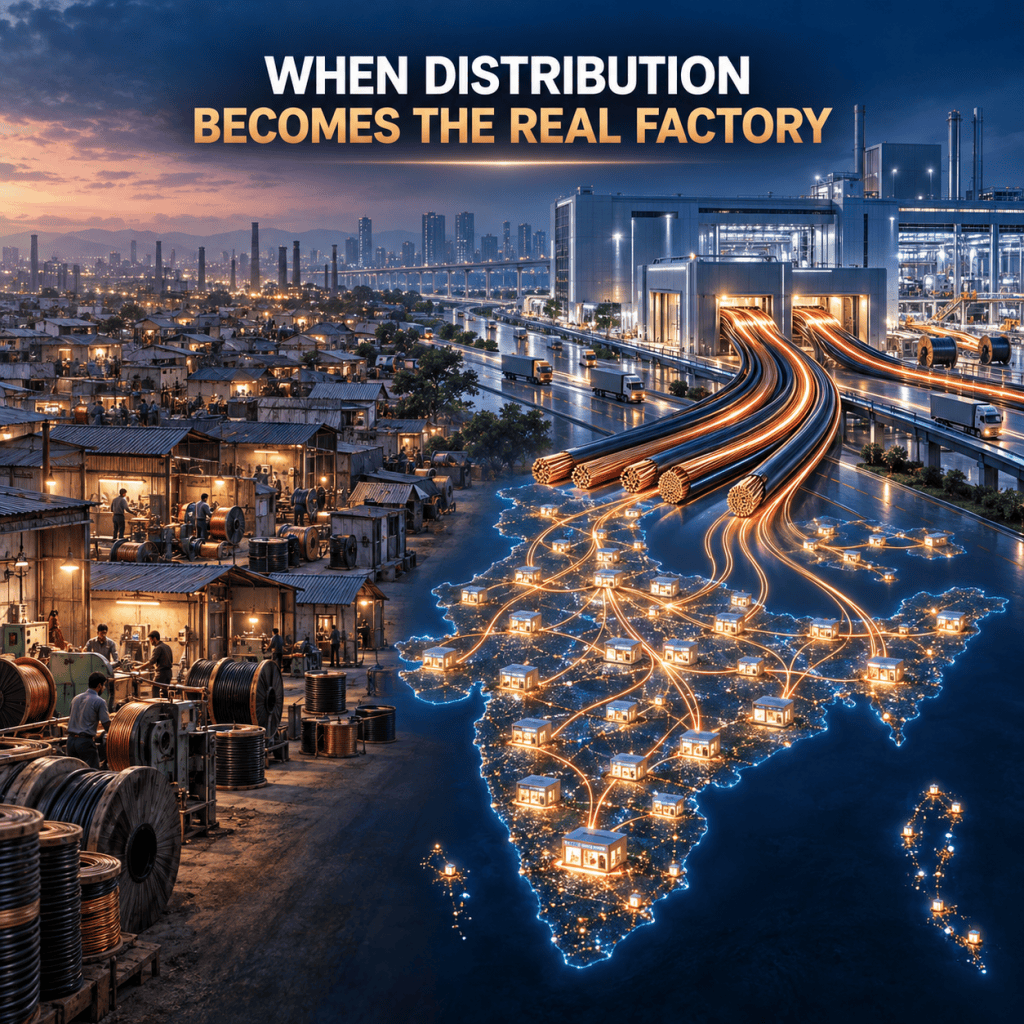
From Fragmented Manufacturing to Conglomerate Expansion
For a long time, India’s wires, cables and electrical-equipment industry grew through thousands of manufacturers, regional brands, traders, electricians and specialised suppliers. Many businesses began as modest family enterprises serving a city, an industrial cluster or a particular category of customer. Their competitive strength came from production knowledge, personal relationships and the ability to supply products at different prices. The market was fragmented, but that fragmentation also created space for entrepreneurship.
This structure is now beginning to change. UltraTech Cement has entered the wires and cables business through Ultravolt, backed by a planned investment of ₹1,800 crore. The company has announced an ambitious national expansion, ultimately targeting more than 100,000 retailers and a position among the top two players within five years. At launch, it described itself as India’s second-largest wires player by production capacity. The venture extends UltraTech’s reach beyond cement and other building materials into a product that passes through many of the same construction channels.
This is not simply the opening of another factory. It represents a deeper transformation in Indian manufacturing. Large conglomerates are learning that they do not always need to invent a new product or enter a completely unfamiliar market. They can move sideways into adjacent industries by combining capital, brand confidence, procurement power, technology and an already-established dealer network.
The modern conglomerate is no longer only a collection of factories. It is becoming a distribution platform capable of launching one manufacturing business after another.
The Factory Is No Longer the Biggest Competitive Advantage
Traditional industrial thinking places the factory at the centre of competition. A company purchases machinery, improves productivity, controls defects and reduces manufacturing costs. If its product is reliable and competitively priced, it is expected to succeed.
But the emerging market tells a more uncomfortable story. A technically efficient manufacturer may still lose if it cannot secure shelf space, influence contractors, provide dealer credit, promote its brand, obtain large institutional orders and deliver quickly across the country.
UltraTech already participates deeply in India’s construction economy. Its building-material network gives it relationships with dealers, contractors, builders and households. Ultravolt therefore does not enter the cable market as an unknown start-up searching for its first distributor. It enters with capital, institutional credibility and access to an ecosystem created through other businesses.
The company reportedly plans to reach more than 500 districts and 6,000 pin codes, supported by warehouses, thousands of UltraTech Building Solutions outlets and its wider dealer relationships. This illustrates a fundamental shift: distribution strength is becoming a manufacturing technology in its own right.
A smaller cable manufacturer may possess equally good machines. It may even produce a better product. But it cannot easily reproduce a national brand, thousands of retail connections, large advertising budgets and the financial patience required to gain market share over several years. The competitive gap is therefore no longer only between efficient and inefficient factories. It is increasingly between companies that control market access and companies that merely manufacture.
India May Gain Capacity but Lose Manufacturing Diversity
The immediate economic argument in favour of large investment is powerful. India requires enormous quantities of wires and cables for housing, renewable energy, transport systems, data centres, electric vehicles, factories and grid modernisation. A large new facility can improve capacity, product quality, formalisation and supply reliability. Greater competition may also bring better technology and more consistent safety standards into a market where poor-quality electrical products can have serious consequences.
Yet higher capacity should not automatically be confused with a healthier industrial structure.
If a few conglomerates use their financial and distribution power to dominate retail channels, independent producers could be pushed toward declining margins. Some may close, others may become contract manufacturers, and the stronger regional firms may be acquired. Consolidation is not necessarily harmful, but excessive consolidation can gradually reduce entrepreneurial diversity, regional competition and the bargaining power of suppliers.
The danger is particularly serious when large firms can tolerate low margins for longer than smaller rivals. A conglomerate may use profits from established businesses to finance rapid expansion in a new category. An independent company surviving entirely on cable sales cannot easily fight a prolonged battle over discounts, advertising, dealer incentives and credit.
This is how a market can appear competitive while becoming structurally unequal. Many brands may remain visible, but only a few firms may possess the capital and distribution architecture required to shape prices and market behaviour.
The Historical Lesson: Industrial Power Migrates Toward the Gatekeeper
Earlier industrial revolutions rewarded control over raw materials, machinery and mass production. Later, power shifted toward brands, supermarkets, digital platforms and logistics networks. In today’s economy, the enterprise that controls the customer relationship often captures more value than the enterprise that makes the product.
India has already seen versions of this change in paints, cement, telecom, retail and digital commerce. Large companies use a strong position in one market to enter a neighbouring one. Cement companies become building-solutions providers. Technology businesses enter finance. Retail platforms develop private labels. Energy groups move into equipment manufacturing and infrastructure.
Wires and cables fit naturally into this movement. They are connected to home construction, electrification and infrastructure investment. For UltraTech, the adjacency is commercially logical. For the wider economy, however, it raises a difficult question: will India’s next manufacturing phase create more independent industrial enterprises, or will it mainly enlarge a small number of corporate ecosystems?
This matters because MSMEs are not simply smaller versions of large firms. They spread industrial capability across regions, create entrepreneurship, train workers and serve specialised markets that may be too small for conglomerates. If they disappear, India may gain scale but lose flexibility.
The MSME Escape Route Is Specialisation, Not a Price War
Small and medium cable manufacturers are unlikely to defeat conglomerates in a battle based on commodity volume, national advertising and dealer discounts. Competing on exactly the same ground could exhaust their finances before it changes the market.
Their more realistic future lies in areas where knowledge, responsiveness and technical adaptation matter more than brand size. These include fire-resistant and low-smoke cables, renewable-energy applications, industrial automation, railways, marine systems, medical equipment, defence production, electric mobility, harsh-environment cables and specially designed products for machinery manufacturers.
Certification must become central to this strategy. An MSME producing for industrial or export markets needs testing facilities, traceability, reliable documentation and recognised quality systems. Clusters should therefore stop seeing common facilities as merely subsidised buildings containing machinery. They should develop shared laboratories, design services, certification support, material-testing systems, export-compliance cells and rapid prototyping capabilities.
Customisation can become another competitive defence. Large companies are excellent at scale, but scale often prefers standardisation. Cluster-based firms can respond faster to small batches, specialised technical requirements and urgent industrial orders. Their future may depend less on selling another ordinary coil of household wire and more on solving an engineering problem that a mass retailer cannot address.
Local Sourcing or a Closed Corporate Value Chain
UltraTech’s entry could create opportunities for MSMEs if the new business develops a broad supplier network. Local enterprises may supply polymers, compounds, packaging, tooling, testing services, maintenance, logistics and specialised components. Technology and quality requirements imposed by a large buyer could also improve supplier capability.
But this outcome is not automatic.
A conglomerate may instead internalise major stages of the value chain, procure from a limited group of large suppliers or demand commercial conditions that smaller enterprises cannot meet. Local sourcing figures can also be misleading if most of the value is concentrated among a few established vendors.
Supplier associations should therefore monitor not only how much a large entrant invests, but how that investment is distributed through the industrial ecosystem. Important questions include the number of MSME vendors developed, the payment terms offered, the transfer of technical knowledge, the geographical spread of sourcing and whether smaller suppliers can move into higher-value activities.
The real development test is not whether a large factory creates a few hundred direct jobs. It is whether the investment expands industrial capability beyond the factory boundary.
Industrial Policy Must Look Beyond the Factory Gate
India’s industrial policy still tends to celebrate announced investment, installed capacity and production incentives. These indicators are important, but they reveal only part of the economy. A country can accumulate modern factories while allowing distribution, procurement and retail access to become increasingly concentrated.
Competition policy must therefore examine market access as seriously as production capacity. Dealer exclusivity, prolonged discounting, access to working capital, payment practices, control over construction channels and the use of power from an adjacent market can shape competition even when no formal monopoly exists.
Industrial policy should also help MSME manufacturers build routes to customers. Cluster branding, public procurement access, digital distribution systems, testing infrastructure, export consortia and shared warehouses may be as important as subsidised machinery. Supporting production without supporting market access can create technically capable firms that remain commercially invisible.
The proposed incentive programme for advanced construction and infrastructure machinery, which remained unapproved at the time under consideration, reflects another policy weakness. India often identifies strategic manufacturing opportunities but moves slowly from discussion to implementation. During such delays, companies with strong balance sheets can advance independently, while smaller manufacturers wait for common infrastructure, technology assistance and affordable finance.
The Future Battle Is Over Who Owns the Market Interface
By the 2030s, electrification will extend far beyond household wiring. Renewable power systems, battery storage, electric transport, automated factories, intelligent buildings and data centres will require increasingly specialised electrical products. Demand will expand, but so will the importance of safety, digital traceability, material performance and environmental compliance.
Large conglomerates will attempt to convert this demand into integrated business ecosystems. A home builder may increasingly purchase cement, paint, pipes, cables and other materials through interconnected brands and distribution systems. This could offer convenience and dependable quality, but it could also make independent market access more difficult.
The decisive question is therefore not whether India will manufacture more wires and electrical equipment. It almost certainly will. The deeper question is who will control the journey between the factory and the customer.
Ultravolt is a warning as much as it is an investment story. It shows that the next phase of manufacturing competition will not be won by machines alone. It will be won through the combined power of finance, brands, logistics, data, dealers and customer access.
India must welcome large investment without allowing scale to become exclusion. A strong industrial economy needs national champions, but it also needs specialised independent producers, competitive clusters and open routes to the market. If MSMEs can manufacture efficiently but cannot reach customers, the country may achieve industrial growth while quietly losing industrial diversity.
Manufacturing #MSME #CapitalGoods #ElectricalEquipment #WiresAndCables #IndustrialPolicy #CompetitionPolicy #ClusterDevelopment #MakeInIndia #SupplyChains


Leave a Reply