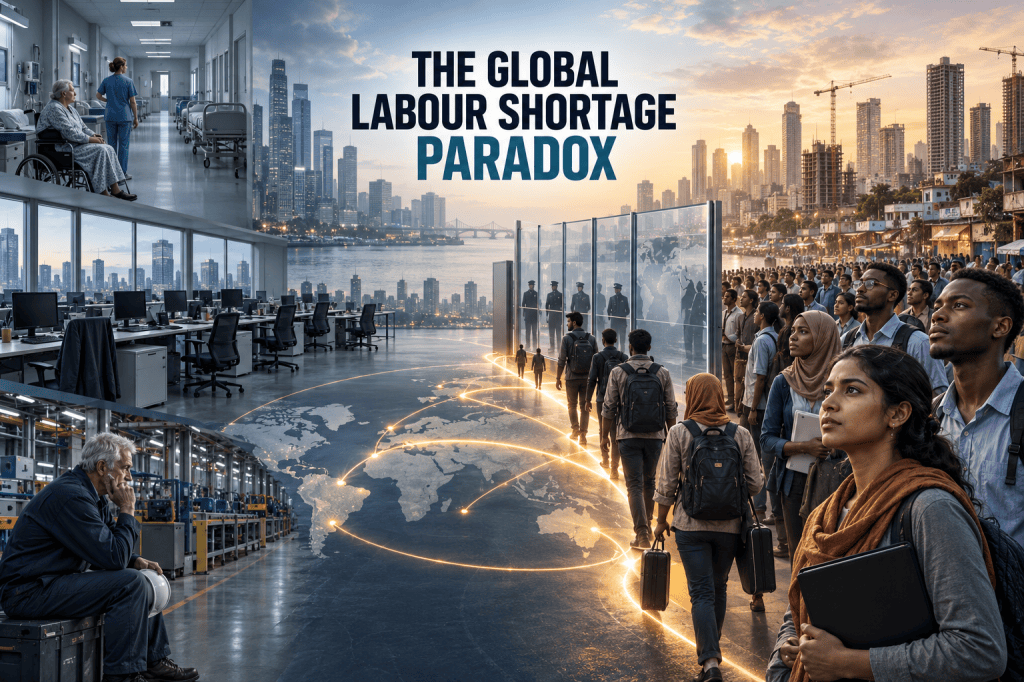
The global economy is entering a strange period. Millions of young people are searching for stable work in South Asia and Africa, while employers in Europe, Japan, South Korea and other ageing economies are struggling to find workers. One part of the world has people without sufficient jobs. Another has jobs without sufficient people. Yet the international system remains better designed for moving goods and money than for moving workers.
This is not simply an employment problem. It is a problem of geography, skills, politics and institutional failure. The workers and the vacancies exist, but they are separated by borders, languages, qualifications, immigration systems and public anxiety.
The result is the global labour shortage paradox.
From Surplus Labour to Missing Workers
For most of modern economic history, policymakers worried about excessive labour supply. Industrialisation released workers from agriculture faster than factories could absorb them. Cities expanded around large pools of inexpensive labour. Governments feared unemployment, wage unrest and social instability.
That historical assumption is now becoming less reliable.
Many advanced economies are moving from an age of surplus labour to an age of demographic scarcity. Families are smaller, people live longer and fewer young workers are entering the labour market. The OECD estimates that the working-age population across its member countries could decline by about 8 per cent by 2060. At the same time, public expenditure on pensions and health could rise by around 3 per cent of GDP.
The problem is therefore larger than unfilled vacancies. A shrinking workforce must produce enough income to support expanding elderly populations. Hospitals need nurses. Care homes need attendants. Factories need technicians. Farms need seasonal labour. Construction companies need skilled and semi-skilled workers. Transport systems need drivers. Digital industries need engineers.
Ageing creates a double pressure. It reduces the number of available workers while increasing demand for labour-intensive services such as healthcare and elderly care.
Young Economies Without Enough Good Jobs
The demographic picture is almost the reverse in South Asia and Africa. Large numbers of young people are entering working age, but economic transformation is not creating sufficient productive employment.
Unemployment statistics reveal only part of this crisis. In poorer economies, many people cannot afford to remain openly unemployed. They enter informal work, irregular self-employment, unpaid family activity or extremely low-productivity occupations. The ILO notes that insecure self-employment remains particularly dominant in South Asia and sub-Saharan Africa.
A person selling a few products on a roadside may officially be employed, but that does not mean the economy is using that person’s productive potential. The real problem is not simply the absence of work. It is the absence of secure, skilled and adequately paid work.
This creates one of the great economic imbalances of the twenty-first century. Ageing societies possess capital, technology, institutions and employment demand but lack enough workers. Young societies possess labour and ambition but lack sufficient capital, industrial capacity and quality employment.
In theory, these two worlds should complement each other. In practice, politics prevents the adjustment.
Borders Are Becoming Economic Bottlenecks
Globalisation made it increasingly easy for a company to transfer money, data, technology and production across borders. Human movement remained tightly controlled.
This contradiction is becoming economically expensive.
A manufacturer can import machinery from another continent within weeks but may wait months or years to recruit the technician needed to operate it. A hospital may have beds, equipment and patients but insufficient nurses. A rural community may need agricultural workers while migration rules keep potential workers outside the country.
The global economy has created sophisticated systems for matching buyers with sellers and investors with projects. It still lacks a credible system for matching workers with countries that need them.
There are understandable reasons for this hesitation. Migration affects housing, public services, wages, culture and political identity. Poorly managed migration can strain cities, encourage exploitation and create public resentment. Employers may use migrant workers to weaken wages or avoid investing in local skills. Governments may admit workers temporarily without providing them with basic rights or a realistic path to social inclusion.
But refusing migration also has consequences. Labour shortages can reduce production, delay infrastructure, increase care costs, close businesses and weaken tax revenues. Demography does not disappear because politics refuses to discuss it.
The Talent Drain Behind the Labour Solution
Migration can ease labour shortages, but it can also transfer scarcity from one country to another.
When doctors, nurses, engineers and technicians leave developing economies, destination countries gain trained workers without bearing the full cost of their education. The home country loses scarce skills, public investment and future institutional capacity.
A rich country may solve its healthcare shortage by recruiting nurses from a country that already has too few nurses. This is not a genuine global solution. It is the international relocation of a shortage toward a country with less political and financial power.
The future migration system must therefore move beyond simple talent extraction. Destination countries should contribute to training capacity in countries of origin. Bilateral agreements could finance nursing colleges, technical institutes, language training and internationally recognised certification. For every worker recruited, additional workers could be trained for the domestic economy.
Migration should become a form of shared human-capital investment rather than a global competition to capture already-trained people.
Automation Will Help but It Cannot Care for Everyone
Ageing economies will increasingly use robots, artificial intelligence and automated systems to compensate for missing workers. Japan and South Korea are already important laboratories for this transition.
Automation can maintain factory output with fewer people. Artificial intelligence can reduce administrative work. Autonomous systems may transform logistics, agriculture and warehousing. Machines can increase the productivity of older workers and help people remain economically active for longer.
But technology is not a complete demographic solution.
Robots can move goods, inspect components and process documents. They cannot easily replace the emotional, physical and social dimensions of childcare, nursing, elderly care, hospitality and community services. The fastest-growing labour needs may emerge precisely in occupations where human presence remains essential.
There is also a deeper paradox. Young countries may face unemployment partly because automation reduces the ability of manufacturing to absorb labour. Ageing countries will automate because they lack workers, while young economies will struggle because the same technology reduces demand for their workers.
Technology may therefore widen the demographic divide unless education, migration and industrial policy are redesigned together.
Migration as International Economic Policy
Migration policy is likely to become as important as trade policy in the coming decades.
Countries will compete not only for investment, technology and energy but also for nurses, caregivers, engineers, construction workers, scientists and technicians. Visa rules, recognition of qualifications, language programmes, social-security portability and protection of migrant rights will become instruments of economic competitiveness.
The most successful countries may not be those with the highest birth rates or the most generous immigration quotas. They may be those that build the best systems for converting migration into productive and socially accepted integration.
This requires planned labour corridors between countries. Training should begin before migration. Skills should be certified according to common standards. Recruitment costs should be transparent. Social-security benefits should travel with the worker. Employers should not be allowed to confiscate documents or create dependency through tied contracts. Returning workers should receive support to use their savings and international experience productively at home.
Migration must also become more circular. A worker should be able to move abroad for several years, gain income and skills, return home and later migrate again without entering irregular channels. Permanent migration will remain necessary, but it should not be the only model.
India and Africa Cannot Export Their Way Out of the Employment Crisis
Young economies must be careful not to treat migration as a substitute for domestic job creation.
India and African countries cannot build their economic futures by becoming permanent suppliers of labour to ageing societies. Only a limited share of their growing workforces will migrate. Most young people will continue to need employment at home.
The demographic dividend is not automatic. A large young population becomes an advantage only when supported by education, nutrition, healthcare, electricity, infrastructure, industrialisation and private investment. Without these foundations, youth becomes a statistic rather than a productive force.
India has an opportunity to build internationally connected skill systems in healthcare, construction, logistics, green energy, electronics, hospitality and advanced manufacturing. But training people merely to receive certificates will not work. Skills must be linked to real employers, measurable competence and recognised international standards.
Africa faces an even larger long-term challenge. Its working-age population will continue expanding while many advanced economies contract. If African economies create industries and productive cities, this workforce could become a major engine of global growth. If they fail, unemployment, informality, political frustration and dangerous migration routes could expand together.
The Coming Politics of Human Scarcity
The future may produce an uncomfortable political contradiction. Ageing countries will economically need migrants while electorally resisting them.
Governments may respond by quietly expanding sector-specific worker programmes while publicly promising tighter borders. This may create a divided migration system in which highly skilled professionals receive favourable treatment, temporary workers receive limited rights and irregular migrants perform essential but poorly protected work.
Such a system may fill vacancies, but it will also create social instability.
The real choice is not between migration and no migration. In many ageing economies, demographic change has already made some level of migration economically necessary. The real choice is between migration that is planned, lawful and humane, and migration that is disorderly, exploitative and politically combustible.
The World Does Not Lack Workers
The global labour shortage is not fundamentally a shortage of human beings. It is a shortage of coordination.
Workers are concentrated where jobs are insufficient. Vacancies are growing where workers are becoming scarce. Qualifications do not travel easily. Training systems do not communicate with migration systems. Governments continue treating demography, education, trade, automation and immigration as separate policy areas even though they are becoming parts of the same economic question.
The coming decades will force a new understanding of globalisation. The decisive resource may no longer be the cheapest raw material, the largest market or even the most advanced machine. It may be the availability of skilled, adaptable and socially protected human beings.
Capital can cross borders in seconds. Goods can cross oceans in weeks. Data can move instantly. But the future of the world economy may depend on whether societies can develop fair and politically sustainable ways for people to move toward opportunity.
A world with unemployed youth on one side and empty workplaces on the other is not suffering from an unavoidable shortage. It is suffering from a failure of economic imagination.
GlobalEconomy #LabourMarket #Migration #Demography #FutureOfWork #Employment #India #Africa #EconomicPolicy


Leave a Reply