The Continent Growing Younger in an Ageing World
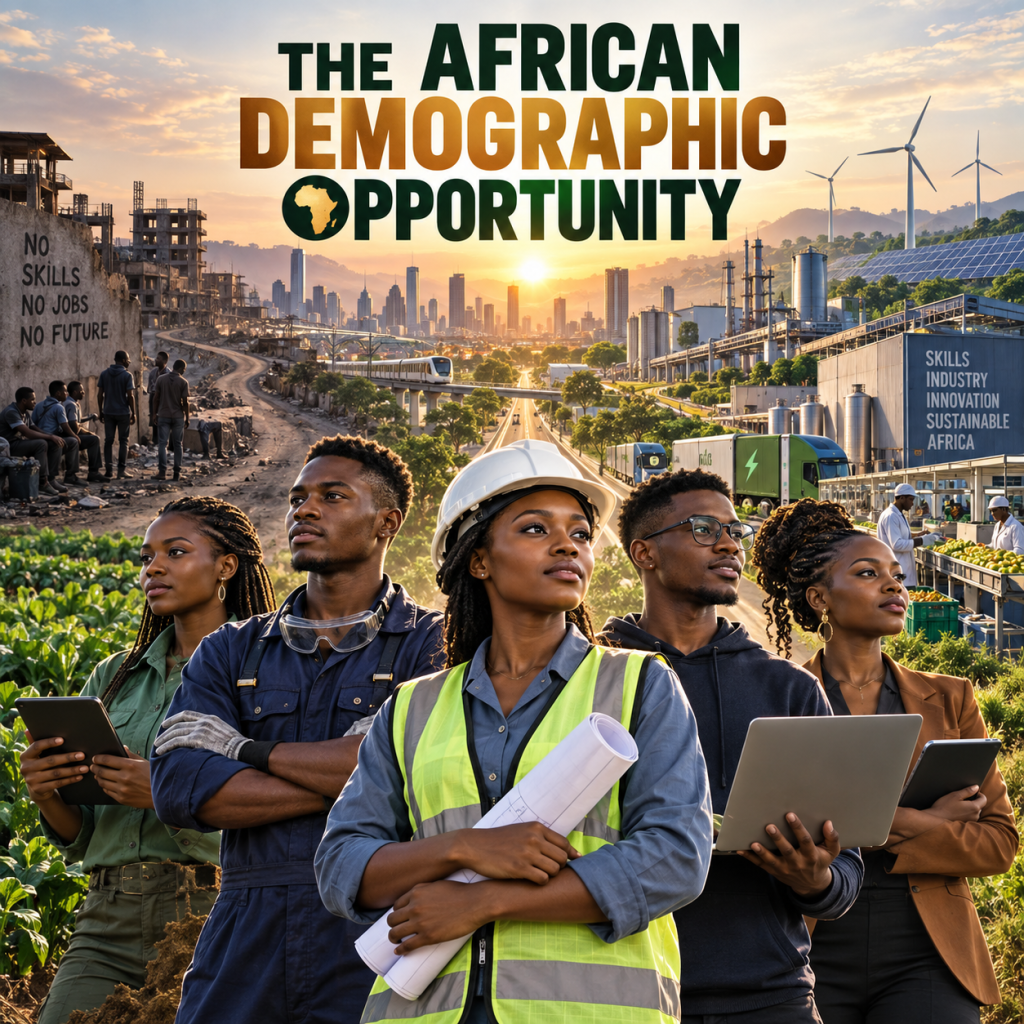
The twenty-first century may be remembered as the period when the centre of the world population slowly shifted towards Africa. Europe is ageing. China’s workforce has begun to contract. Japan is already struggling with labour shortages. Several countries in East Asia are recording historically low birth rates. Even India, still a relatively young country, will gradually move towards an older population structure. Africa is travelling in the opposite direction.
Africa’s population is projected to approach 2.5 billion by 2050, representing more than one-fourth of humanity. Its working-age population could rise from about 883 million in 2024 to around 1.6 billion by 2050. By then, almost one in every four working-age people in the world may be African. These figures make Africa’s demographic transformation one of the most important economic developments of this century. United Nations Economic Commission for Africa
But population is not prosperity. A young population is only human potential. Whether that potential becomes production, innovation and purchasing power depends upon the economic system built around it.
History Shows That Youth Alone Creates Nothing
The demographic dividend is often discussed as though it arrives automatically when a country has more workers than dependants. History tells a different story.
The economic rise of East Asia was not produced by population structure alone. It was supported by mass education, public health, agricultural reform, export-oriented manufacturing, infrastructure and disciplined industrial policy. Workers became productive because factories, ports, electricity, technology and markets were expanding alongside them.
In contrast, many resource-rich countries have experienced population growth without structural transformation. Their economies expanded through minerals, oil or commodity exports, but employment did not grow at the same speed. National income increased without creating enough productive work. The result was often a narrow modern economy surrounded by a very large informal one.
This distinction is critical for Africa. The continent does not merely need faster economic growth. It needs a different kind of growth. An oil project, mine or telecommunications company may add significantly to GDP while employing relatively few people. A young continent requires sectors capable of absorbing millions of workers year after year.
The Dangerous Gap Between Workers and Work
Up to 12 million young Africans enter the labour market annually, while only about 3 million formal wage jobs are currently being created each year. The region’s working-age population could increase by roughly 740 million over the next three decades. World Bank
This is not a minor employment mismatch. It is a structural warning.
Unemployment statistics alone cannot fully explain the problem because many young people cannot afford to remain openly unemployed. They enter informal trading, insecure services, subsistence agriculture or irregular digital work. They may technically be employed but still earn too little to build a stable life. The real crisis is therefore not simply the absence of work. It is the shortage of productive, secure and reasonably paid work.
A street vendor surviving from one day to the next and an engineer working in an advanced manufacturing plant are both counted as employed, but their economic contribution and future security are very different. If most new workers are pushed into low-productivity activities, the demographic dividend will exist on paper while disappearing in everyday life.
Industrialisation Before Automation Closes the Door
Africa’s demographic opportunity is arriving at an unusually difficult moment. East Asian economies industrialised when globalisation was expanding, manufacturing was labour-intensive and developed markets were relatively open to imports. Africa must now industrialise in a world of automation, protectionism, climate restrictions, geopolitical rivalry and increasingly sophisticated production systems.
Robotics and artificial intelligence may allow companies to manufacture closer to their main markets with fewer workers. Carbon standards may make exports from electricity-deficient economies more expensive. Trade restrictions may reduce access to foreign markets. Heavy debt burdens may limit the ability of governments to build infrastructure.
This means Africa cannot simply repeat the Asian development model. It must build a more varied economic path combining modern agriculture, food processing, textiles, pharmaceuticals, construction materials, renewable energy, minerals processing, digital services and regional manufacturing.
The greatest mistake would be to export raw materials while importing finished products for an expanding population. That model creates shipping activity and government revenue, but too little employment, technology or domestic capability. Africa must capture more value between the mine, farm and final market.
The African Continental Free Trade Area can help create a market large enough to support regional industries. But a trade agreement without roads, reliable customs systems, standards, finance and electricity remains largely a legal promise. Economic integration must become physical integration.
Electricity Is the First Employment Policy
Every demographic strategy eventually meets the electricity system.
Schools need power. Hospitals need power. Digital businesses need power. Cold-storage facilities, irrigation systems, workshops, textile units and factories need dependable power. Where electricity is expensive or unreliable, enterprises remain small, machinery remains underused and investors hesitate.
Africa has enormous solar, wind, hydro and geothermal potential. Yet potential energy does not operate a machine. Generation must be connected to grids, storage, transmission, local distribution and affordable industrial supply. Large national projects are necessary, but decentralised systems and mini-grids will also be important for rural enterprises and smaller towns.
Energy policy should therefore not be treated only as a climate or infrastructure issue. It is directly connected to employment, industrialisation and demographic stability. The real measure of an energy project should include how many enterprises it enables, how much production it supports and how many livelihoods it transforms.
Education Must Move From Certificates to Capability
An expanding school system is essential, but enrolment alone cannot deliver a demographic dividend. The more difficult question is whether education produces usable capability.
Migration Is an Outcome, Not the Original Problem
Young people need literacy and numeracy, but they also need technical, digital, managerial and problem-solving skills. Africa will require electricians, machinists, nurses, food technologists, logistics professionals, construction workers, software developers and production supervisors. Universities cannot be the only gateway to economic mobility. Strong vocational institutions, apprenticeships and industry-linked training systems will be equally important.
Education policy must also include girls and young women at its centre. When women receive education, healthcare, financial access and genuine employment opportunities, household incomes rise and demographic transitions generally become more manageable. Excluding women from productive work would mean wasting nearly half of the continent’s demographic strength.
Training, however, cannot substitute for job creation. Teaching millions of young people new skills without expanding enterprises may simply produce better-qualified unemployment. Skills policy and industrial policy must move together.
Investment Must Build Economies, Not Enclaves
Africa needs private investment, but the quality of investment matters as much as its volume.
An investment that extracts minerals, imports most equipment, employs few local workers and exports unprocessed output may increase foreign exchange earnings without transforming the surrounding economy. Better investment creates supplier networks, transfers knowledge, processes local resources and connects domestic firms to larger value chains.
Governments will need to make difficult choices. Tax concessions should be linked to training, local sourcing, exports, research and job creation. Public finance should help viable domestic enterprises expand instead of permanently protecting politically connected firms. Small and medium enterprises need access to markets, technology, standards and long-term finance, not only repeated entrepreneurship workshops.
The future of African employment will not be created only by large multinational corporations or technology start-ups. It will depend heavily on whether millions of small firms can become productive medium-sized enterprises. The missing middle of African industry is also the missing bridge between population growth and mass employment.
Migration towards Europe and other regions is often described mainly as a border-security issue. In reality, it is also an economic signal. People move when the geography of opportunity does not match the geography of population.
A young African workforce could help ageing economies facing labour shortages. Managed migration, skills partnerships and legal mobility can benefit both Africa and destination countries. Migrants send money home, acquire knowledge and create business networks.
But migration cannot become a substitute for African development. If the most educated workers continually leave because local systems cannot use their talent, countries may finance education while richer economies capture its benefits. At the same time, restricting migration without expanding opportunities at home will merely force movement into more dangerous channels.
The long-term answer lies neither in completely open borders nor in higher walls. It lies in creating credible economic futures within African countries while building regulated international pathways for mobility.
The Demographic Dividend Has an Expiry Date
Africa’s youth advantage will not last forever. Every young population eventually ages. The real question is whether today’s young people will become tomorrow’s productive, secure and tax-paying middle class or tomorrow’s ageing informal workforce without savings or social protection.
The window for action is therefore narrower than it appears. Roads built twenty years late cannot recover the opportunities lost by an entire generation. A child who receives poor nutrition and weak schooling today cannot be converted instantly into a highly productive worker in 2045. Demographic policy begins long before a person enters the labour market.
The deepest risk is not population growth itself. It is delayed transformation.
If industrialisation, education, electricity and investment expand quickly enough, Africa can become a major centre of production, consumption and innovation. Its growing cities could create huge markets. Its young workforce could support ageing regions. Its entrepreneurs could build new models in energy, agriculture, healthcare and digital finance.
If transformation remains slow, however, the same population could face overcrowded cities, insecure informal work, political frustration, climate stress and rising migration pressure. In that case, the world may wrongly describe Africa’s youth as the source of instability when the real failure was the absence of economic preparation.
Africa is not carrying a guaranteed demographic dividend. It is carrying a demographic decision. The number of young people is already becoming visible. What remains uncertain is whether governments, businesses and the international financial system will build an economy large enough for their ambitions.
Africa #DemographicDividend #Industrialisation #YouthEmployment #EconomicDevelopment #FutureOfWork #Investment #Manufacturing #GlobalEconomy


Leave a Reply