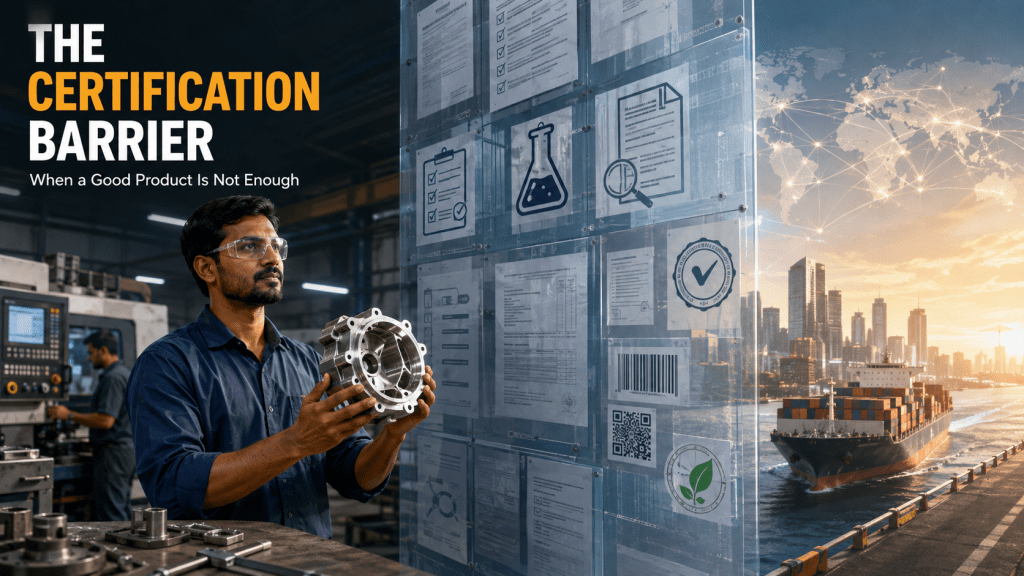
From the Age of Craftsmanship to the Age of Proof
For most of economic history, quality was established through direct experience. A buyer examined the cloth, tasted the food, tested the tool or relied on the reputation of the producer. Trust was personal, local and accumulated over time. Industrialisation changed this relationship. Production expanded beyond local markets, supply chains crossed national borders and buyers could no longer personally know every manufacturer. Standards, laboratory testing and third-party certification emerged as mechanisms for creating trust at scale.
This was an important advance. Standards made electrical appliances safer, medicines more reliable, buildings stronger and international trade more predictable. But the system gradually acquired a second function. Certification no longer merely confirmed quality; it began determining who was permitted to enter the market.
A product can now be technically sound, competitively priced and genuinely innovative, yet remain commercially unacceptable because the producer cannot provide the required certificate, laboratory report, environmental clearance, process audit, safety mark or traceability record. The modern market increasingly asks not only whether a product is good, but whether its goodness can be documented in the prescribed language, verified by an approved institution and continuously demonstrated through an auditable system.
This is the certification barrier: the growing distance between the ability to produce quality and the institutional capacity to prove it.
Quality Has Become an Infrastructure, Not Merely a Factory Practice
India’s MSMEs are often advised to improve quality. The advice is correct but incomplete. Quality is frequently presented as an internal management issue—as if every enterprise could become globally competitive merely by improving discipline on the shop floor. In reality, internationally acceptable quality depends on an entire external infrastructure: recognised laboratories, trained auditors, calibration facilities, certification agencies, environmental consultants, testing equipment, digital traceability systems and officials capable of interpreting complex technical requirements.
A small manufacturer may be producing an excellent component in Rajkot, Ludhiana, Coimbatore or Pune, but the nearest suitably accredited testing facility may be located hundreds of kilometres away. Samples must be transported, production may have to be paused, documentation prepared and tests repeated if a parameter or format is rejected. Different buyers can demand different standards for essentially the same product. A certificate accepted in one market may not be recognised in another.
The official fee is therefore only a small part of the real cost. The enterprise also bears consultancy expenses, employee time, sample destruction, travel, process modification, calibration, renewal, surveillance audits and the commercial loss caused by delay. BIS, for example, lists separate application, inspection, annual licence and product-related marking requirements under its certification process. The very existence of concessions for smaller enterprises recognises that certification carries a disproportionate burden for them. Bureau of Indian Standards
For a large company, these are manageable fixed costs spread across millions of units. For a microenterprise producing small quantities, the same cost becomes a heavy charge on every unit sold. This is why compliance can be formally equal but economically unequal.
India’s Invisible Quality Divide
India’s MSME sector contributes roughly 30 per cent of GDP and has historically accounted for about 45 per cent of the country’s exports, while supporting more than 110 million jobs. These figures reveal a fundamental contradiction. The enterprises most essential to employment, regional industrialisation and export diversity are often the least equipped to finance the systems now required for market participation. Ministry of MSME
The divide is not simply between high-quality and low-quality producers. It is increasingly between documented and undocumented quality.
A small food processor may maintain excellent hygiene but lack the testing history, residue documentation or batch-level traceability demanded by a large retail chain. An engineering unit may manufacture a reliable part but remain excluded from an international vendor list because it lacks an approved quality-management system. A textile enterprise may meet conventional product specifications but fail to demonstrate chemical compliance, water use, recycled content or the origin of its raw material. A toy, electrical or medical-device producer may discover that redesigning the product is easier than navigating the overlapping requirements of testing, certification and market approval.
The problem becomes sharper when regulations change frequently or are communicated through technical documents that smaller firms cannot easily interpret. A major company can employ compliance specialists. A microenterprise depends on a local consultant, an industry association, a buyer or even informal advice from another entrepreneur. Errors are then treated as evidence of poor capability, although they may actually reflect weak access to institutional guidance.
India is therefore at risk of developing two manufacturing economies. The first consists of enterprises capable of producing, documenting, testing and certifying at scale. The second consists of enterprises capable of producing, but unable to convert their practical competence into institutionally recognised proof. The second economy may survive in local and informal markets, but it will find the doors to exports, public procurement and sophisticated supply chains increasingly closed.
Certification Can Become a Non-Tariff Wall
Tariffs are visible. Certification barriers are more difficult to see. A foreign market may officially impose a low import duty while requiring multiple product tests, sustainability declarations, factory audits, packaging specifications and proof that every stage of production conforms to prescribed rules.
The WTO has long recognised that duplicate testing, delays and discriminatory conformity-assessment procedures can raise trade costs significantly. It has promoted the principle of one standard, one test and, where required, one certification accepted across markets. Yet fragmented recognition remains a serious practical problem. World Trade Organization
This burden falls unevenly. Research referenced by the WTO notes that fixed trade costs represent a larger share of the unit cost for small firms because they export smaller quantities. A certification expense that is marginal for a multinational corporation can make an entire export order unviable for an MSME. WTO Aid for Trade
Standards can consequently produce a paradox. They are designed to improve market trust, but poorly designed conformity systems can reduce competition. Large firms absorb the cost and strengthen their position. Smaller firms remain suppliers to intermediaries, sell under another company’s brand or withdraw from formal markets. Certification then stops being only a quality instrument and becomes a mechanism of industrial concentration.
This does not mean standards should be diluted. Unsafe products, false environmental claims and unreliable testing damage consumers and responsible producers alike. The real issue is whether the system helps capable enterprises reach the standard or simply eliminates those unable to navigate the procedure.
The Next Barrier Will Be Data, Not Paper
The future of certification will go far beyond a stamp on a product. Global markets are moving towards continuous, data-based verification. Buyers will increasingly want to know where raw materials originated, how much carbon was emitted, whether workers were treated fairly, which chemicals were used, whether waste was recycled, how product safety was monitored and whether digital components are protected from cyber risks.
Products are likely to acquire digital identities containing information about origin, repairability, recycled content, environmental impact and movement through the supply chain. Artificial intelligence may continuously examine supplier data and automatically flag firms with missing or inconsistent records. Sustainability claims will face stronger verification. Carbon reporting, due-diligence rules and digital product passports could become commercial requirements even where they are not directly imposed on every small supplier by law.
This transition will change the meaning of industrial competitiveness. In the twentieth century, a firm needed machinery and skilled labour. In the twenty-first century, it also needs a credible data trail.
That creates a serious risk for India. Many MSMEs still operate through partially manual production records, informal supplier relationships and disconnected software. Their products may be physically compliant but digitally unverifiable. A missing data field could exclude a supplier as effectively as a defective component. The danger is not that Indian MSMEs will stop producing. It is that they will continue producing while becoming invisible to the world’s most valuable markets.
The coming quality divide may therefore be less about good products versus bad products and more about machine-readable enterprises versus commercially unreadable ones.
The Danger of Compliance Without Capability
India has launched important programmes to encourage quality improvement, including the Zero Defect Zero Effect approach. Its wider philosophy—combining product quality with environmental responsibility—is directionally correct. The challenge is to ensure that such programmes produce lasting capability rather than a collection of certificates. The ZED framework itself emphasises assessment, handholding and managerial and technological improvement, not certification alone. Quality Council of India
A certificate obtained with temporary consultant support does not necessarily transform an enterprise. Once the consultant leaves, records may not be maintained, equipment may not be recalibrated and improvement may stop. The enterprise then begins preparing for audits rather than managing quality every day.
This is compliance without capability: files are created, formats are completed and certificates displayed, but the underlying production system remains unchanged. It benefits neither the enterprise nor the buyer.
The opposite problem is capability without certification. Some firms have strong technical knowledge accumulated over generations but lack formal systems to convert that knowledge into evidence. India needs to connect these two worlds. Traditional skill must become measurable without being destroyed by excessive bureaucracy, while certification must represent genuine capability rather than superior paperwork.
Certification Must Become a Shared Cluster Service
The present policy model treats certification primarily as an individual enterprise responsibility. That is inefficient in an economy dominated by micro and small firms. If every unit must separately identify standards, employ consultants, build limited testing facilities and negotiate with certification bodies, the country repeatedly pays for the same learning.
A cluster-based approach could change the economics. Industrial clusters should have common laboratories, calibration services, environmental testing, mobile diagnostic units, shared traceability platforms and panels of qualified compliance specialists. These centres should not merely test the final product. They should help firms understand why a product failed, modify the process and prepare for changing domestic and international requirements.
Sector-specific quality cells could monitor regulations in important export markets and translate technical changes into plain-language instructions. A small exporter should be able to identify, through a single digital window, which standards apply to a product, where testing is available, how much it will cost, how long it should take and whether the resulting certificate will be accepted in the destination market.
Public procurement could also become a bridge rather than a wall. New suppliers could be given pre-certification assistance, controlled trial orders and a defined period to achieve higher standards. Procurement must protect quality, but it should not be designed so that only firms with a long history of government contracts can satisfy the entry conditions.
Subsidies should increasingly support capability creation rather than reimburse certificates after the event. Support could cover gap assessments, process redesign, testing failures, calibration, digital record systems and employee training. The objective should be to reduce the cost of learning, not merely the price of the final document.
From Ease of Doing Business to Ease of Proving Quality
India’s industrial policy often concentrates on finance, infrastructure, technology and market access. Quality infrastructure connects all four. Credit cannot help an enterprise enter a market if its product lacks recognised certification. Better machinery cannot produce export growth if testing results are not internationally accepted. An e-commerce platform cannot create trust when product claims cannot be verified. Public procurement preferences have limited value when eligibility conditions remain too complex for small firms.
The next generation of MSME policy must therefore measure the ease of proving quality. Important indicators would include the distance to an accredited laboratory, average testing time, cost per certification, rate of sample rejection, number of repeat tests, availability of local technical assistance and international recognition of Indian test reports. These are not administrative details. They influence which firms grow, which districts industrialise and which products India can sell to the world.
Mutual recognition agreements with major trading partners should become a strategic export priority. If an Indian product is tested by a competent accredited laboratory, unnecessary retesting abroad should be reduced. India must also strengthen participation by MSMEs and cluster institutions in standards-setting. Standards created without the voice of smaller producers can unintentionally encode the technologies, scale and operating models of large corporations.
The Certificate Must Become a Bridge
The certification barrier reveals a deeper weakness in modern markets. We increasingly confuse what can be documented with what is genuinely capable. Documentation is necessary because trust cannot operate globally without evidence. But when the cost of producing evidence becomes greater than the cost of producing quality, the system begins selecting firms by administrative capacity rather than productive merit.
The answer is neither to reject standards nor to protect low quality. It is to democratise access to quality infrastructure.
India must build a system in which a capable microenterprise can understand a standard, test affordably, correct deficiencies quickly and obtain evidence that is accepted across markets. Laboratories must become centres of industrial learning. Certification bodies must become partners in upgrading. Digital traceability must be designed as shared infrastructure rather than another expensive software burden placed on each firm.
The strategic question is no longer whether Indian MSMEs can manufacture good products. Millions already do. The question is whether India can create an institutional system capable of recognising, strengthening and communicating that quality to the world.
In the emerging economy, the certificate will increasingly stand between production and participation. If it remains costly, fragmented and difficult to navigate, it will quietly turn quality systems into gates around high-value markets. If redesigned as accessible common infrastructure, it can become something very different: a bridge carrying India’s smallest producers into its largest opportunities.
MSMEs #Quality #CertificationBarrier #IndianIndustry #Exports #IndustrialDevelopment #SmallBusiness #MadeInIndia


Leave a comment