From energy shortage to energy transition
For decades, India’s energy debate focused on scarcity. Industries faced power cuts, households lacked reliable electricity and imported oil placed pressure on the economy. Renewable energy entered the policy system first as an environmental alternative, but it has now become central to energy security, industrial policy and international competitiveness.
India has rapidly expanded solar and wind capacity and created one of the world’s largest renewable-energy markets. Yet installing renewable capacity and building a renewable manufacturing economy are not the same achievement.
The rise of financial scale
The proposed acquisition of a 1.4 GW operational solar portfolio by CESC’s renewable-energy arm illustrates how renewable assets are becoming large financial portfolios. Consolidation can provide stronger balance sheets, lower financing costs and more professional management. It may also help recycle capital into new projects.
But ownership concentration creates an important question. If a few large companies own the projects while critical machinery, materials and technology remain imported, what part of the green transition is truly domestic?
India can become a renewable-energy giant while remaining technologically dependent. It can own solar farms without controlling wafer technology, production equipment, advanced materials, storage systems or specialised power electronics.
The missing middle of green manufacturing
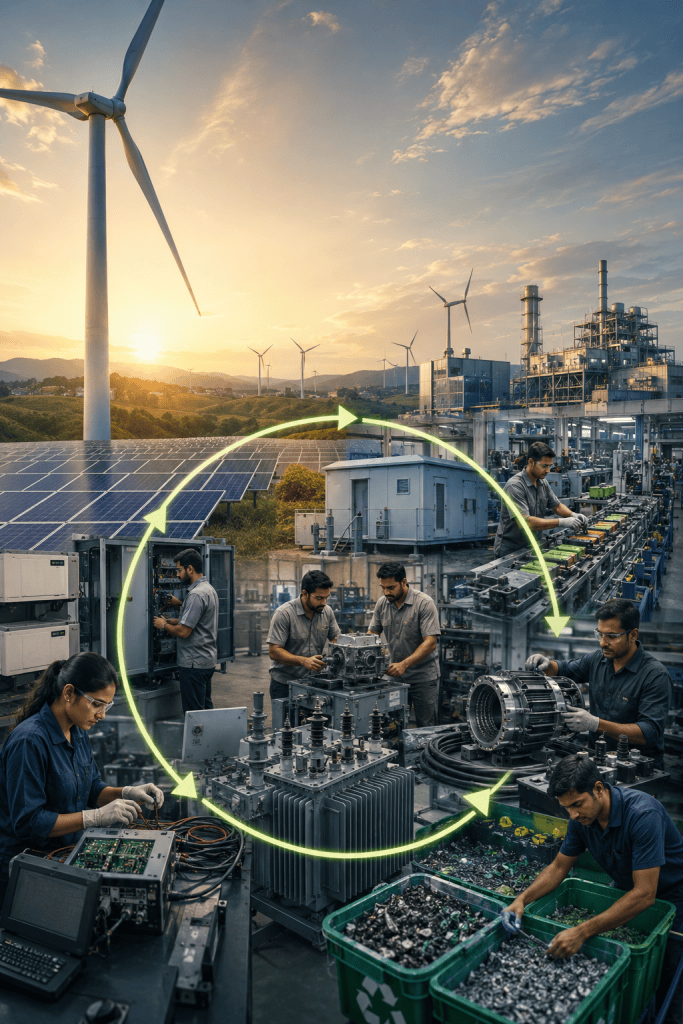
Public discussion often focuses on solar modules, batteries and large plants. The wider manufacturing ecosystem receives less attention. Renewable-energy systems require inverters, transformers, cables, mounting structures, bearings, monitoring devices, cooling systems, control software, testing equipment, recycling technology and specialised maintenance services.
This is the natural space for MSMEs, but participation will not happen automatically. Large project developers frequently prefer proven suppliers because equipment failure can affect an entire power plant. Smaller manufacturers therefore need certification, testing infrastructure, long-term procurement visibility and opportunities to demonstrate performance.
Renewable clusters should be developed around complete supply chains rather than individual flagship factories. A large plant surrounded by weak local suppliers creates production without creating an ecosystem.
The next waste problem is already being manufactured
Solar modules, batteries and wind-turbine components will eventually reach the end of their useful lives. India is currently celebrating installation, but the future will also involve dismantling, material recovery and waste management. Recycling must be designed before the waste arrives.
This creates a major opportunity for new MSME clusters specialising in repair, refurbishment, second-life batteries, material separation and recovery of valuable metals. If recycling technology is neglected, India may replace fossil-fuel dependence with dependence on imported critical materials while creating a new domestic waste burden.
Gigawatts are not enough
Renewable-energy policy commonly measures success through installed capacity. That indicator is important but incomplete. India must also measure domestic value addition, technological ownership, supplier diversity, skilled employment and recyclability.
The future energy economy will be shaped not merely by who generates electricity but by who controls the machinery, data, materials and maintenance systems behind it. India’s green transition will remain incomplete if it produces clean power through imported intelligence.
The real objective should therefore be deeper than energy independence. It should be technological independence supported by competitive MSMEs, specialised clusters and a circular manufacturing system. Only then will the renewable revolution become an industrial revolution.
RenewableEnergy #SolarPower #GreenManufacturing #MSME #CleanEnergy #CircularEconomy


Leave a comment