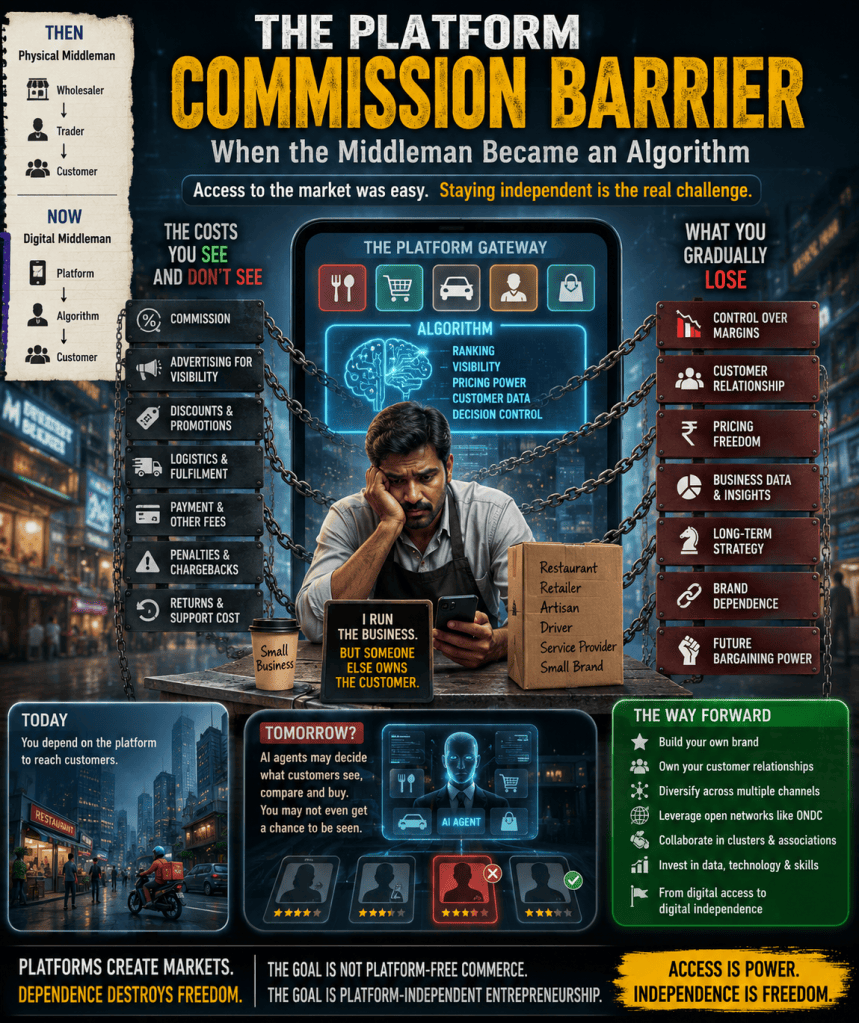
For centuries, small businesses struggled because they could not reach the market. Today, millions can reach the market through a smartphone. A restaurant can find customers without opening another branch. An artisan sitting in a small town can display products nationally. A driver can find passengers without standing at a taxi point. A home-based entrepreneur can receive digital payments and sell beyond the neighbourhood.
It looks like one of the greatest democratisations of commerce in history.
But a new economic barrier is quietly emerging.
The problem is no longer simply how to enter the market. The deeper question is who controls the road between the producer and the customer.
This is the Platform Commission Barrier.
From the Physical Middleman to the Digital Gatekeeper
India has spent decades trying to reduce the number of intermediaries between producers and consumers. Farmers were told to shorten agricultural value chains. Artisans were encouraged to escape dependence on traders. MSMEs were encouraged to sell directly. Digitalisation appeared to provide the answer.
But history may be repeating itself in a technologically sophisticated form.
The traditional middleman controlled physical access to markets. The emerging digital intermediary can influence visibility, customer discovery, payment flows, pricing, advertising and increasingly even business intelligence.
That is a much deeper form of intermediation.
The transformation happened gradually. Platforms initially solved genuine problems. They reduced search costs. They aggregated fragmented demand. They built payment infrastructure, logistics systems, rating mechanisms and digital trust. For a small enterprise, these services can be enormously valuable.
The economic problem begins when convenience becomes dependence.
A business that once used a platform as an additional sales channel may slowly discover that the platform has become its principal gateway to customers.
At that point, the relationship changes.
The Commission Is Only the Visible Cost
Public discussion often focuses on platform commission rates. But commission is only one layer of the emerging platform economy.
A seller may also face advertising expenditure, promotional participation, discount expectations, logistics charges, payment costs, packaging requirements, penalties, return costs or the need to spend more simply to remain visible.
This creates a strange economic situation.
A small business may experience rising digital sales while its real economic independence is declining.
Consider a restaurant receiving a large share of its orders through food-delivery platforms. Revenue can increase, but every additional platform order does not necessarily produce the same profitability as a direct customer. The restaurant may also have to spend on visibility because being present on a platform is different from being discovered on it.
The same logic increasingly affects retailers, beauty and home-service providers, hotels, artisans, independent professionals, drivers and emerging consumer brands.
The digital marketplace therefore creates an important distinction between gross sales and economic value retained by the producer.
India should start measuring both.
The New Rent Is Visibility
The industrial economy charged businesses for physical space.
The platform economy increasingly charges businesses for digital visibility.
This may become one of the defining business costs of the next decade.
Imagine a small brand competing with thousands of sellers. Technically, everybody has access to the marketplace. Economically, however, access means little if customers rarely see the product.
The scarce resource is no longer shelf space.
It is screen space.
And screen space is controlled by algorithms.
This creates an unconventional form of market power because the rules determining commercial visibility are often difficult for small businesses to understand. Ranking, ratings, fulfilment performance, advertising expenditure, discounts, customer behaviour and numerous other signals can influence who appears before the customer.
The small entrepreneur therefore faces a new challenge. Earlier, the shopkeeper worried about rent. Tomorrow, the entrepreneur may worry about algorithmic rent.
The Customer Paradox
Perhaps the biggest long-term danger is not commission at all.
It is ownership of the customer relationship.
A restaurant may cook the meal. A driver may provide the ride. An artisan may manufacture the product. A retailer may hold the inventory. A service professional may perform the work.
But the platform may know the customer better.
It can observe searches, transactions, frequency, location, preferences, price sensitivity, ratings and behavioural patterns across enormous numbers of transactions.
Data therefore changes the traditional balance of bargaining power.
The producer creates the product.
The platform increasingly understands the market.
This distinction will become extremely important in an AI-driven economy.
Artificial intelligence can convert transaction histories into predictions about demand, pricing, customer behaviour, inventory and emerging product categories. A small enterprise sees its own transactions. A large platform can potentially see patterns across an entire ecosystem.
That creates an information asymmetry that earlier generations of competition policy were never designed to address.
India Could Produce Millions of Digital Tenants
India’s digital transformation is creating extraordinary opportunities. UPI, smartphones, digital identity, e-commerce, online logistics and platform-based services have dramatically reduced many barriers to participation.
But participation should not automatically be confused with empowerment.
There is a possible future in which India has millions of digitally active entrepreneurs who own their factories, kitchens, vehicles, skills and inventory but do not fully control customer acquisition.
They would be entrepreneurs in legal terms but increasingly tenants in economic terms.
Their digital landlord would not necessarily own their physical assets.
It would own the gateway to demand.
This is particularly important for MSMEs because small enterprises usually have weaker bargaining power. A large brand can negotiate commercial conditions, develop independent distribution networks, build its own application and invest heavily in customer acquisition.
A small restaurant, artisan or retailer often cannot.
The platform can therefore be simultaneously the greatest opportunity and the greatest dependency.
The Discount Trap
There is another contradiction.
Platforms can encourage businesses to compete heavily on price because customers can compare alternatives instantly.
Discounting can generate transactions but also gradually train customers to purchase primarily when incentives are available.
The small producer can then enter a cycle:
more discount produces more visibility, more visibility produces more sales, more sales increase platform dependence, and greater dependence makes leaving the platform increasingly difficult.
This is not necessarily exploitation by design. Much of it can emerge naturally from the economics of two-sided digital markets and intense competition.
But the outcome still deserves attention.
An economy cannot judge digital inclusion merely by counting how many sellers have joined platforms.
We should ask how many are becoming sustainably profitable because of them.
ONDC Points Towards a Different Question
India’s experiments with open digital commerce are important precisely because they raise a structural question.
Must digital markets always develop around a few vertically integrated gateways, or can buyers, sellers, logistics providers and technology companies interact through more interoperable networks?
The significance of open-network approaches goes beyond creating another shopping channel.
They introduce the possibility that digital public infrastructure can reduce excessive dependence on individual intermediaries.
But open architecture alone will not guarantee competitive markets. Sellers still need branding, logistics, technology, working capital, customer service and digital capability.
The next generation of Indian MSME policy therefore cannot simply tell small businesses to go digital.
It must teach them how to remain independent while becoming digital.
The Next MSME Policy Should Measure Digital Dependency
India traditionally classifies enterprises according to investment and turnover.
The platform economy may require another indicator: dependency.
What percentage of a firm’s customers come through its largest digital intermediary?
How much of its margin is absorbed by commissions, advertising, discounts and fulfilment expenses?
Does the business maintain its own customer database?
Can it move between platforms?
Can customers discover the business independently?
Could the enterprise survive if its ranking suddenly fell?
These questions may eventually become as important as turnover and credit availability.
A company generating ₹1 crore of platform-driven sales but retaining little margin and possessing almost no independent customer relationship may be structurally weaker than another company generating smaller sales through diversified channels.
Revenue alone can hide dependency.
From Platform Access to Platform Bargaining Power
The policy debate therefore needs to evolve.
The first phase of India’s digital economy was about access.
The second should be about bargaining power.
Small businesses need multi-platform strategies, independent websites, interoperable commerce, direct customer communities, digital branding capabilities and stronger ownership of business data.
Industry associations and clusters can play an important role. A single artisan has almost no bargaining power against a large digital ecosystem. Thousands of producers organised through clusters, cooperatives or producer enterprises can potentially share logistics, marketing, technology, analytics and branding infrastructure.
This is where India’s traditional cluster-development experience can unexpectedly become relevant to the digital economy.
The future MSME cluster may not simply share a testing laboratory or common production facility.
It may share digital infrastructure, customer analytics, fulfilment systems, AI tools and independent market channels.
The AI Platform Could Become Even More Powerful
The next stage is more disruptive.
Today platforms largely organise transactions.
Tomorrow AI agents may increasingly decide transactions.
Consumers may simply tell an AI system to find the best restaurant, book a service, purchase a product or arrange transportation. The AI may compare thousands of providers before presenting only a handful.
That means the commercial battle could move from getting onto the first page of a platform to getting into the recommendation set of an AI agent.
The new economic question will become frighteningly simple:
Who decides what the machine recommends?
If a few digital systems mediate discovery, comparison, payment and purchasing simultaneously, the platform commission problem could evolve into something much larger — an algorithmic access problem.
Businesses that do not understand this transition may become invisible even while remaining digitally connected.
The Real Future Is Not Platform Versus Small Business
Platforms are not the enemy. They have solved genuine economic problems and created markets that previously did not exist. India would lose enormous opportunities by treating digital intermediation simply as something to regulate away.
The challenge is concentration of dependency.
The healthiest future is one in which a restaurant can use a delivery platform without surrendering its entire customer relationship, an artisan can access national markets without becoming invisible unless advertising is purchased, a driver can use digital aggregation while retaining reasonable economic choice, and an MSME can benefit from algorithms without becoming permanently subordinate to them.
The objective should therefore not be platform-free commerce.
It should be platform-independent entrepreneurship.
That distinction matters.
The twentieth-century economic struggle was largely about ownership of factories, land, capital and distribution.
The twenty-first-century struggle may increasingly be about ownership of access.
India has succeeded remarkably in bringing millions of businesses onto digital networks. The next challenge is harder.
We must ensure that businesses do not merely operate on the digital economy.
They must retain enough power to build their own future inside it.
Otherwise, the great promise of removing the middleman may end with an extraordinary historical irony.
We may eliminate thousands of small middlemen only to create a handful of extremely powerful digital ones.
PlatformCommission #DigitalEconomy #MSME #SmallBusiness #India #Ecommerce #AI #Entrepreneurship #FutureOfBusiness #IndianEconomy


Leave a comment