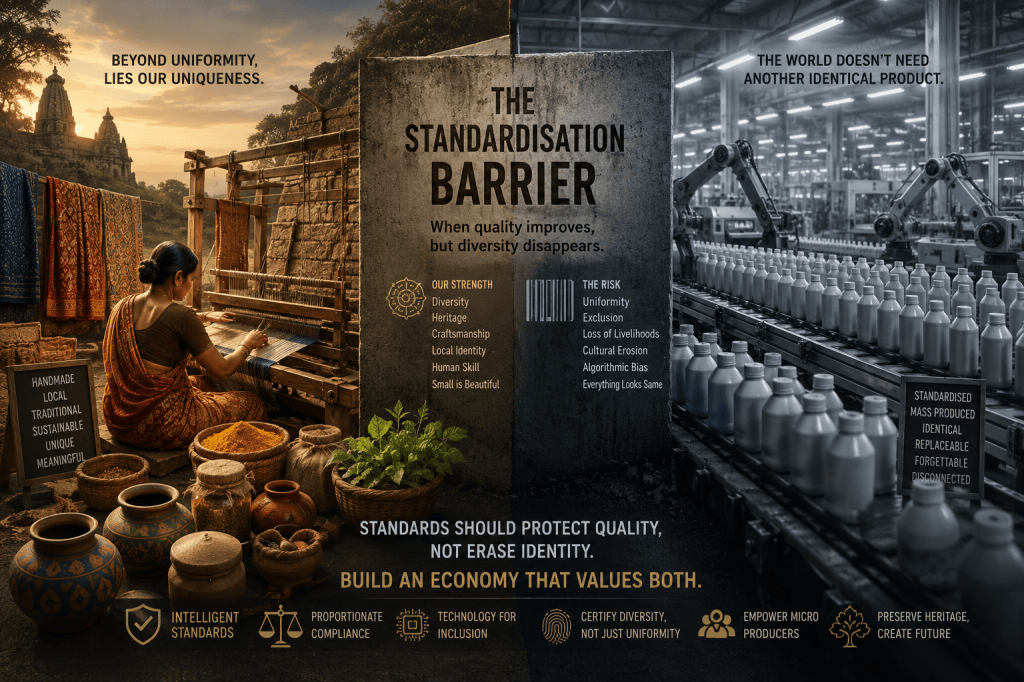
For more than a century, modern economic development has been built around a powerful idea: if products can be made uniform, they can be produced faster, tested more easily, transported farther and sold at larger scale. Standardisation helped create modern manufacturing. It made spare parts interchangeable, improved safety, reduced transaction costs and allowed global supply chains to connect factories across continents.
But there is a question we rarely ask.
What happens when the product itself was never meant to be uniform?
This question is becoming increasingly important for India. A machine component may need exact dimensions. An electrical appliance must meet safety requirements. A medicine must satisfy strict standards. But should the same economic philosophy of uniformity be applied to a handwoven sari, handmade pottery, regional food, herbal preparation or an artisan-made product?
The danger is not standardisation itself. The danger begins when we confuse standardisation with quality.
From Industrial Revolution to the Economy of Sameness
Historically, standardisation emerged because industrialisation required repetition. Mass factories could not function efficiently if every component was different. Railways needed common gauges. Machines needed interchangeable parts. Electrical systems needed common specifications. International trade later required common technical languages so that a buyer in one country could trust a product manufactured thousands of kilometres away.
This system produced enormous economic benefits.
But India entered modern industrialisation with a very different productive structure. Alongside factories, the country retained millions of artisans, weavers, food processors, traditional producers and micro-enterprises whose economic value often came precisely from variation.
A handloom product is not valuable because every piece is identical.
It may be valuable because every piece is slightly different.
That difference is not necessarily a defect. It can be the product.
Yet our economic institutions are still largely designed around an industrial assumption: quality means consistency.
This creates what may be called the Standardisation Barrier.
When Quality Standards Become Entry Barriers
Standards are normally presented as neutral technical requirements. In reality, compliance has an economic cost.
A producer may need testing, certification, documentation, laboratory access, consultants, specialised packaging, traceability systems, periodic renewal and record keeping. A large company can distribute these costs across millions of units.
A micro-enterprise cannot.
Imagine a company producing one million units annually and an artisan group producing 2,000 specialised products. Even when the compliance requirement is identical, its economic burden per product can be radically different.
This is why a standard that appears equal on paper can be unequal in practice.
The problem becomes particularly serious when regulations designed for industrial production are applied mechanically to handmade, traditional or low-volume production.
India has a vast MSME base, and micro enterprises constitute the overwhelming majority of enterprises within it. India also has large numbers of people associated with handicrafts, handloom, traditional food production and other decentralised livelihoods. These are not marginal cultural activities. They form part of a distributed productive economy connecting villages, small towns, women producers, family enterprises and specialised regional skills.
If compliance systems do not understand this production structure, formalisation can unintentionally become exclusion.
The Strange Case of Handmade Imperfection
Consider handicrafts.
Industrial thinking sees variation as a manufacturing problem. Craft thinking often sees variation as authenticity.
Two handmade carpets may not be exactly identical. Two pieces of pottery may have minor differences. Handwoven fabric may contain small variations that distinguish it from machine-produced cloth.
A rigid standardisation system can therefore create a strange outcome.
The more handmade a product is, the more difficult it may become to satisfy a system designed around machine consistency.
Eventually producers learn the economic lesson. They modify products to make certification easier, simplify designs to increase repeatability, replace traditional materials with standardised inputs and reorganise production around specifications preferred by large buyers.
The product becomes easier to sell.
But gradually it may also become less distinctive.
We should therefore recognise a difficult truth: markets do not always destroy traditional production directly. Sometimes they destroy it by making traditional production increasingly resemble industrial production.
India Cannot Standardise Its Way Into Competitiveness
India’s development challenge is unusual because the country must simultaneously build advanced manufacturing and preserve decentralised productive capabilities.
We need semiconductor fabrication and handloom weaving.
We need precision engineering and handmade products.
We need globally standardised pharmaceuticals and regionally distinctive foods.
These are not contradictions. They represent different parts of the productive economy.
The policy mistake is to assume that one architecture of standards can govern all of them.
The future should therefore move from uniform standards toward intelligent standards.
Safety must remain non-negotiable. Health protection must remain strong. Consumers must receive reliable information. Export markets require credible certification.
But beyond these essential requirements, standards should become proportionate to production scale, product characteristics and actual risk.
A micro food producer should not automatically face a compliance architecture designed around a giant food-processing corporation.
A traditional artisan should not need to become a miniature industrial factory merely to enter formal markets.
Technology Could Solve the Problem or Make It Worse
The next phase of standardisation will not be driven only by government regulation.
It will increasingly be driven by digital platforms, artificial intelligence, automated procurement, traceability systems and algorithmic marketplaces.
This creates a much bigger future risk.
Digital markets prefer structured information.
Algorithms like standard categories, standard dimensions, standard photographs, standard delivery schedules, standard product codes and predictable specifications.
But traditional economies are often built around exactly the opposite characteristics: variation, seasonality, customisation, small batches, local materials and human skill.
Tomorrow’s biggest standardisation barrier may therefore not be a government certificate.
It may be an algorithm that simply does not know how to classify a product.
If digital commerce systems increasingly determine visibility, products that cannot easily fit standardised databases may become economically invisible.
Artificial intelligence could intensify this process by directing demand toward products that are easiest to compare, predict, price and deliver.
We could therefore enter a strange future where technology gives consumers access to millions of products while quietly reducing the diversity of products that remain economically viable.
India Needs Standards for Diversity, Not Standards Against Diversity
The solution is not weaker quality control.
It is smarter quality architecture.
India could develop differentiated certification systems for handmade, traditional and micro-produced goods. Common testing facilities can reduce compliance costs across clusters. Digital certification can simplify documentation. Producer organisations can undertake collective compliance. Geographical Indications can be connected more effectively with quality assurance and market access. Standards can distinguish between safety requirements and characteristics arising naturally from handmade production.
Most importantly, policy must recognise acceptable variation.
Instead of forcing every traditional product toward identical specifications, certification can define ranges, processes, materials, origins and authenticity parameters.
This would fundamentally change the philosophy of regulation.
We would move from asking whether every product is identical to asking whether every product is trustworthy.
That is a far more intelligent definition of quality.
The Economic Value of Difference
The global economy may actually be moving toward a moment when India’s diversity becomes more valuable rather than less.
Mass manufacturing is becoming increasingly automated. Artificial intelligence, robotics and advanced manufacturing will make standardised products cheaper and easier to reproduce almost anywhere.
When machines can manufacture perfect uniformity, human variation may acquire a premium.
The future competitive advantage of Indian handicrafts, handloom, regional foods and traditional products may therefore come precisely from characteristics that conventional industrial thinking considers inefficient: small batches, local identity, craftsmanship, imperfect repetition and human involvement.
India should not attempt to compete with machines by making artisans behave more like machines.
It should make the world value what machines cannot reproduce easily.
This requires a completely different industrial strategy.
Standards should protect authenticity rather than erase it. Technology should document craftsmanship rather than replace it. Digital traceability should tell the story of origin. E-commerce should enable customised production. Certification should become a passport to markets rather than a gate keeping small producers outside them.
The Future Risk Is Not Low Quality. It Is High Uniformity.
Economic history teaches us that efficiency creates wealth.
But history also teaches us that excessive efficiency can remove resilience.
Agriculture discovered this when genetic diversity declined. Cities discovered it when traditional neighbourhood economies disappeared. Global supply chains discovered it when excessive concentration created vulnerabilities.
Production systems may eventually learn the same lesson.
An economy containing thousands of specialised local production systems may sometimes appear less efficient than one dominated by standardised factories. But it may possess something equally valuable: diversity, adaptability, distributed knowledge and cultural capital.
Once these capabilities disappear, they are extremely difficult to recreate.
A weaving technique lost after generations cannot simply be reopened like a factory.
A traditional recipe disconnected from its community cannot easily be reconstructed through a laboratory.
An artisan ecosystem that disappears because younger generations see no economic future in the occupation may take decades to rebuild, if it can be rebuilt at all.
This makes the Standardisation Barrier much more than a technical policy issue.
It is a question about what kind of economy India wants to become.
India certainly needs standards.
But India also needs difference.
The challenge of the next twenty years will not be choosing between quality and tradition. It will be designing institutions capable of protecting both.
Because the most dangerous economy of the future may not be one where products are unreliable.
It may be an economy where everything meets the standard, but everything begins to look the same.
Standardisation #MSME #Handicrafts #Handloom #IndianEconomy #Manufacturing #Artisans #MakeInIndia #TraditionalKnowledge #DigitalEconomy #ArtificialIntelligence #InclusiveGrowth #IndustrialPolicy #LocalEconomy #FutureOfManufacturing


Leave a comment