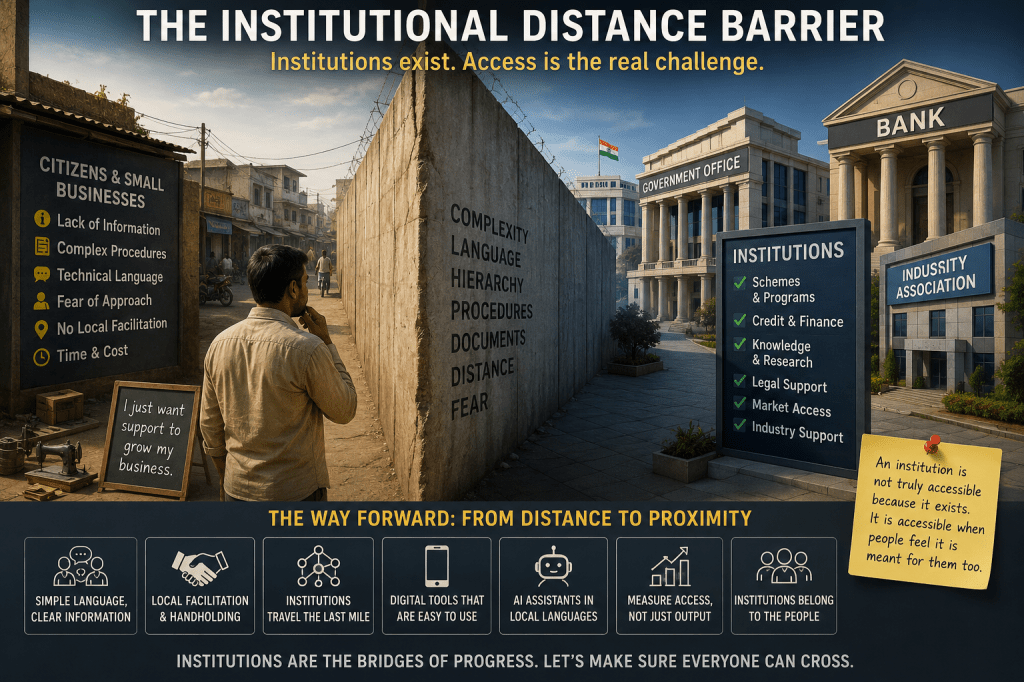
When an Institution Exists on the Map but Not in the Life of the Citizen
India has spent decades building institutions. Banks have expanded into smaller towns. Government departments have district offices. Universities and technical institutions have multiplied. Courts exist across the country. MSME support organisations, industry associations, skill centres, incubation centres and development agencies have been created. Digital platforms have brought many government services onto mobile phones.
Yet there is a strange contradiction.
An institution can be only two kilometres away and still feel impossibly distant.
A small entrepreneur may pass a bank every morning but borrow from a local moneylender. A craft producer may live near a government support office but never enter it. A micro enterprise may operate close to a university but have no idea whom to approach for technical assistance. A worker may have a legitimate grievance but avoid the legal system. A small manufacturer may be surrounded by industry organisations yet remain outside their networks.
This is the Institutional Distance Barrier.
It is not mainly about kilometres. It is about confidence, language, procedure, hierarchy, information and the feeling of whether an institution belongs to people like us.
India Built Institutions, but Access Was Often Designed from the Institution Outwards
The historical roots of this problem are deeper than they appear.
Many modern institutions in India inherited administrative cultures developed during the colonial period. Administration was designed primarily around control, documentation and hierarchy rather than easy citizen participation. Independence transformed the purpose of the state, but institutional behaviour could not be transformed overnight.
After 1947, India created an extraordinary development architecture. Public sector banks, development finance institutions, agricultural extension systems, district industries centres, cooperatives, universities, technical institutes and numerous welfare and enterprise-development programmes expanded the reach of the developmental state.
Bank nationalisation in 1969 and subsequent branch expansion dramatically widened formal banking geographically. Later, financial inclusion programmes, Aadhaar-linked systems, digital payments, Jan Dhan accounts, UPI and online government services reduced several physical barriers.
But geographical expansion should not be confused with institutional inclusion.
The office arrived.
The institution did not always become approachable.
This distinction matters enormously.
The Real Barrier Is Often the First Door
Imagine a first-generation entrepreneur running a tiny manufacturing unit.
He wants finance to purchase machinery.
The bank may ask for financial statements, projected cash flows, GST records, collateral information, quotations, credit history and several declarations. Each requirement may have a legitimate reason. But collectively they create an institutional language that the entrepreneur may not understand.
The bank officer understands the system.
The chartered accountant understands the system.
The consultant understands the system.
The entrepreneur understands the business.
Ironically, the person creating the economic activity may understand the institutional process least.
This creates an entirely new market: the market for navigating institutions.
Agents, consultants, brokers, documentation specialists and informal intermediaries emerge between citizens and institutions. Some provide genuinely useful services. Others simply monetise complexity.
The more difficult an institution is to approach directly, the more valuable the intermediary becomes.
That should worry us.
An economy can gradually reach a situation where access to public institutions becomes privately brokered.
Complexity Is Not Neutral
We often treat procedural complexity as an inconvenience. Economically, it is much more serious.
Complexity creates a hidden transaction cost.
A large company can employ lawyers, accountants, compliance teams, government-relations professionals and consultants. A micro enterprise cannot.
The same ten-page procedure therefore does not impose the same cost on everybody.
For a large corporation, it may represent a few hours of professional work.
For a small entrepreneur, it may mean closing the shop for a day, travelling to an office, waiting in a corridor, returning with another document, paying someone to complete a form and losing several days of income.
Institutional complexity therefore behaves almost like a regressive tax.
The smaller you are, the more expensive institutional navigation can become relative to your resources.
This is one reason why economic informality can survive even when formalisation offers benefits. People do not always remain outside formal systems because they reject institutions. Sometimes institutions unintentionally make entry expensive.
Language Can Become Economic Infrastructure or an Economic Wall
India’s institutional language deserves much more attention.
Government schemes are frequently explained through administrative terminology. Banks communicate through financial terminology. Courts operate through legal terminology. Universities communicate through academic terminology. Technology programmes use technical terminology.
The citizen is expected to translate all of them.
This creates an invisible literacy requirement far beyond the ability to read and write.
A person may be highly competent at manufacturing garments, repairing machinery, producing handicrafts, processing food or managing a small trading business and still feel completely lost when confronted with institutional language.
India therefore has millions of economically capable people who may appear institutionally incapable.
That is not necessarily their failure.
It is often a design failure.
A truly inclusive institution should not measure accessibility by whether information has been uploaded on a website. It should ask whether the intended user can understand the information, act on it and complete the process without depending unnecessarily on someone more powerful.
Digitalisation May Reduce Distance and Create a New Distance at the Same Time
India’s digital transformation has created enormous possibilities.
Digital payments, online registrations, electronic procurement, digital certificates, online banking and government portals can eliminate travel, reduce paperwork and improve transparency.
But there is an uncomfortable possibility.
We may be converting physical institutional distance into digital institutional distance.
A portal can be available twenty-four hours a day and still be inaccessible in practice.
If an entrepreneur does not understand which category to select, which certificate to upload, why an application has been rejected or whom to contact when the system fails, digitalisation has not eliminated institutional distance. It has merely moved the queue from the corridor to the screen.
The old system had a clerk.
The new system may have an error message.
For sophisticated users this is progress. For vulnerable users it can sometimes be another form of exclusion.
The next generation of Digital India therefore needs to move beyond digitising procedures towards simplifying procedures.
That is a much more difficult reform.
Universities Are Close to Industry but Often Far from Enterprises
The same institutional distance exists between knowledge institutions and businesses.
India has universities, engineering colleges, IITs, research laboratories, incubation centres and technical institutes spread across the country. At the same time, thousands of MSME clusters struggle with basic problems of productivity, design, testing, energy efficiency, automation, quality control and product development.
This is one of India’s great economic paradoxes.
Knowledge exists.
Problems exist.
But the bridge between them is often weak.
A small manufacturer rarely knows which professor, laboratory or research centre can solve a production problem. Researchers may have little incentive to spend months solving the practical problems of small enterprises.
The result is geographical proximity without economic connectivity.
A university fifteen kilometres from an industrial cluster can sometimes be institutionally further away than a technology supplier located in another country.
Industry Associations Can Also Become Distant
Industry bodies are supposed to solve collective problems.
Yet smaller enterprises sometimes perceive associations as organisations dominated by larger, older or better-connected businesses.
Meetings may happen in formal venues. Communication may occur in English. Leadership may circulate among established networks. Policy discussions may focus on macro issues while the smallest member is worried about a delayed payment, machine breakdown, worker shortage or rejected loan.
When this happens, representation becomes technically available but socially distant.
This has serious consequences because small enterprises then lose collective voice precisely when they need it most.
An association should not merely ask how many enterprises are members.
It should ask how many enterprises feel that they can call the association when they have a problem.
That is a much better measure of institutional relevance.
The Dangerous Rise of the Informal Gatekeeper
Wherever formal institutions become difficult to navigate, informal gatekeepers gain power.
The broker knows which desk to approach.
The consultant knows how the application should be worded.
The local intermediary knows whom to telephone.
The accountant understands the portal.
The politically connected person knows how to accelerate the file.
Some intermediation is economically useful. Modern economies require specialists.
The danger begins when the intermediary becomes necessary not because the problem is technically complex but because the institution itself is difficult to access.
Then complexity starts producing power.
Those who understand the institutional maze gain an economic advantage over those who do not.
Over time, this can create a disturbing parallel economy of access.
The institution may officially be open to everyone while effective access depends upon networks.
That weakens trust.
The Next Reform Should Be Institutional Proximity
India has already pursued financial inclusion, digital inclusion, infrastructure inclusion and social inclusion.
The next frontier should be institutional proximity.
Every major public-facing institution should begin measuring the distance between itself and its least sophisticated user.
Banks could develop local enterprise facilitation desks that help entrepreneurs become credit-ready rather than merely evaluating completed applications.
Universities could establish permanent MSME interface cells connected to nearby industrial clusters.
Government departments could redesign schemes around user journeys rather than administrative structures.
Industry associations could establish neighbourhood-level facilitation networks.
Legal institutions could dramatically expand affordable mediation and simplified dispute-resolution systems.
Artificial intelligence could eventually become especially powerful here.
Imagine a small entrepreneur speaking in Hindi, Tamil, Bengali, Marathi or another Indian language into a mobile phone and asking a simple question about a loan, government scheme, export procedure or regulatory requirement.
An AI-based institutional navigator could explain the procedure in everyday language, identify missing documents, generate forms, track applications and explain rejection reasons.
Used properly, AI could become the institutional translator of the twenty-first century.
But there is also a danger.
If poorly designed algorithms merely automate complicated systems, India could create a new generation of invisible bureaucracies where nobody understands why an application was rejected.
The future choice is therefore not between human institutions and digital institutions.
It is between understandable institutions and incomprehensible ones.
The Institution Must Travel the Last Mile
For decades, development policy has talked about taking services to the last mile.
Perhaps we need to reverse the idea.
Instead of asking citizens to travel the last mile towards institutions, institutions should travel the last mile towards citizens.
This means building local facilitation capacity inside industrial clusters, craft clusters, rural production centres and small towns.
A facilitator who understands banking, government schemes, technology institutions, markets and local businesses can sometimes generate more economic impact than another portal or another scheme.
Because the missing infrastructure is often not financial infrastructure or physical infrastructure.
It is connective infrastructure.
Someone has to connect the entrepreneur to the bank, the producer to the market, the factory to the university, the worker to the skill system and the citizen to the state.
The Most Advanced Institution May Eventually Be the Simplest One
The conventional view of institutional sophistication is based on technology, regulations, buildings, databases and professional expertise.
The future may judge institutions differently.
The best institution may be the one that requires the least explanation.
The best government scheme may be the one that citizens can access without an agent.
The best bank may be the one that helps a viable entrepreneur become finance-ready.
The best university may be the one whose knowledge regularly enters factories, farms and communities.
The best industry association may be the one whose smallest member feels comfortable walking through its door.
And the best digital platform may be the one that almost disappears behind a simple human experience.
India does not suffer from an absolute shortage of institutions. In many areas, it has built an impressive institutional architecture.
The deeper challenge is converting institutional presence into institutional participation.
That requires a fundamental shift in thinking.
Do not ask only how many branches were opened.
Ask who walks into them.
Do not ask only how many schemes were launched.
Ask who can understand them.
Do not ask only how many portals were created.
Ask who can complete the process without assistance.
Do not ask only how many universities surround an industrial cluster.
Ask how many factories have ever solved a problem with them.
And do not measure institutional success only by expenditure, applications processed or programmes conducted.
Measure the number of people who once stood outside the system and can now navigate it confidently.
Because an institution that people are afraid to approach is only partially an institution.
It is a building, a website, a rulebook and a budget.
The real institution begins when an ordinary citizen believes that the door belongs to them too.
InstitutionalReform #MSME #IndianEconomy #EconomicDevelopment #FinancialInclusion #DigitalIndia #ArtificialIntelligence #EaseOfDoingBusiness #MSMEDevelopment #PublicPolicy #InclusiveGrowth #IndustrialClusters #Governance #FutureOfIndia


Leave a comment