The Shrinking Room to Govern
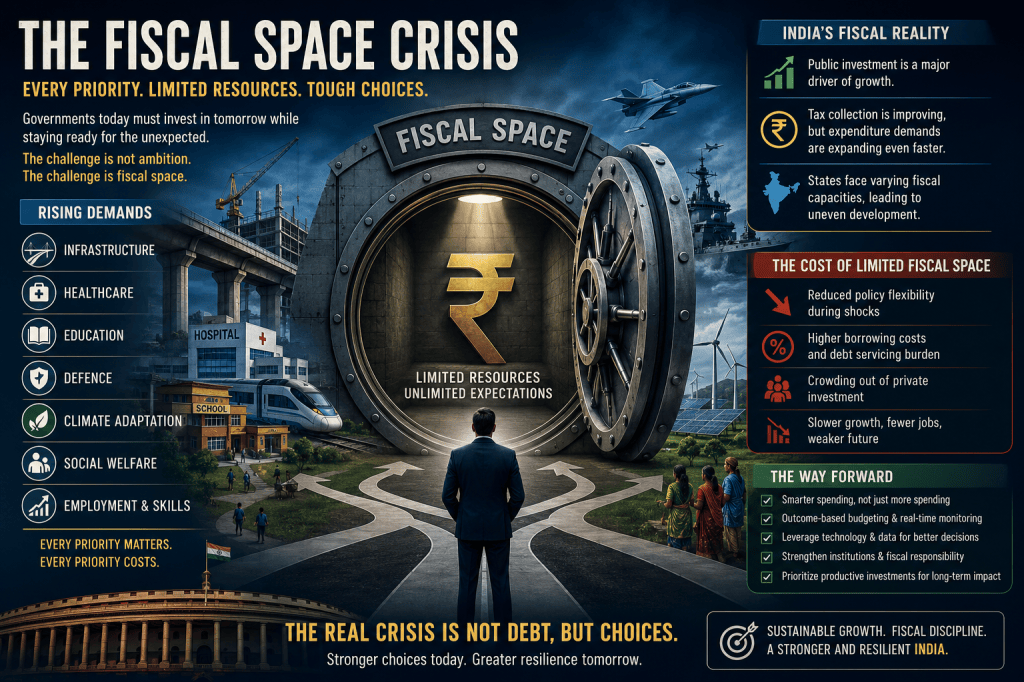
Every nation eventually reaches a stage where economic progress is no longer limited by ambition but by the government’s ability to finance it. Fiscal space is that invisible room within public finances that allows governments to invest, respond to emergencies, and prepare for the future without creating unsustainable debt. Today, this room is becoming increasingly crowded. Infrastructure demands are rising, healthcare systems require constant strengthening, education needs modernization, defence spending is expanding, climate change is forcing massive adaptation costs, and social welfare expectations continue to grow. The real crisis is not a shortage of priorities. The crisis is that every priority is competing for the same limited financial resources.
From Building Nations to Managing Obligations
History shows that governments once used public spending primarily to build roads, ports, irrigation systems, schools, and industries. These investments created productive economies that generated future income. Over time, however, public expenditure has become far more complex. Modern governments must simultaneously protect vulnerable citizens, maintain national security, manage aging infrastructure, respond to natural disasters, support technological transitions, and prepare for unpredictable global shocks. Fiscal management has therefore evolved from planning development to balancing competing obligations. The challenge is no longer deciding where to spend, but deciding what cannot be funded.
India’s Growth Story Faces a Fiscal Test
India has demonstrated that well-targeted public investment can stimulate economic growth, improve connectivity, and encourage private sector participation. Large investments in highways, railways, logistics, digital infrastructure, renewable energy, and urban development have strengthened the country’s long-term productive capacity. At the same time, tax collection has improved through greater formalisation of the economy, digital tax administration, GST reforms, and expanding compliance. Yet stronger revenues alone are not enough. Public expenditure is growing even faster as the country faces increasing demands from healthcare, education, employment generation, defence preparedness, climate resilience, agriculture, and social protection. The gap between available resources and expanding expectations is becoming increasingly difficult to manage.
The Uneven Fiscal Strength of States
India’s fiscal challenge is not uniform. Some states possess stronger industrial bases, broader tax revenues, and better administrative capacity, allowing them to invest more aggressively in development. Others remain dependent on transfers from the Union Government while simultaneously facing high welfare obligations and infrastructure deficits. This uneven fiscal capacity risks widening regional inequalities, where financially stronger states accelerate growth while weaker states struggle to invest in essential public services. Over time, such disparities could affect migration, employment, industrial investment, and social cohesion.
The Cost of Limited Fiscal Space
When fiscal space narrows, governments lose flexibility. During economic downturns, pandemics, financial crises, geopolitical conflicts, or climate-related disasters, they may have less room to respond quickly without increasing debt. Greater borrowing can lead to higher interest costs, leaving a larger share of public revenues committed to debt servicing rather than productive investment. If governments continue borrowing heavily, financial markets may demand higher returns, increasing borrowing costs for both the public and private sectors. As government borrowing absorbs available capital, businesses may find it more expensive to invest, slowing entrepreneurship, industrial expansion, innovation, and job creation.
The Coming Era of Smarter Public Finance
The future of fiscal policy will depend less on how much governments spend and more on how effectively they allocate every rupee. Artificial intelligence, real-time public expenditure monitoring, outcome-based budgeting, predictive analytics, and digital governance can significantly improve spending efficiency while reducing waste and leakages. Equally important will be expanding public-private partnerships, monetising public assets responsibly, strengthening municipal finance, encouraging innovative financing mechanisms, and improving the quality rather than merely the quantity of public expenditure. Fiscal discipline should not become an excuse for reducing development, but a framework for achieving greater impact with limited resources.
The Real Crisis Is Not Debt but Choices
The Fiscal Space Crisis is ultimately a crisis of decision-making. Governments cannot indefinitely promise everything to everyone while maintaining financial stability. Every additional subsidy, every new welfare scheme, every infrastructure project, and every defence investment involves an economic trade-off. Countries that build strong institutions, improve tax efficiency, prioritise productive investments, and measure the outcomes of public spending will preserve the flexibility needed to face future crises. Those that postpone difficult fiscal decisions may discover that the greatest economic risk is not running out of money, but running out of choices.
IndiaEconomy #EconomicPolicy #Infrastructure #FiscalDiscipline #PublicInvestment #EconomicGrowth #ClimateFinance #FutureEconomy


Leave a Reply