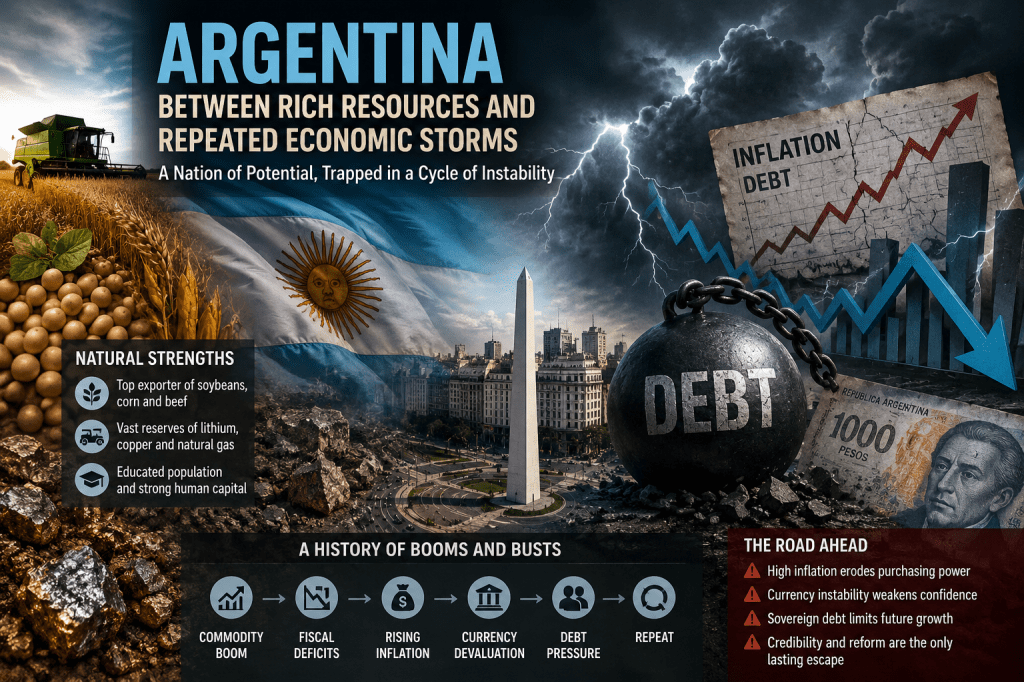
A Country That Has Everything Except Stability
Argentina often looks like a country that should be far richer than it is. It has fertile agricultural land that feeds millions across the world, abundant reserves of oil, gas and minerals, and a highly educated population capable of building competitive industries. Yet its economic story has been shaped less by what it owns and more by how often confidence in its economy has broken down. Over the last century, periods of growth have repeatedly been followed by inflation, debt crises and currency instability. The lesson is simple but uncomfortable. Natural wealth alone cannot create lasting prosperity. Trust in economic institutions matters even more.
Inflation Is More Than Rising Prices
Inflation is often discussed as a number released every month, but in Argentina it has become part of everyday life. Families rush to spend salaries before prices rise again. Businesses hesitate to invest because future costs are impossible to predict. Savings lose value quickly, pushing people toward foreign currencies or physical assets. When inflation becomes a habit, it slowly changes behaviour across society. Economic decisions become short term because long-term planning feels risky. This is one of the hidden costs of inflation that statistics rarely capture.
Debt Becomes a Bridge That Leads Back to Crisis
Argentina has repeatedly borrowed heavily to finance growth, social spending and fiscal deficits. Borrowing can support development when managed wisely, but repeated dependence on debt without sustained economic reforms creates a cycle that becomes increasingly difficult to escape. Higher debt raises investor concerns, borrowing costs increase, confidence weakens and the national currency comes under pressure. Governments then face difficult choices between spending cuts, tax increases or additional borrowing. Each option carries economic and political costs, making reforms even harder to sustain.
Currency Confidence Cannot Be Ordered Into Existence
A strong currency is built on trust rather than government announcements. Whenever confidence declines, people naturally seek safer alternatives to protect their savings. This weakens the domestic currency further and increases the cost of imports, feeding another round of inflation. Argentina has experienced this pattern many times. Exchange-rate instability therefore becomes both a financial problem and a psychological one. Once trust disappears, rebuilding it can take years rather than months.
Agriculture Cannot Carry the Entire Economy
Argentina remains one of the world’s leading agricultural exporters, supplying grains, soybeans and other farm products to global markets. These exports provide valuable foreign exchange and help support economic activity. However, dependence on agricultural earnings also exposes the country to fluctuations in global commodity prices and unpredictable weather conditions. Climate change adds another layer of uncertainty. A modern economy cannot rely on agriculture alone. Manufacturing, technology, advanced services and innovation must become stronger engines of growth if long-term stability is to be achieved.
Hidden Strengths Waiting for the Right Environment
Despite repeated crises, Argentina still possesses remarkable strengths. Its educated workforce, scientific capability, entrepreneurial culture and vast natural resources provide a strong foundation for future development. Large reserves of critical minerals and energy resources could become increasingly valuable as the global economy shifts toward clean energy and advanced technologies. Yet these opportunities will only translate into prosperity if policy stability encourages long-term investment instead of short-term speculation.
The Next Crisis May Look Different
The future challenge for Argentina may not resemble earlier debt crises. Global financial markets are becoming more sensitive to fiscal credibility, climate risks and geopolitical uncertainty. Investors increasingly reward countries that provide stable institutions, predictable regulations and responsible public finances. Nations that fail to build credibility may face higher borrowing costs and reduced investment even if they possess abundant natural wealth. The competition will increasingly be for trust rather than resources.
The Real Currency Is Credibility
Argentina reminds the world that economic development is ultimately built on confidence. Investors need confidence to invest. Businesses need confidence to expand. Families need confidence to save and plan for the future. Governments need confidence to implement reforms that survive political cycles. Inflation, debt and currency instability are often symptoms of a deeper challenge rather than the root cause. The real asset that determines long-term prosperity is macroeconomic credibility. Countries that protect this invisible foundation are more likely to convert natural wealth into lasting progress. Those that neglect it risk repeating the same economic story, no matter how rich their resources may be.
#Argentina #Inflation #DebtCrisis #Macroeconomics #CurrencyStability #Agriculture #EconomicReforms #NaturalResources #InvestmentConfidence #GlobalEconomy


Leave a comment