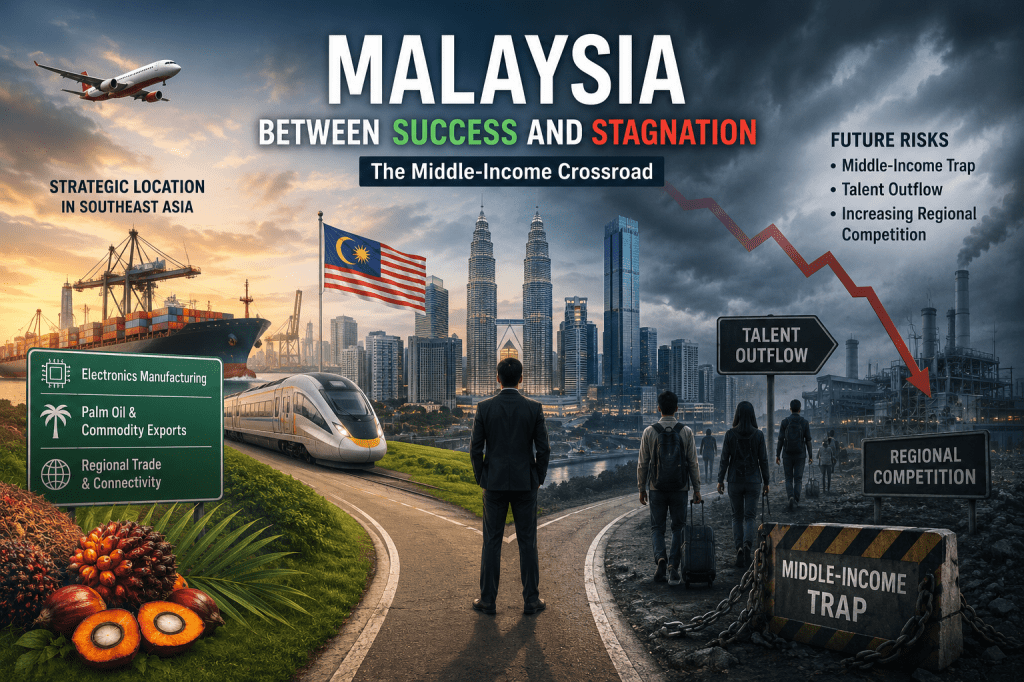
The Factory That Must Learn to Think
Malaysia is often presented as one of Asia’s economic success stories. It transformed itself from an economy dependent on rubber, tin and agriculture into a major manufacturing nation within a few decades. Electronics factories, modern ports and global supply chains changed the country’s economic landscape. Yet the next chapter may prove far more difficult than the first. Building factories was only the beginning. Building ideas, innovation and global technology leadership is a much tougher challenge.
Industrial Success Is No Longer Enough
For years Malaysia benefited from its strategic location in Southeast Asia, political stability and openness to international investment. Global companies established electronics manufacturing facilities that helped create jobs, exports and rising incomes. Palm oil and other commodities continued to generate valuable foreign exchange, while manufacturing diversified the economy beyond natural resources. This balanced growth model delivered remarkable progress and improved living standards for millions.
However, every successful economic model eventually reaches a point where yesterday’s strengths become tomorrow’s limitations. Manufacturing based largely on assembling products designed elsewhere creates income, but it does not always create technological leadership. As wages rise and neighbouring economies become more competitive, simply producing efficiently is no longer enough.
The Invisible Wall Called the Middle-Income Trap
Many countries have succeeded in becoming middle-income economies. Far fewer have successfully crossed into the league of innovation-driven high-income nations. Malaysia now stands in front of this invisible wall.
The middle-income trap is not created by declining growth alone. It appears when productivity rises slowly, research remains limited, domestic companies struggle to become global technology leaders and skilled workers search for better opportunities abroad. At this stage, economic success depends less on building more factories and more on building knowledge, patents, advanced design capabilities and globally competitive brands.
Talent Is Becoming the Most Valuable Export
Malaysia faces a quiet challenge that cannot be measured only through trade statistics. Many highly educated professionals leave the country in search of higher salaries, stronger research ecosystems and better career opportunities. This talent outflow represents a hidden economic cost because every skilled engineer, scientist or entrepreneur who leaves takes future innovation with them.
In the coming decades, countries will compete less for natural resources and more for human intelligence. Nations capable of attracting and retaining talented people will shape future industries, while those losing talent may struggle despite having modern infrastructure.
Commodities Cannot Carry Tomorrow’s Economy
Palm oil remains one of Malaysia’s strongest export sectors and continues to contribute significantly to national income. Yet commodity markets have always been cyclical. Prices fluctuate with global demand, climate conditions, sustainability regulations and geopolitical developments. Depending too heavily on commodities creates uncertainty that no country can fully control.
The future belongs to economies that combine natural resources with advanced processing, biotechnology, precision manufacturing and green technologies. Value creation will increasingly matter more than resource ownership.
Competition Is No Longer Coming From One Direction
Malaysia once competed mainly with developed economies for investment. Today the competition has become far more intense. Vietnam continues attracting manufacturers through competitive costs. Indonesia is expanding downstream mineral industries. Thailand is strengthening automotive production. Singapore dominates advanced technology and financial services. Even emerging economies are improving logistics, digital infrastructure and industrial capabilities.
This means Malaysia must compete simultaneously on cost, quality, innovation, sustainability and technological sophistication. The race has become multidimensional.
The Next Economic Revolution Will Be Built on Innovation
Artificial intelligence, semiconductor design, digital manufacturing, clean energy, advanced electronics and biotechnology are reshaping global production. Countries that create these technologies will capture the highest value, while those performing only assembly may face slower long-term income growth.
Malaysia already possesses a strong industrial foundation. The challenge is converting manufacturing excellence into innovation leadership. Universities, research institutions, startups, venture capital and industry partnerships must become as important as industrial parks and export zones.
The Future Will Reward Reinvention
Malaysia has already demonstrated that transformation is possible. The journey from agriculture to manufacturing proved that determined policy, investment and global integration can change a nation’s destiny. The next transformation demands even greater ambition. The economy must evolve from producing products to producing knowledge, technology and original solutions.
The greatest risk for Malaysia is not losing factories. It is believing that yesterday’s industrial success alone will guarantee tomorrow’s prosperity. The countries that will lead the next generation are those willing to reinvent themselves before circumstances force them to do so. Malaysia has the foundation, the geography and the experience. The question is whether it can transform success into sustained innovation before the global economy moves even further ahead.
#MalaysiaEconomy
#MiddleIncomeTrap
#InnovationEconomy
#ElectronicsManufacturing
#PalmOil
#IndustrialTransformation
#TalentRetention
#GlobalCompetitiveness
#SoutheastAsia
#FutureGrowth


Leave a comment