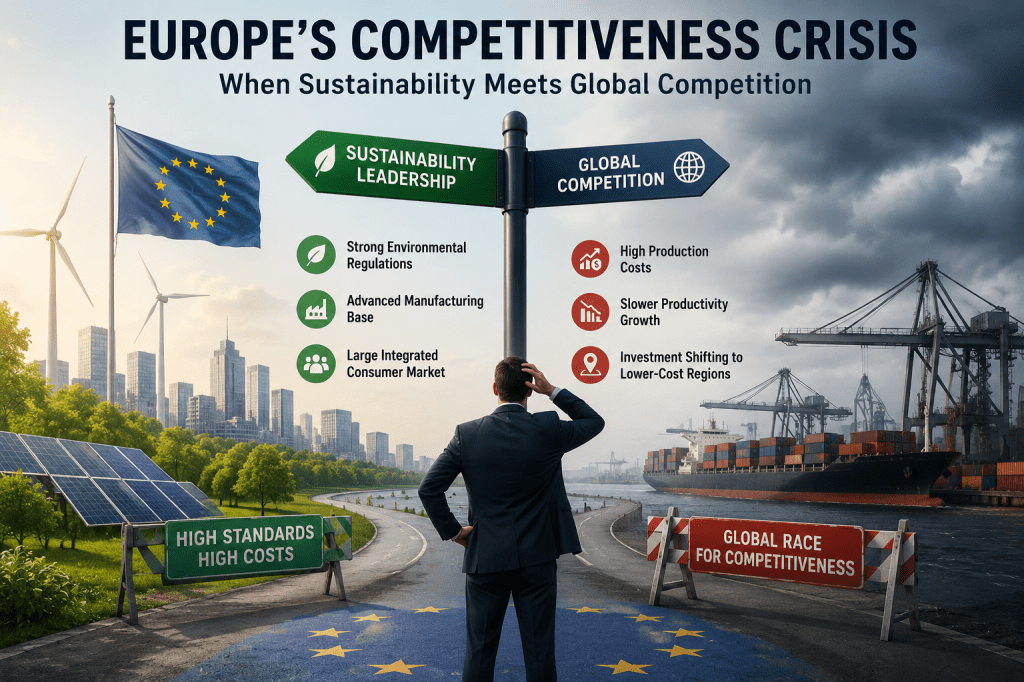
Before the World Wars, Europe was the world’s industrial heartland. It built its prosperity on manufacturing, engineering, innovation, and global trade. After decades of conflict, the European Union emerged as an ambitious experiment that combined economic integration with peace, social protection, and shared prosperity. For many years, this model delivered remarkable results. A single market of hundreds of millions of consumers, world-class manufacturing, strict environmental standards, and strong labour protections made Europe one of the most influential economic regions on earth. Today, however, the European Union stands at a difficult crossroads where maintaining global competitiveness has become just as important as protecting social and environmental values.
Growth Without Speed
The biggest challenge facing the European Union is not the absence of wealth but the slowing pace of creating new wealth. Many European economies remain among the richest in the world, yet economic growth has become modest compared with faster-growing regions in Asia and parts of North America. While emerging economies continue expanding industrial capacity and adopting new technologies at remarkable speed, Europe often finds itself balancing economic decisions with complex regulatory, environmental, and social objectives. This cautious approach creates stability but sometimes slows industrial transformation.
Climate Leadership Comes With Economic Costs
Europe has become the global leader in climate action. Strict emission standards, renewable energy targets, circular economy policies, and sustainable manufacturing have influenced environmental policies across the world. However, leadership carries a price. Compliance with increasingly demanding environmental regulations raises production costs for industries ranging from steel and chemicals to automobiles and heavy engineering. Businesses that support sustainability also face growing pressure to remain profitable while competing against manufacturers operating under far less demanding regulatory systems. The question is no longer whether green policies are necessary but whether industries can remain globally competitive while carrying higher transition costs.
Manufacturing Still Matters
Despite increasing attention to digital services, manufacturing remains the backbone of Europe’s economic strength. Germany’s engineering excellence, Italy’s industrial design, France’s aerospace capabilities, and the broader European network of advanced suppliers continue to make the region a manufacturing powerhouse. Yet the competitive advantage that once relied on technology and quality alone is narrowing. Emerging economies are rapidly upgrading their technological capabilities, while automation is reducing the importance of labour-cost differences. Europe now competes not only on quality but also on speed, flexibility, energy costs, and investment attractiveness.
The Cost of Doing Business Is Rising
One of Europe’s most pressing economic concerns is the steadily increasing cost of production. High wages, expensive energy, ageing infrastructure in some regions, compliance costs, and taxation have collectively raised the cost of manufacturing. While these factors reflect Europe’s commitment to quality of life and worker welfare, they also encourage multinational companies to relocate production or expand investments in regions offering lower operating costs. Capital today moves faster than governments can design industrial policies, making investment competition increasingly intense.
Productivity Has Become the New Battlefield
Future economic leadership will depend less on the number of workers and more on how productive each worker becomes. Europe faces slowing productivity growth despite having highly educated populations and sophisticated industries. Digital transformation, artificial intelligence, advanced robotics, and next-generation manufacturing require continuous investment, rapid commercialisation of research, and greater entrepreneurial risk-taking. If productivity growth remains weak, even technologically advanced economies may struggle to sustain rising living standards.
The Investment Migration Risk
Global investment increasingly follows predictable economic logic rather than historical reputation. Investors compare energy prices, taxation, regulation, labour flexibility, infrastructure, and market access before deciding where to build factories or research facilities. If Europe’s cost structure continues rising while competing regions improve efficiency, manufacturing investment could increasingly shift toward Asia, Latin America, Eastern Europe, and parts of Africa. Such shifts may occur gradually but can reshape global production networks over the coming decades.
The Next European Economic Test
The European Union is entering a defining economic decade. It must prove that sustainability, industrial competitiveness, and social welfare can reinforce rather than weaken one another. Future success will depend on simplifying regulations without compromising environmental goals, accelerating innovation without increasing inequality, attracting investment while maintaining high labour standards, and strengthening productivity through technology rather than relying solely on historical industrial strength. The world’s largest integrated consumer market remains a powerful advantage, but markets alone no longer guarantee economic leadership. The countries that combine innovation, affordability, speed, and resilience will define the next era of global competitiveness. Europe’s challenge is not preserving yesterday’s success but reinventing its economic model before global competition reshapes it from the outside.
#EuropeanUnion #Competitiveness #IndustrialPolicy #AdvancedManufacturing #GreenTransition #Productivity #Investment #Innovation #GlobalTrade #EconomicFuture


Leave a comment