The Silent Economic Crisis
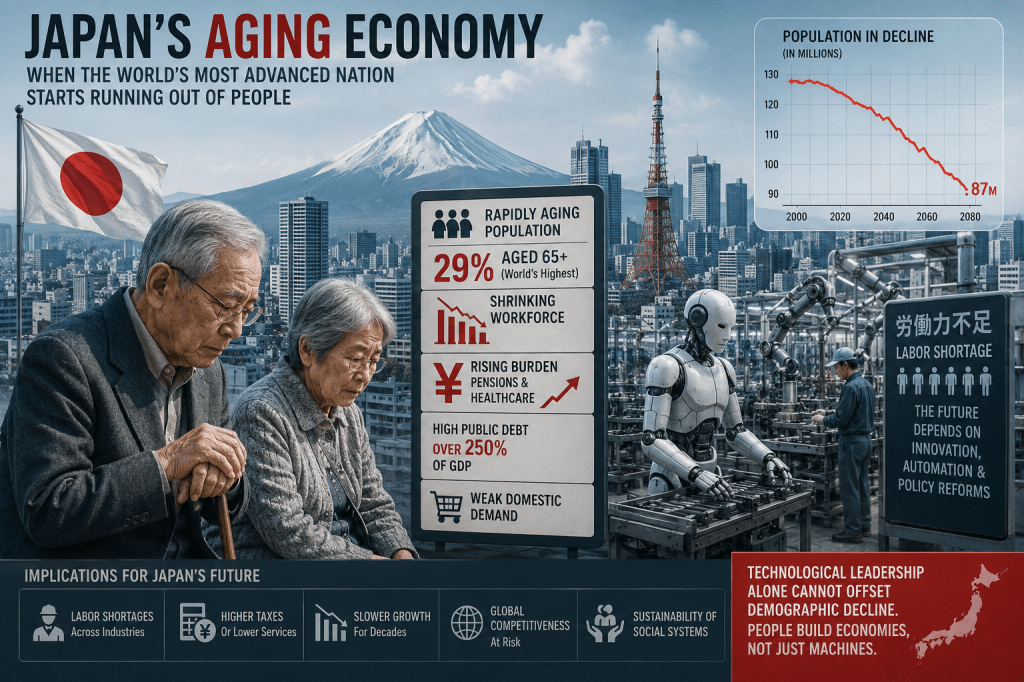
Japan has spent decades proving that discipline, innovation and world-class manufacturing can build one of the strongest economies on Earth. It became a global symbol of precision engineering, robotics, automobiles and electronics. But today Japan is teaching the world a different lesson. Even the most advanced technology cannot fully replace a shrinking and aging population. The biggest challenge is no longer building better machines. It is finding enough people to keep the economy moving.
When Population Becomes the Biggest Economic Resource
For centuries, countries measured their strength through land, minerals or military power. The twenty first century is changing that equation. Human capital has become the most valuable national asset. Japan has one of the oldest populations in the world, with fewer young workers entering the labour market every year while the number of retired citizens continues to rise. This creates an economic imbalance where fewer people are expected to support a growing elderly population. No economic model can remain comfortable when its workforce keeps shrinking.
Factories Are Smart but Workers Are Missing
Japan remains a global manufacturing powerhouse. Its factories continue to produce some of the world’s finest automobiles, industrial machinery, electronics and advanced materials. Robots are replacing repetitive work and artificial intelligence is improving efficiency. Yet factories, hospitals, farms and service industries are increasingly struggling to find enough workers. Machines can improve productivity, but they cannot completely replace human creativity, care, leadership and decision making. The future may reveal that technology works best alongside people rather than instead of them.
The Growing Weight of Public Debt
Japan also carries one of the highest public debt burdens in the world. For many years low interest rates and domestic savings helped make this manageable. But an aging society is steadily increasing spending on pensions, healthcare and social protection. As more money is directed toward supporting an older population, fewer resources remain for future investments in innovation, education and economic expansion. The pressure grows quietly, making every budget decision more difficult than the last.
A Market That Is Slowly Losing Energy
An economy grows when people spend, invest and create new demand. Aging societies naturally become more cautious. Older households often save more and consume less, while fewer young families mean lower demand for housing, education, consumer goods and new businesses. Domestic markets begin to lose momentum even when exports remain strong. This creates an economy that appears stable on the surface but gradually loses its ability to generate fresh growth from within.
The World Is Watching Japan’s Future
Many developed and even emerging economies are moving toward similar demographic patterns. Falling birth rates are becoming common across Asia, Europe and parts of North America. Japan is no longer an isolated example. It is becoming a preview of what many countries may experience over the next two decades. The real challenge is not simply living longer. It is ensuring that longer lives remain economically productive and socially sustainable.
The Next Economic Revolution Will Be Human
The next phase of economic competition may not be won by the country with the fastest computers or the biggest factories. It may belong to nations that successfully combine technology with healthy population growth, skilled workers, flexible immigration, lifelong learning and strong family support systems. Japan has already mastered industrial excellence. Its next challenge is rebuilding demographic strength in a world where people are becoming the scarcest economic resource of all. The greatest warning from Japan is that prosperity cannot survive forever if the number of people creating it continues to decline.Ten important keywords
#JapanEconomy
#DemographicChange
#AgingPopulation
#LabourShortage
#Manufacturing
#PublicDebt
#HealthcareCosts
#PensionReforms
#EconomicGrowth
#FutureOfWork


Leave a comment