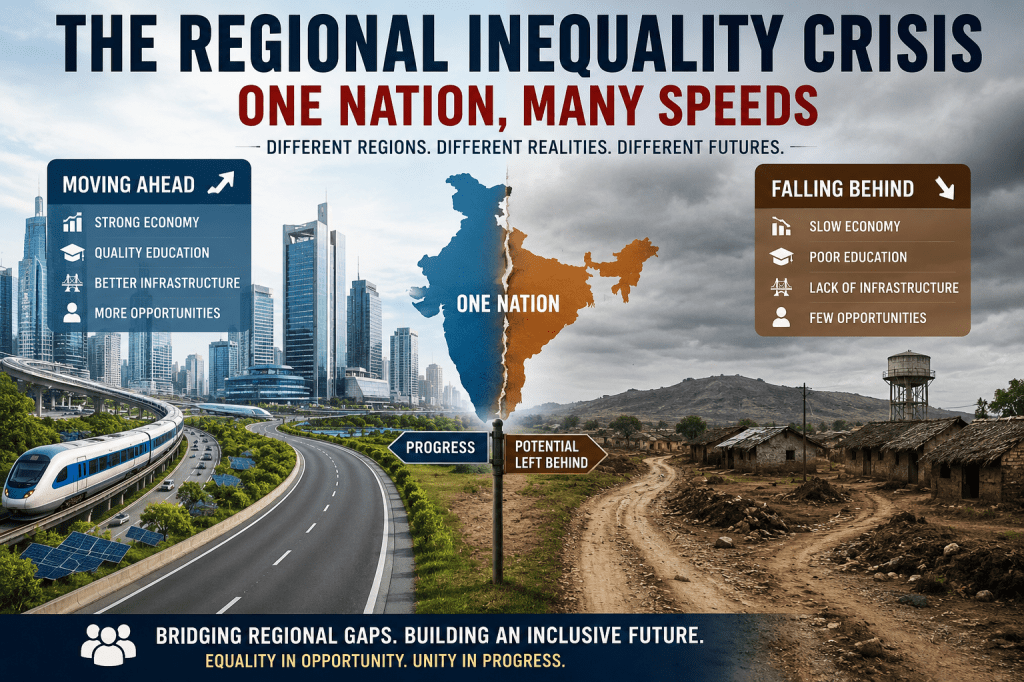
The Regional Inequality Crisis
India is often described as the fastest-growing major economy in the world. The headline sounds impressive. The statistics look encouraging. New highways are being built, airports are expanding, digital payments are transforming commerce, and manufacturing ambitions are rising. Yet beneath this national story lies a more uncomfortable reality. India is not moving forward as one economy. It is moving forward as many different economies growing at very different speeds.
The roots of this divide are not new. Since independence, some regions benefited from stronger industrial foundations, better educational institutions, superior connectivity, and more effective governance systems. Over time, these advantages multiplied. States in the south and west built stronger ecosystems for manufacturing, services, exports, technology, healthcare, and education. Human development indicators improved alongside economic growth. Meanwhile, many regions in central and eastern India struggled to attract similar levels of investment and economic diversification.
The result is a widening map of opportunity. A young graduate in Bengaluru, Hyderabad, Pune, Chennai, or Ahmedabad often faces a completely different future compared to a similarly qualified young person in many less-developed districts of the country. The difference is not merely income. It is access to quality education, healthcare, transport, digital infrastructure, skilled jobs, entrepreneurship networks, and investment capital. Geography increasingly shapes destiny.
Migration as an Economic Signal
Migration is often presented as a success story of labour mobility. In reality, it is also a silent report card on regional inequality. Millions of people leave their hometowns not because they want to, but because economic opportunities are concentrated elsewhere. Entire districts are becoming suppliers of labour rather than centres of development. Families remain separated for years. Villages lose their most productive youth. Cities become overcrowded while rural regions experience economic stagnation.
Historically, migration helped balance labour shortages and economic growth. But when migration becomes one-directional and permanent, it signals a deeper structural problem. It suggests that opportunity is not being created where people live. Instead, people are forced to chase opportunity wherever it exists.
Infrastructure and Investment Divide
Infrastructure remains one of the strongest predictors of regional prosperity. Investors rarely choose locations based on incentives alone. They look for roads, ports, electricity, logistics networks, skilled workers, reliable institutions, and efficient administration. Regions that already possess these strengths continue attracting more investment. Regions lacking them struggle to break the cycle.
This creates a self-reinforcing pattern. Investment generates jobs. Jobs generate income. Income attracts talent. Talent attracts more investment. Meanwhile, less-developed regions face the opposite cycle. Lower investment leads to fewer jobs, weaker local demand, and continued economic outmigration. The gap gradually widens.
The Hidden Cost of Uneven Growth
National GDP growth can sometimes hide regional distress. A few high-performing states can lift overall economic numbers while significant parts of the country remain economically fragile. This creates an illusion of uniform progress. In reality, uneven development often weakens national resilience.
A nation cannot sustainably depend on a limited number of growth engines forever. Excessive concentration of industry, services, talent, and infrastructure creates pressures on housing, transport, water resources, and urban governance. At the same time, underdeveloped regions remain unable to contribute fully to national growth. The country effectively operates below its true potential.
The Future Risk: A Geography of Frustration
The next decade may transform regional inequality from an economic challenge into a social and political challenge. Rising aspirations, social media exposure, and digital connectivity have made people more aware of opportunities available elsewhere. Expectations are increasing faster than local economic opportunities.
When citizens repeatedly observe that prosperity is concentrated in certain regions while their own areas remain stagnant, frustration grows. Such frustration can influence migration patterns, political demands, social cohesion, and governance outcomes. Economic inequality between individuals is difficult enough. Inequality between entire regions can become even more destabilizing.
Beyond Growth: The Need for Distributed Prosperity
The future of India will depend not only on how fast it grows but also on where growth occurs. The real challenge is not creating a few global cities. The challenge is creating hundreds of thriving districts. Economic success must move beyond metropolitan corridors and spread into smaller towns, secondary cities, and rural enterprise clusters.
This requires a new development imagination. Investments must follow people, not merely markets. Industrial ecosystems must be built in emerging regions. Education, healthcare, logistics, digital infrastructure, and local entrepreneurship need equal attention. Regional development should no longer be treated as welfare policy. It should be treated as economic strategy.
The Regional Inequality Crisis is ultimately not about statistics. It is about millions of people waiting for opportunity to arrive where they live. If India succeeds in reducing regional disparities, it could unlock one of the largest development transformations in modern history. If it fails, the country may continue growing rapidly while becoming increasingly divided between regions that are accelerating and regions that are standing still.
The greatest economic question of the next twenty years may not be whether India grows. It may be whether India grows together.Important Keywords
#RegionalInequality
#BalancedDevelopment
#MigrationEconomics
#InclusiveGrowth
#HumanDevelopment
#InfrastructureGap
#Industrialization
#RegionalDisparities
#EconomicTransformation
#NationalCohesion


Leave a comment