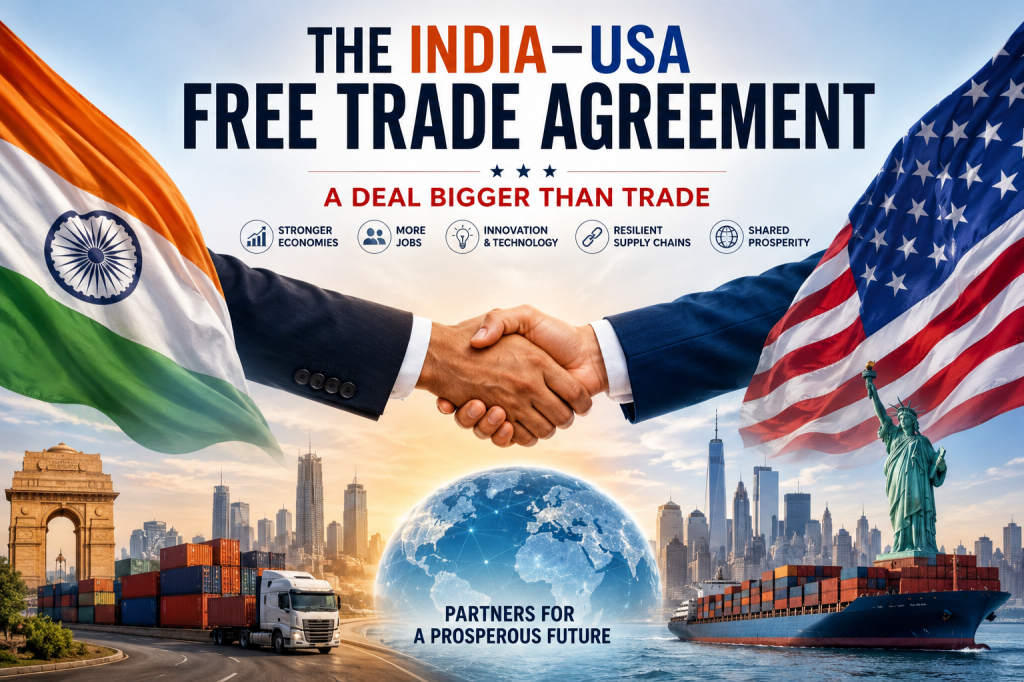
From Trade Deficits to Strategic Dependence
Trade agreements were once simple documents designed to reduce tariffs and increase commerce. The future India–USA Free Trade Agreement is something very different. It is emerging at a time when economics, technology, security, supply chains, energy, and geopolitics have become deeply interconnected. This is not merely about selling more goods. It is about deciding how two of the world’s largest democracies position themselves in a rapidly changing global economy.
For decades, the United States viewed India primarily as a large market, while India viewed the United States as a source of technology, investment, and export opportunities. Today, both countries are driven by a new reality. Globalisation is no longer operating under the old rules. Supply chains are being reorganized, technology is becoming strategic, and economic partnerships are increasingly shaped by geopolitical considerations. In this environment, an India–USA FTA would represent far more than a commercial arrangement. It would be a statement about the future architecture of the global economy.
The End of Cheap Globalisation
The last thirty years were built on the assumption that production should happen wherever costs were lowest. That era is fading. Companies now worry as much about resilience as efficiency. Governments worry as much about security as growth. The pandemic, geopolitical tensions, semiconductor shortages, and shipping disruptions have exposed the risks of excessive dependence on a few locations.
For the United States, India represents an alternative manufacturing destination capable of reducing supply chain concentration. For India, the agreement offers a chance to attract investment, integrate into higher-value production networks, and expand exports. Yet the opportunity comes with a difficult question. Can India become a global manufacturing hub without exposing domestic industries to overwhelming competition?
The Tariff Wall and the Competitiveness Question
Much of the debate around an FTA focuses on tariffs. Lower duties can certainly increase trade flows. Indian exports in sectors such as textiles, pharmaceuticals, engineering goods, chemicals, electronics, and services could gain better access to the American market. American firms would gain improved access to one of the world’s fastest-growing consumer markets.
But tariffs are often the easiest part of trade agreements. The harder challenge lies in competitiveness. A factory does not become globally competitive simply because tariffs fall. Productivity, infrastructure, logistics, technology adoption, workforce skills, energy costs, and regulatory efficiency matter far more. If these weaknesses remain unresolved, tariff reductions alone may increase imports faster than exports.
The real test for India is not whether markets open. The real test is whether Indian enterprises are ready when they do.
Beyond Goods: The Technology Battlefield
The most important chapters of a future India–USA FTA may not concern goods at all. They may concern data, artificial intelligence, digital trade, semiconductors, biotechnology, advanced manufacturing, and intellectual property.
The twenty-first century economy is increasingly driven by intangible assets rather than physical products. Data has become a strategic resource. Algorithms are becoming economic infrastructure. Nations that control advanced technologies may shape future economic hierarchies.
For India, deeper access to American technology ecosystems could accelerate industrial transformation. For the United States, India offers talent, scale, and market depth. Yet this area will also generate friction. Questions about data localization, digital sovereignty, intellectual property protection, and technology transfer are unlikely to disappear. The future negotiations may therefore resemble a technology partnership as much as a trade agreement.
Agriculture: The Most Sensitive Frontier
No trade negotiation involving India is complete without agriculture. Millions of livelihoods depend on farming. American agriculture operates at a scale and productivity level that often differs significantly from Indian conditions.
Any substantial market opening could generate concerns among farmers, policymakers, and rural communities. At the same time, consumers increasingly demand better quality, greater variety, and lower prices. Balancing these competing interests will be among the most politically sensitive aspects of any agreement.
The challenge is not simply economic. It is social and political. Trade negotiations often become debates about livelihoods, identity, and economic security.
A New Era for Services
India’s greatest strength may not lie in goods but in services. Information technology, consulting, finance, healthcare, education, engineering, and professional services increasingly define India’s global economic role.
An ambitious agreement could improve mobility for professionals, reduce barriers to service exports, and deepen collaboration in knowledge-intensive sectors. In a world where digital services are growing faster than merchandise trade, this could become one of the most significant long-term benefits.
The future may see Indian talent becoming as important an export as Indian products.
The Geopolitical Layer Nobody Can Ignore
The India–USA relationship is increasingly shaped by strategic calculations. Both countries seek stability in the Indo-Pacific. Both are concerned about supply-chain resilience. Both recognize the importance of emerging technologies and critical minerals.
As a result, an FTA would carry geopolitical significance far beyond trade statistics. It could become part of a broader framework involving technology partnerships, defence cooperation, energy security, and critical supply chains.
This creates opportunities but also risks. Excessive dependence on any single economic partner can create vulnerabilities. Strategic partnerships must strengthen economic flexibility rather than reduce it.
Looking Toward 2040
The most important impact of an India–USA FTA may not be visible in the first year or even the first decade. Its significance will emerge through investment decisions, technology flows, industrial restructuring, and supply-chain realignments that unfold over many years.
By 2040, the global economy may look very different. Artificial intelligence could transform manufacturing. Digital trade may surpass many traditional sectors. Climate regulations may reshape industrial competitiveness. Critical minerals, data networks, and advanced technologies may become more important than traditional trade flows.
In that future, the success of an India–USA FTA will not be measured by how much trade increased. It will be measured by whether India used the agreement to become more innovative, more productive, and more globally competitive.
The agreement should therefore be viewed not as a destination but as a test. A test of India’s ability to move from being a large market to becoming a leading economic power. Trade deals can open doors. Only competitiveness can determine what lies behind them.
#IndiaUSFTA
#TradeDiplomacy
#GlobalSupplyChains
#ManufacturingCompetitiveness
#DigitalTrade
#TechnologyPartnership
#StrategicEconomics
#ExportGrowth
#GeopoliticalEconomy
#FutureOfTrade
 "Connecting communities, empowering nations: Unifying the Regional and Global Economy ."
Leave a comment