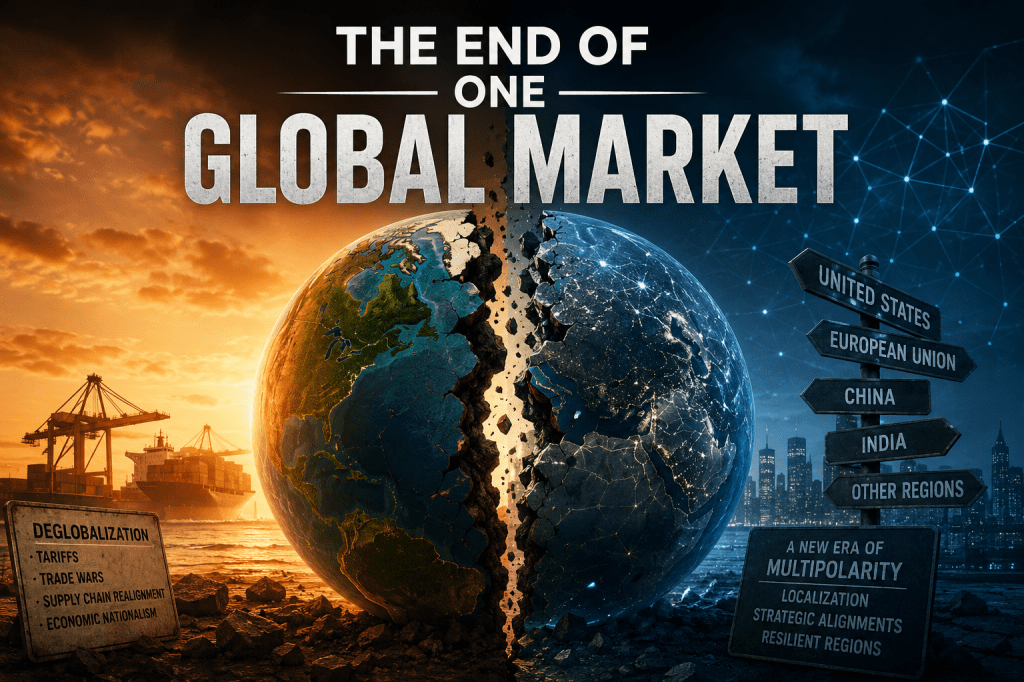
For nearly three decades, the world believed that globalization was an unstoppable force. Factories moved to the most efficient locations, goods crossed borders with increasing ease, and economic integration became the defining feature of the global economy. The assumption was simple. Trade would follow economics, not politics. Today that assumption is rapidly breaking down.
When Geography Replaces Economics
The new reality is that trade is no longer determined only by cost, efficiency, or comparative advantage. Geography, security concerns, political alliances, and strategic interests are increasingly shaping economic decisions. Nations are becoming more selective about whom they trade with, where they source critical inputs, and which supply chains they trust. The result is a world economy that is slowly dividing into overlapping economic blocs rather than functioning as a single integrated marketplace.
The Rise of Political Supply Chains
Historically, businesses built supply chains to minimize costs and maximize efficiency. A company sourced from the cheapest producer, regardless of political considerations. That model is changing. Governments now view supply chains as strategic assets. Semiconductors, rare earth minerals, pharmaceuticals, food products, and energy resources are increasingly linked to national security concerns. Supply chains are being filtered through political relationships. Reliability is often valued more than efficiency. This shift may create resilience in some sectors, but it also increases costs for businesses and consumers.
India Between Competing Worlds
India occupies a unique position in this emerging landscape. Unlike many countries that are firmly aligned with a particular geopolitical bloc, India continues to maintain economic relationships across multiple competing groups. This strategic neutrality creates significant opportunities. Companies seeking alternatives to concentrated supply chains increasingly view India as a potential manufacturing and investment destination. At the same time, balancing relationships with different economic powers requires careful policy management. Every trade negotiation, technology partnership, and investment decision becomes more complex in a fragmented world.
The New Export Challenge
Indian exporters may face a future where a single global strategy is no longer sufficient. Different markets may require different supply chains, compliance systems, standards, certifications, and business partnerships. An exporter serving Europe may face sustainability requirements, while another targeting North America may encounter security-related regulations. Markets that once appeared interconnected may increasingly operate under separate rules. Businesses that fail to adapt could find themselves excluded from important opportunities.
The Cost of Duplication
One of the least discussed consequences of trade fragmentation is the growing cost of duplication. Multiple production facilities, parallel supply chains, separate technology ecosystems, and regional standards may improve security but reduce economic efficiency. The world may become safer from supply disruptions while becoming more expensive. The gains that globalization delivered through specialization and scale could gradually erode. Consumers may pay more. Businesses may invest more. Governments may subsidize more. Everyone may carry a larger economic burden.
A Future of Many Globalizations
The future may not be defined by deglobalization but by the emergence of several competing versions of globalization. Instead of one interconnected world economy, there may be multiple economic networks operating simultaneously. Countries and firms will constantly navigate between these overlapping systems. Flexibility, adaptability, and geopolitical awareness may become as important as productivity and innovation.
The Silent Trade Revolution
The most important transformation may be occurring quietly. The world is not abandoning trade. It is redefining the purpose of trade. Economic efficiency is no longer the only objective. Security, resilience, political alignment, and strategic autonomy are becoming equally important. History may eventually view this period not as the end of globalization, but as the beginning of a more fragmented, more complex, and potentially less efficient global economic order. The challenge for countries like India will be to convert uncertainty into opportunity while avoiding the costs of becoming trapped between competing economic worlds.
#GlobalTrade #TradeFragmentation #Geoeconomics #SupplyChains #IndiaTrade #EconomicBlocs #StrategicNeutrality #Globalization #ExportStrategy #FutureEconomy
 "Connecting communities, empowering nations: Unifying the Regional and Global Economy ."
Leave a comment