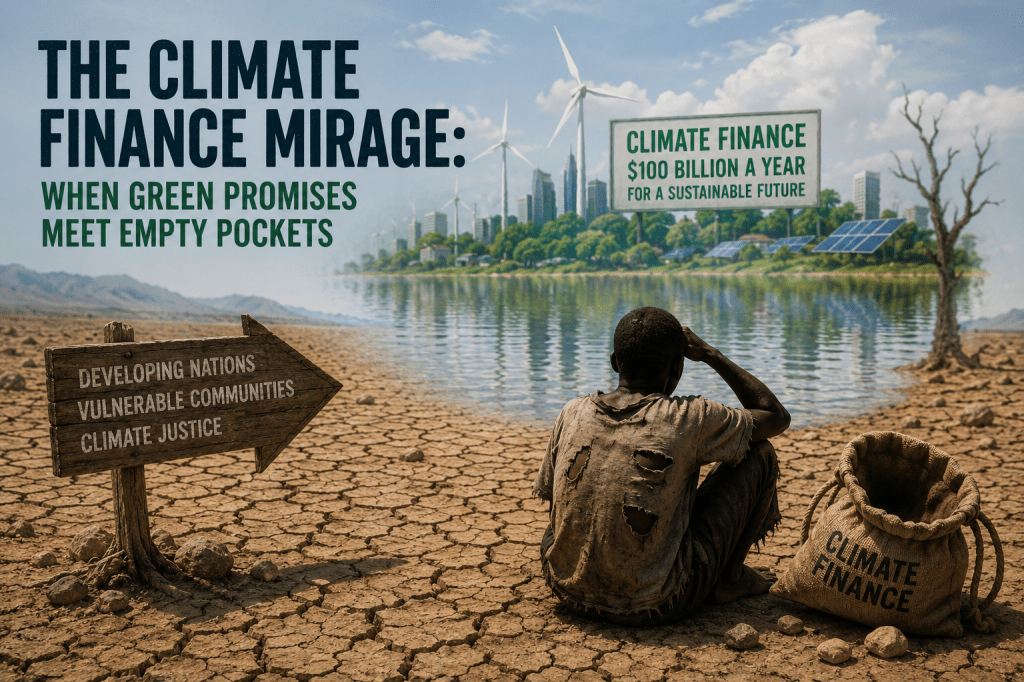
The Cost of Saving the Planet
Climate change is often presented as a technological challenge. In reality, it is increasingly becoming a financial challenge. The world is asking developing countries to build renewable energy systems, strengthen climate resilience, protect vulnerable communities, modernize infrastructure, and reduce emissions, all at the same time. Yet the most important ingredient required for this transformation remains in short supply: affordable finance.
History offers an uncomfortable lesson. Most industrialized economies achieved prosperity through centuries of carbon-intensive growth. Developing countries are now being asked to follow a different path while still trying to provide jobs, housing, infrastructure, healthcare, and education to millions of citizens. The challenge is not whether climate action is necessary. The challenge is who pays for it and how quickly the money arrives.
Development Versus Decarbonisation
For countries such as India, climate policy is no longer just an environmental issue. It is deeply connected with economic development. Expanding renewable energy capacity, improving water security, strengthening coastal protection, building climate-resilient agriculture, and modernizing urban infrastructure require investments running into hundreds of billions of dollars.
The dilemma is simple but uncomfortable. Every rupee invested in climate adaptation competes with investments in roads, schools, hospitals, industrial development, and employment generation. Policymakers are therefore forced to balance immediate development priorities with long-term climate commitments. This balancing act will become even more difficult as climate impacts intensify.
The Promise of Climate Finance
Global climate conferences have repeatedly produced ambitious financing commitments. Headlines often celebrate large numbers and new pledges. However, the gap between announcements and actual implementation remains substantial. Funds frequently move slowly, eligibility conditions can be restrictive, and many developing countries struggle to access affordable financing.
The result is growing frustration. Climate finance is often discussed as if it already exists at scale, while many countries continue searching for the resources needed to execute basic adaptation and mitigation projects. The difference between promised finance and delivered finance has become one of the most important fault lines in global climate negotiations.
Debt Is Becoming the Hidden Climate Risk
Many developing economies are entering a period of elevated debt burdens. Governments facing high interest payments have less fiscal space available for green investments. Borrowing additional funds for climate projects can become financially risky, even when those projects are environmentally necessary.
This creates a dangerous cycle. Countries most vulnerable to climate shocks are often the least able to finance climate resilience. Floods, droughts, heatwaves, and storms increase economic losses, while financial constraints reduce the ability to prepare for future disasters. Climate vulnerability and financial vulnerability increasingly reinforce one another.
India and the Race Against Time
India represents one of the most important climate stories of the twenty-first century. The country must simultaneously expand economic opportunities, reduce poverty, improve infrastructure, and strengthen climate resilience for a population exceeding 1.4 billion people. Few nations face such a complex combination of development and environmental responsibilities.
Renewable energy expansion has progressed rapidly, yet adaptation needs remain enormous. Water management, heat resilience, agricultural productivity, urban infrastructure, and disaster preparedness will require sustained investments for decades. Access to low-cost climate finance could significantly accelerate these efforts. Without it, the pace of transition may remain slower than global expectations.
The New Politics of Climate Money
Climate finance is gradually becoming a geopolitical issue rather than merely a developmental one. Questions about responsibility, fairness, technology transfer, carbon markets, and financing obligations are becoming more contentious. Disputes over who should contribute, who should receive support, and under what conditions are likely to intensify.
Future climate negotiations may be shaped less by scientific debates and more by financial negotiations. Countries may increasingly challenge financing commitments, demand accountability, and seek compensation for climate-related losses. The politics of climate money could become as important as the politics of climate itself.
The Future May Depend More on Finance Than Technology
The coming decades may reveal a surprising reality. The world already possesses many of the technologies needed for a cleaner future. Solar panels, wind energy, battery storage, energy efficiency systems, and climate adaptation tools continue to improve. The larger constraint may not be innovation but investment.
The climate transition is often portrayed as a battle against emissions. It may ultimately become a battle against financial inequality. Nations with access to affordable capital will adapt faster, build resilience earlier, and capture emerging green opportunities. Those without sufficient financing may find themselves trapped between climate vulnerability and development pressures.
The future of climate action will therefore be decided not only in laboratories, boardrooms, or international summits. It will also be decided in banks, financial institutions, sovereign budgets, and investment markets. The greatest climate challenge of the next generation may not be finding solutions. It may be finding the money to implement them.
#ClimateFinance
#GreenTransition
#RenewableEnergy
#ClimateResilience
#SustainableDevelopment
#EnergyTransition
#GreenInvestments
#ClimateAdaptation
#DebtAndDevelopment
#GlobalClimateGovernance
 "Connecting communities, empowering nations: Unifying the Regional and Global Economy ."
Leave a comment