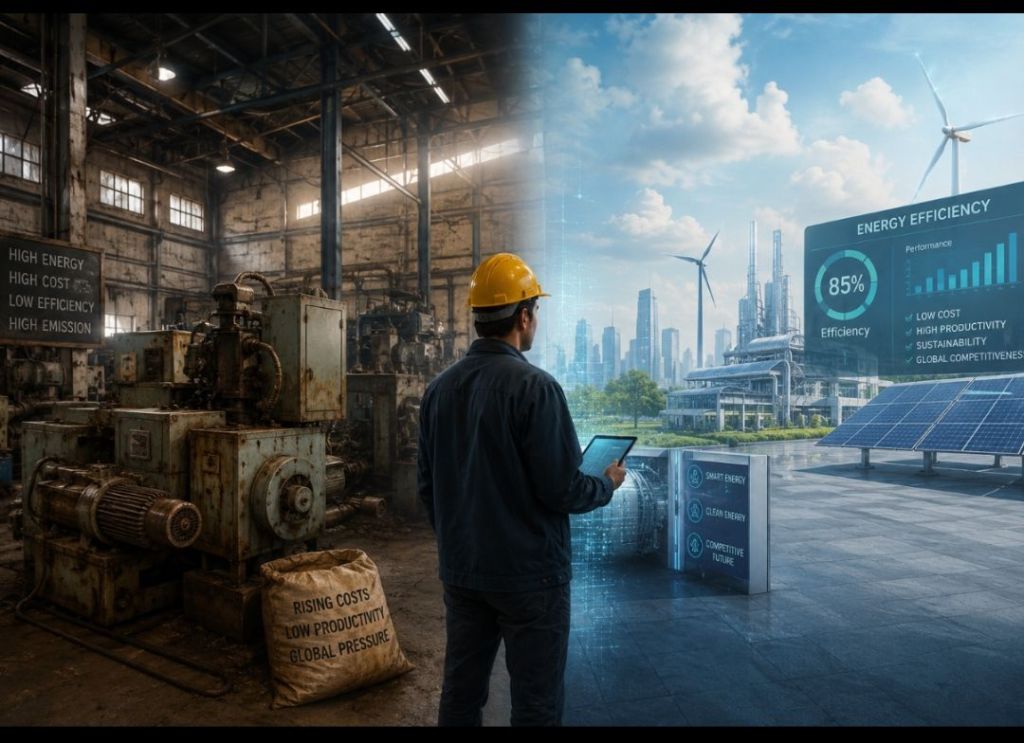
Factories Do Not Compete on Machines Alone
For much of industrial history, manufacturing competitiveness was shaped by labour costs, access to raw materials, and proximity to markets. Energy was important, but it was often treated as a background utility rather than a strategic resource. That assumption is rapidly becoming outdated. Across the world, energy is emerging as one of the most decisive factors determining which industries grow, which survive, and which gradually disappear.
India’s manufacturing story reflects this transition. Over the past several decades, thousands of MSMEs have built businesses through entrepreneurial effort, family investments, and practical experience. Many of these enterprises continue to operate machinery that was installed years ago, sometimes decades ago. While such equipment may still function, it often consumes significantly more energy than modern alternatives. Rising power costs therefore do not simply increase expenses; they gradually erode competitiveness from within.
The Cost Nobody Notices Until It Becomes a Crisis
In many industrial clusters, discussions about productivity focus on labour, finance, or technology adoption. Energy efficiency rarely receives equal attention. Energy audits remain limited, and investments in efficiency improvements are often postponed because they are viewed as non-essential expenditures. Yet the cumulative impact can be substantial. Small increases in energy consumption multiplied across thousands of operating hours create hidden costs that weaken profit margins and reduce the ability of firms to invest in innovation.
The challenge becomes even more complex when electricity quality varies across regions. Frequent voltage fluctuations, interruptions, and inconsistent supply conditions can affect machinery performance, product quality, and maintenance costs. For large corporations these issues may be manageable. For smaller enterprises operating with limited financial buffers, they can become a recurring source of uncertainty.
The New Trade Barrier May Arrive Through Energy
A major transformation is now unfolding in global markets. Historically, exporters worried about tariffs and quotas. In the future, carbon footprints, energy efficiency, and sustainability performance may become equally important. Buyers in advanced markets are increasingly examining how products are manufactured, not merely what products cost.
This shift creates a difficult reality for energy-intensive sectors. Manufacturers that rely on inefficient production systems may find themselves facing higher compliance requirements, additional reporting obligations, and greater scrutiny from international customers. What once appeared to be a local operational issue could soon influence access to global markets.
The concern is not only environmental. It is economic. Countries and companies that produce goods using less energy may enjoy lower costs, better margins, and stronger market positioning. Those that fail to adapt may discover that competitiveness is being lost long before financial statements reveal the problem.
The Future Factory May Be Measured by Every Unit of Power Consumed
The next phase of industrial competition is likely to reward efficiency rather than scale alone. Smart energy management systems, real-time monitoring, predictive maintenance, renewable energy integration, and resource optimization may become standard features of successful manufacturing enterprises. Energy will increasingly be treated as a strategic asset rather than an unavoidable expense.
For Indian MSMEs, this transition presents both risk and opportunity. Those that modernize early could improve productivity, reduce costs, strengthen sustainability credentials, and become preferred suppliers in global value chains. Those that delay may face a growing gap between themselves and more efficient competitors.
The Real Question Is Not About Power Supply
The deeper issue is not whether electricity is available. The real question is whether industries can transform the way they consume energy. A nation can build power plants, transmission lines, and renewable capacity, but manufacturing competitiveness ultimately depends on what happens inside factories.
The future may not divide industries between large and small, or between domestic and global firms. It may divide them between those that understand energy as a strategic resource and those that continue to treat it as a routine utility. In that divide lies one of the least discussed but most significant challenges facing Indian manufacturing in the coming decades.
#EnergyEfficiency #ManufacturingCompetitiveness #MSMEs #IndustrialTransformation #SustainableManufacturing #CarbonCompliance #IndustrialProductivity #EnergyManagement #ExportCompetitiveness #FutureOfManufacturing


Leave a Reply