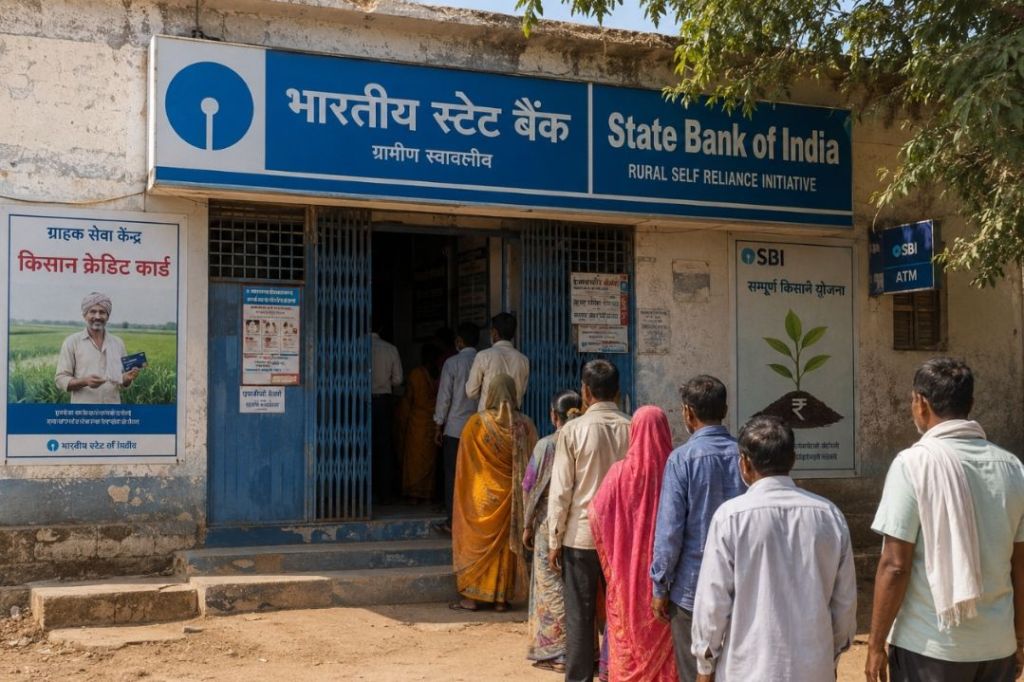
India’s banking system is once again being asked to play the role of economic rescuer. The recent direction to Public Sector Banks to prepare scalable lighthouse initiatives for rural lending and informal sector financing appears positive on the surface because agriculture, small enterprises, street vendors, artisans, and rural entrepreneurs continue to face severe credit shortages. Yet beneath the policy optimism lies a much deeper structural question. Is India genuinely building productive rural economic ecosystems, or is the banking system repeatedly being used to compensate for the failure of broader development policy?
Historically, India’s rural banking journey has moved in cycles. Nationalisation of banks in 1969 aimed to democratise credit and reduce the domination of urban commercial interests. Regional Rural Banks, cooperative structures, priority sector lending, SHG-bank linkage programmes, Mudra loans, Jan Dhan accounts, and digital payment systems were all introduced with the promise of financial inclusion. However, despite decades of intervention, a large portion of informal economic activity still depends on informal lenders, supplier credit, family networks, and local borrowing chains. This itself reveals that institutional finance has expanded numerically but not structurally transformed the rural economy.
The current proposal asking PSBs to create replicable lending models for small and marginal borrowers reflects growing concern within the government about slowing rural demand, stress in agriculture-linked livelihoods, and stagnation in micro-enterprise productivity. Banks are being encouraged to simplify processes, improve grievance systems, and reduce transaction costs. While these measures are welcome, the deeper challenge is not merely access to credit but the absence of sustainable income generation ecosystems. Credit without market access, technology support, logistics, branding, and productivity enhancement often becomes delayed distress rather than development.
One of the biggest concerns is the increasing financialisation of poverty. Rural India today is entering a dangerous phase where formal loans are replacing informal borrowing, but income growth is not rising proportionately. This creates a silent debt trap hidden behind financial inclusion statistics. In many regions, borrowers are taking loans not for productive investment but for survival expenditure, social obligations, healthcare costs, or repayment of previous liabilities. When banking systems aggressively push lending targets without parallel strengthening of local economic productivity, NPAs simply shift from corporate balance sheets to millions of small borrowers.
The focus on MSME and informal sector lending also exposes a contradiction in India’s development strategy. Policymakers frequently celebrate startups, digital economy expansion, AI, manufacturing corridors, and large infrastructure projects, but the informal sector still contributes a massive share of employment. India’s economic structure remains dualistic. A globally visible formal economy exists alongside a vulnerable low-productivity economy surviving with weak institutional support. Banks are now being asked to bridge this divide, but banking institutions alone cannot substitute for industrial policy, local entrepreneurship development, cluster strengthening, or agricultural reforms.
There is also a geopolitical dimension hidden behind this banking push. Global inflationary pressures, West Asia tensions, energy price volatility, and possible interest-rate hikes are increasing pressure on developing economies. In such periods, governments often rely on domestic demand stimulation to maintain growth momentum. Rural lending becomes a tool not just of inclusion but of macroeconomic stabilisation. However, expanding credit during uncertain global conditions carries risks. If inflation rises and interest rates harden further, repayment stress in vulnerable sectors could intensify rapidly.
Another critical issue is whether Public Sector Banks possess the institutional capability to deeply understand informal economic realities. Traditional banking systems were designed around collateral, documentation, and stable cash-flow patterns. Informal enterprises function differently. Seasonal income, fluctuating cash cycles, lack of accounting records, family-based labour systems, and local market volatility require relationship-based financing rather than purely algorithmic lending. Excessive digitisation without human understanding may actually exclude the most vulnerable borrowers while creating the illusion of inclusion through numerical targets.
The article also indirectly highlights a larger transformation in banking itself. Banks are increasingly moving from being financial intermediaries to becoming instruments of social policy, political signalling, and economic management. This creates pressure on governance structures. Public Sector Banks are expected simultaneously to remain profitable, support welfare-linked inclusion, finance infrastructure, absorb policy shocks, and manage financial stability. Such multidimensional expectations may weaken long-term institutional efficiency if not backed by deep reforms in risk assessment, local capacity building, and accountability systems.
A particularly important concern is the absence of ecosystem thinking. Lending alone cannot revive rural and informal sectors unless supported by procurement systems, export linkages, skill development, digital literacy, storage infrastructure, logistics chains, and local industrial clustering. Countries that successfully transformed rural economies did not rely only on credit expansion. They built production ecosystems. China strengthened township enterprises. Germany empowered local manufacturing clusters. East Asian economies linked finance directly with industrial competitiveness. India still largely treats credit as an isolated intervention rather than part of a coordinated economic architecture.
The coming decade may therefore determine whether India’s rural finance expansion becomes a developmental breakthrough or a financial stress cycle. If rural lending is integrated with local value-chain development, cluster-based manufacturing, agri-processing, rural tourism, digital commerce, and decentralised industrialisation, it can generate real economic transformation. But if it becomes another target-driven expansion exercise disconnected from productivity and market realities, the country may witness growing indebtedness masked as inclusion.
The future of Indian banking may not depend only on balance sheets and interest rates. It may depend on whether finance can reconnect with the real economy of farmers, artisans, workers, women entrepreneurs, small manufacturers, and local producers. The challenge before India is not simply to lend more. The challenge is to create an economic system where borrowing genuinely leads to sustainable wealth creation rather than temporary financial survival.
#BankingReforms #RuralEconomy #MSME #FinancialInclusion #PublicSectorBanks #IndianEconomy #CreditGrowth #InformalSector #EconomicDevelopment #ClusterDevelopment


Leave a Reply