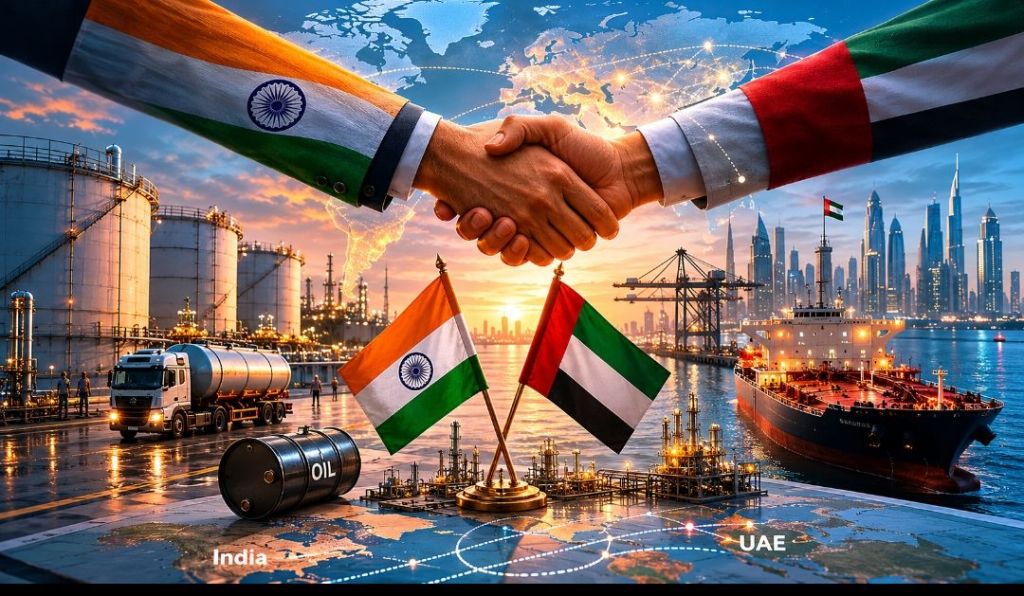
The India-UAE energy agreement is being projected as a visionary geopolitical breakthrough, but beneath the optimism lies a far more uncomfortable reality. The agreement reflects not merely cooperation but India’s growing structural anxiety about its own energy insecurity. The larger question remains unanswered: why is a country aspiring to become the world’s third-largest economy still dependent on external actors for the most critical pillar of economic survival?
India today imports nearly 85 percent of its crude oil requirement. This means every geopolitical disruption, every shipping conflict, every Strait of Hormuz tension, and every Gulf political crisis directly threatens inflation, fiscal stability, industrial production and even household consumption inside India. The UAE arrangement may reduce immediate risks, but it does not solve the core vulnerability. It merely redistributes dependency across a more diversified network. Strategic diversification is not the same as strategic sovereignty.
From Globalisation to Managed Fragility
The world is no longer moving toward deeper and smoother globalization. It is becoming more fragmented, regionalized and politically transactional. Nations are no longer building relationships based purely on economic efficiency. They are building supply chains based on political trust, military alignment and crisis resilience.
This is not a healthy evolution of globalization. It is evidence that the world economy has entered an era of managed fragility.
Energy corridors, semiconductor chains, data cables, logistics routes and payment systems are increasingly becoming geopolitical weapons. Countries are stockpiling resilience because they no longer trust the stability of the international system. Strategic partnerships in energy, shipping and logistics are therefore not simply symbols of strength. They are also signs that the global order itself is losing credibility.
India’s Strategic Contradiction
India wants to emerge as a manufacturing and economic superpower, yet its industrial architecture remains deeply energy dependent and import intensive. The contradiction is dangerous.
A country cannot sustainably become a global manufacturing hub while remaining structurally dependent on imported energy, imported semiconductors, imported technology platforms and imported critical minerals. Even if India becomes a major assembly hub, real economic sovereignty will remain weak if strategic inputs remain externally controlled.
Emergency storage reserves and offshore arrangements may create temporary stability, but reserves are temporary cushions, not permanent solutions. Strategic petroleum reserves can buy weeks or months of stability, but they cannot eliminate systemic dependence. In reality, India is attempting to insure itself against global chaos because it lacks full domestic resilience.
The Gulf Is Also Under Pressure
Another hidden dimension is that Gulf economies themselves are becoming insecure about the future. For decades, oil producers enjoyed enormous bargaining power because the world depended on them. But the energy transition, renewable technologies, electrification and climate politics are slowly weakening the long-term certainty of hydrocarbon dominance.
This explains why Gulf nations are aggressively investing in logistics, ports, AI, tourism, data infrastructure and geopolitical partnerships. They understand that oil alone may not guarantee future influence. Their engagement with India is therefore not purely strategic friendship. It is also an economic survival strategy to remain embedded in future Asian growth.
India should recognize this clearly. The relationship is mutually beneficial, but it is driven by hard economic realism from both sides.
Resilience Is Becoming the New Currency of Power
The definition of power itself is changing globally. Earlier, military size and territorial control defined strength. Now resilience defines power.
Countries capable of absorbing shocks, diversifying supply chains, maintaining stable institutions and ensuring uninterrupted access to energy, food, technology and finance will dominate the next phase of the world economy.
This is why ports, logistics corridors, digital payments, semiconductor ecosystems and energy reserves are suddenly being discussed like strategic weapons. The future battlefield may not always be fought with missiles. It may increasingly be fought through supply-chain disruption, sanctions, shipping chokepoints, cyber warfare and financial isolation.
India’s challenge is therefore far larger than signing bilateral agreements. The real challenge is building a deeply integrated domestic ecosystem capable of surviving external shocks without panic.
India’s Missing Long-Term Industrial Vision
India may emerge as a stabilizing geopolitical force, but only if it overcomes decades of policy inconsistency and fragmented industrial planning.
India still suffers from:
weak manufacturing depth
high logistics costs
energy inefficiencies
import dependence in advanced technologies
fragmented MSME supply chains
low R&D intensity
weak university-industry integration
excessive bureaucratic complexity
Without solving these structural weaknesses, India risks becoming a large consumption market rather than a truly sovereign industrial economy.
The danger is that India may celebrate diplomatic partnerships while neglecting domestic institutional capacity. Agreements can create opportunities, but only strong ecosystems convert opportunities into national power.
The Hidden Inflation Threat
Another uncomfortable truth is inflation vulnerability. Energy shocks remain one of the fastest transmitters of economic pain in India. Fuel prices influence transportation, food prices, fertilizer costs, electricity tariffs and manufacturing expenses.
Even a temporary Gulf disruption can quickly create:
rising inflation
pressure on the rupee
widening fiscal deficits
reduced household purchasing power
slowing industrial growth
This means India’s macroeconomic stability is still externally exposed despite decades of growth. A truly resilient economy should not remain so vulnerable to distant geopolitical tensions.
The Future Will Belong to Ecosystems, Not Isolated Nations
Perhaps the biggest lesson from these emerging partnerships is that no country can survive alone anymore. The future world economy will revolve around resilient ecosystems rather than isolated national economies.
However, India must ensure that participation in global networks does not become permanent strategic dependence. The goal should not merely be securing imports during crises. The goal should be creating domestic technological, industrial and energy capabilities strong enough to negotiate global partnerships from a position of confidence.
Otherwise India may become deeply connected to the world but still remain structurally vulnerable within it.
The emerging energy partnerships in the Gulf region are therefore not merely about oil storage or logistics cooperation. They are mirrors reflecting the anxieties of a fragmented world order, the fragility of modern globalization and India’s unfinished journey toward true economic sovereignty.
#India #EnergySecurity #Geopolitics #EconomicResilience #SupplyChains #Manufacturing #IndustrialPolicy #GlobalTrade #StrategicAutonomy


Leave a comment