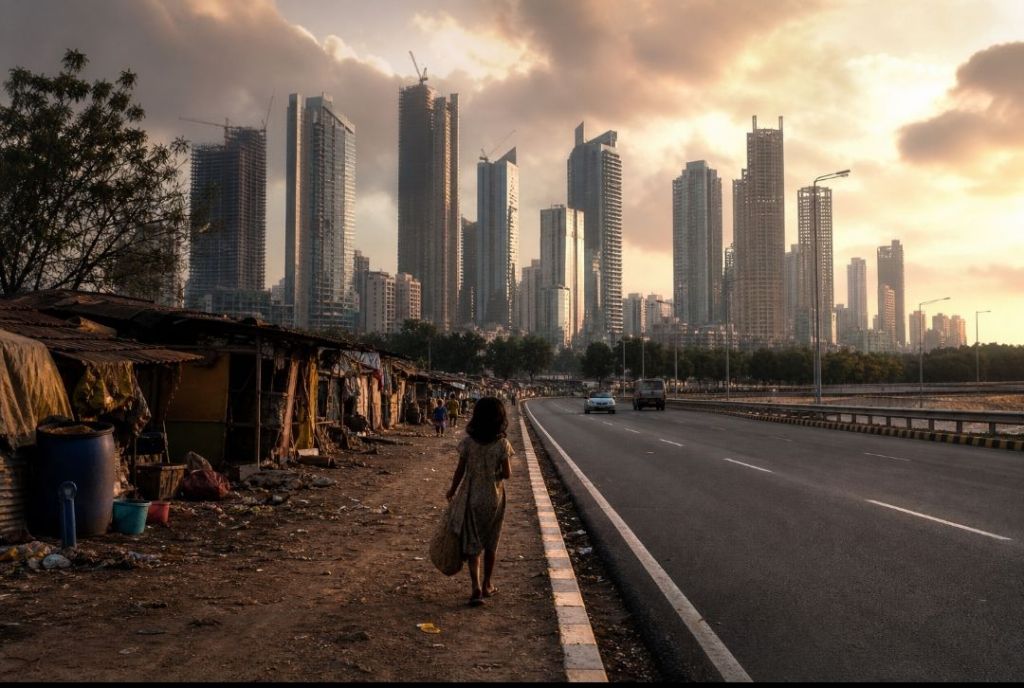
The idea of economic growth has long been celebrated as a measure of national success, rooted in post-war development thinking where rising output was assumed to naturally improve lives. Yet, over time, this assumption has begun to weaken as the lived realities of inequality, uneven access, and fragile social mobility challenge the very foundation of what growth means. Today, growth is no longer just about expanding GDP; it is increasingly judged by how widely its benefits are distributed and whether it creates a stable and cohesive society. The historical belief that growth would trickle down is giving way to a more complex understanding that without deliberate structural interventions, growth can deepen divides rather than bridge them.
India’s Expanding Economy, Uneven Outcomes and Structural Gaps
India presents a compelling but contradictory story where rapid economic expansion coexists with persistent inequality. Over the past decade, the country has made significant strides in digital inclusion through initiatives linked to platforms such as Aadhaar and financial access through programs like Pradhan Mantri Jan Dhan Yojana, bringing millions into the formal financial system. This has created a new layer of economic participation, enabling direct benefit transfers and reducing leakages. However, access does not automatically translate into economic empowerment. Income distribution remains skewed, with wealth increasingly concentrated, while a large segment of the population continues to operate within low-productivity informal structures.
The rural-urban divide continues to shape opportunity in India, not merely as a geographical distinction but as a structural imbalance in access to quality education, healthcare, infrastructure, and employment. Urban centers absorb growth and investment, while rural areas often remain dependent on agriculture and informal livelihoods with limited upward mobility. The informal sector, which employs a majority of the workforce, remains particularly vulnerable, characterized by income instability, lack of social security, and exposure to economic shocks. Even as social protection systems expand through schemes like Ayushman Bharat, their coverage and adequacy remain uneven, often failing to fully shield households from financial distress.
Global Patterns of Inequality, Social Fractures and Economic Uncertainty
The challenges observed in India are not isolated but reflect a broader global shift where inequality is emerging as a defining risk to economic and political stability. Across developed and developing economies alike, rising disparities in income and wealth are fueling social tensions and eroding trust in institutions. The global economic architecture, once driven by liberalization and integration, is now facing pressures from protectionism, identity politics, and uneven development outcomes.
Migration and demographic transitions are further reshaping labour markets, creating both opportunities and disruptions. Younger populations in developing regions seek employment in economies that are themselves grappling with automation and structural shifts. At the same time, aging populations in developed countries create demand for labour but also strain welfare systems. These opposing demographic forces are creating complex migration patterns, often leading to social and political friction.
Balancing Growth with Redistribution: Policy Dilemmas and Future Pathways
Governments across the world are increasingly confronted with the difficult task of balancing growth with redistribution. Excessive focus on redistribution without growth risks stagnation, while growth without redistribution risks instability. The policy challenge lies in designing systems that create productive employment, strengthen human capital, and ensure equitable access to opportunities. This requires moving beyond short-term welfare measures toward long-term structural reforms in education, healthcare, labour markets, and enterprise ecosystems.
In the Indian context, this also means rethinking the role of micro, small, and informal enterprises, which are central to employment but often excluded from formal growth narratives. Bridging this gap requires targeted investments in productivity, market access, and institutional support, rather than treating informality as a residual category.
The Future of Growth: From Expansion to Inclusion
Looking ahead, the future of economic growth will likely be judged less by its speed and more by its inclusiveness. Technological advancements, climate transitions, and geopolitical shifts will continue to reshape economic landscapes, but their outcomes will depend on how societies manage distributional challenges. Growth that fails to address inequality risks becoming self-limiting, as social unrest, weak demand, and institutional distrust undermine long-term stability.
The real question, therefore, is not whether economies can grow, but whether they can grow in a way that sustains dignity, opportunity, and cohesion. Inclusive growth is no longer a moral aspiration; it is an economic necessity for a stable and resilient future.
#InclusiveGrowth #Inequality #DigitalInclusion #SocialMobility #InformalEconomy #RuralUrbanDivide #EconomicPolicy #GlobalEconomy #WelfareSystems #FutureOfWork
 "Connecting communities, empowering nations: Unifying the Regional and Global Economy ."
Leave a comment