A Historical Shift from Labour Advantage to Technology Sovereignty
Electronics manufacturing has never been static. In its early phase, countries competed on low-cost labour and basic assembly, with East Asia emerging as the global factory. Over time, nations like South Korea and Taiwan moved up the value chain by investing in semiconductor fabrication, design capabilities, and deep supply chain ecosystems. Today, the world is entering a far more complex phase where manufacturing is no longer just about producing devices, but about controlling technology, data, and strategic autonomy. The shift is visible in how governments now treat electronics not merely as an industry, but as a pillar of national security and economic resilience.
Scale Without Depth
India’s electronics manufacturing story has shown impressive growth, especially in mobile phone assembly and exports. Production-linked incentives and cluster-based approaches have attracted global firms and created large-scale manufacturing capacities. However, a deeper look reveals a structural imbalance. Much of the activity remains concentrated in assembly operations, where imported components dominate the value chain. The share of domestic value addition is still relatively low, often estimated in the range of 15 to 20 percent for many electronic products. This means that while export numbers are rising, the real technological and economic gains are limited. The challenge is not growth, but depth.
Between Vision and Reality
India’s push toward semiconductor fabs and OSAT units reflects a recognition of this gap. Semiconductors are the foundation of modern electronics, from smartphones to defence systems. Yet, entering this space is not just about financial incentives. It requires decades of ecosystem building, including ultra-skilled human capital, reliable infrastructure, access to water and energy, and a strong research base. The global leaders in this sector have built capabilities over generations. India’s ambition is bold, but the risk lies in underestimating the complexity. Without parallel investment in design capabilities, R&D, and supply chain networks, fabs alone may not deliver the intended transformation.
Design and Intellectual Ownership
One of the most critical gaps in India’s electronics ecosystem is in chip design and intellectual property creation. While the country has a strong base of engineers working for global firms, much of this talent is integrated into external value chains rather than building domestic capabilities. The future of electronics manufacturing will be defined not by who assembles products, but by who designs and controls the architecture of technology. This is where India needs a strategic pivot. Building design ecosystems, supporting startups in deep tech, and linking academia with industry will be essential to move beyond contract manufacturing.
Supply Chains in a Geopolitical Era
The global electronics landscape is being reshaped by geopolitical tensions, particularly between the United States and China. Export controls, technology restrictions, and efforts to diversify supply chains are creating both risks and opportunities. Countries are no longer willing to depend on a single source for critical components. This has opened a window for nations like India to position themselves as alternative manufacturing hubs. However, this opportunity comes with conditions. Global firms are looking for reliability, policy stability, and ecosystem depth, not just cost advantages. Without addressing these factors, the shift in supply chains may remain partial.
The Cost Barrier: Why Entry is Getting Harder
Electronics manufacturing, especially in semiconductors, is becoming increasingly capital-intensive. Setting up a state-of-the-art fabrication unit can require investments of billions of dollars, with rapid technological obsolescence adding further risk. This creates a high entry barrier for new players and limits the number of countries that can realistically compete at the frontier. For India, this means that strategic prioritisation is crucial. Rather than trying to compete across the entire value chain, focusing on specific segments where the country can build competitive advantage may yield better results.
Clusters Without Ecosystems: The Structural Challenge
India’s approach to electronics manufacturing has relied heavily on creating clusters. While clusters can provide scale and infrastructure, they do not automatically create ecosystems. An ecosystem requires dense networks of suppliers, service providers, research institutions, and skilled labour. It also requires trust and collaboration among stakeholders. Many Indian clusters are still evolving toward this stage. The risk is that without ecosystem depth, clusters may remain dependent on imported inputs and external technologies, limiting their long-term sustainability.
From Manufacturing to Technology Leadership
Looking ahead, the future of electronics manufacturing will be shaped by convergence. Technologies such as artificial intelligence, advanced materials, and quantum computing will redefine the industry. The boundaries between manufacturing, design, and services will blur. Countries that succeed will be those that can integrate these elements into a cohesive strategy. For India, this means moving beyond a narrow focus on production and embracing a broader vision of technology leadership. This includes investing in education, fostering innovation, and creating policies that encourage risk-taking and long-term thinking.
The Worker Behind the Machine
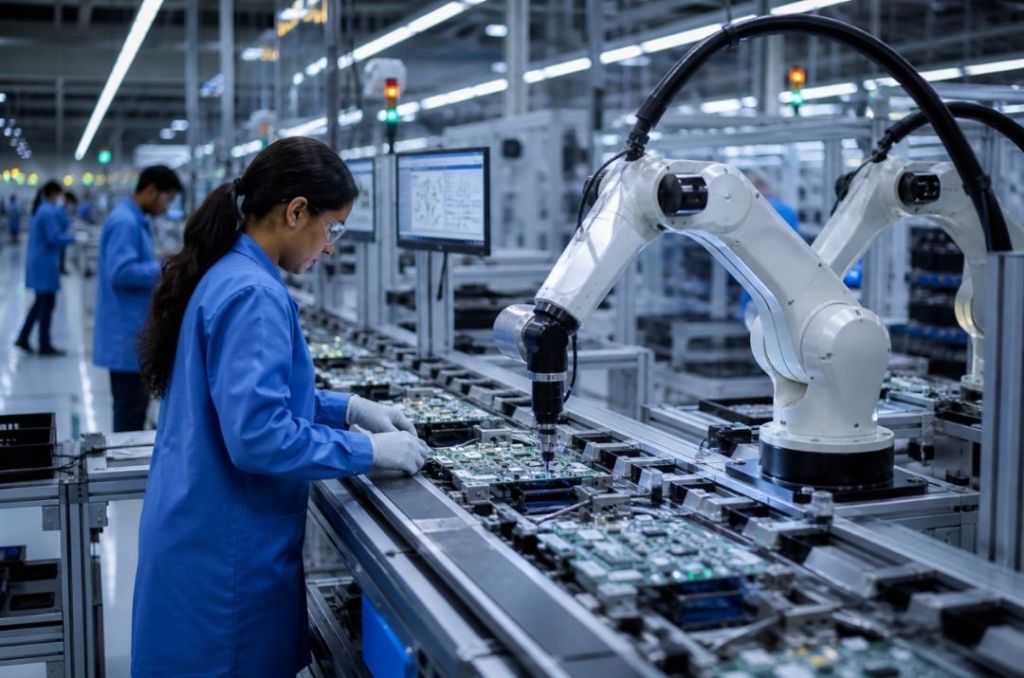
Amid all the discussions on technology and strategy, it is important to remember the human dimension. Electronics manufacturing has created millions of jobs, particularly for young workers entering the formal economy. However, as the industry moves toward automation and advanced technologies, the nature of work is changing. Skills that were relevant in assembly operations may become obsolete. This creates both a challenge and an opportunity. Investing in skill development and continuous learning will be critical to ensure that workers are not left behind in this transition.
The Real Question of Competitiveness
The transformation of electronics manufacturing is not just about building factories or increasing exports. It is about redefining competitiveness in a world where technology, geopolitics, and economics are deeply intertwined. India has made a strong start, but the journey ahead requires a shift in mindset. From scale to depth, from assembly to design, and from short-term incentives to long-term capability building. The real test will be whether the country can move from being a participant in global value chains to becoming a creator of them.
#ElectronicsManufacturing #Semiconductors #MakeInIndia #GlobalValueChains #TechSovereignty #IndustrialPolicy #MSMEClusters #InnovationEconomy #SupplyChainResilience #FutureOfWork
 "Connecting communities, empowering nations: Unifying the Regional and Global Economy ."
Leave a comment