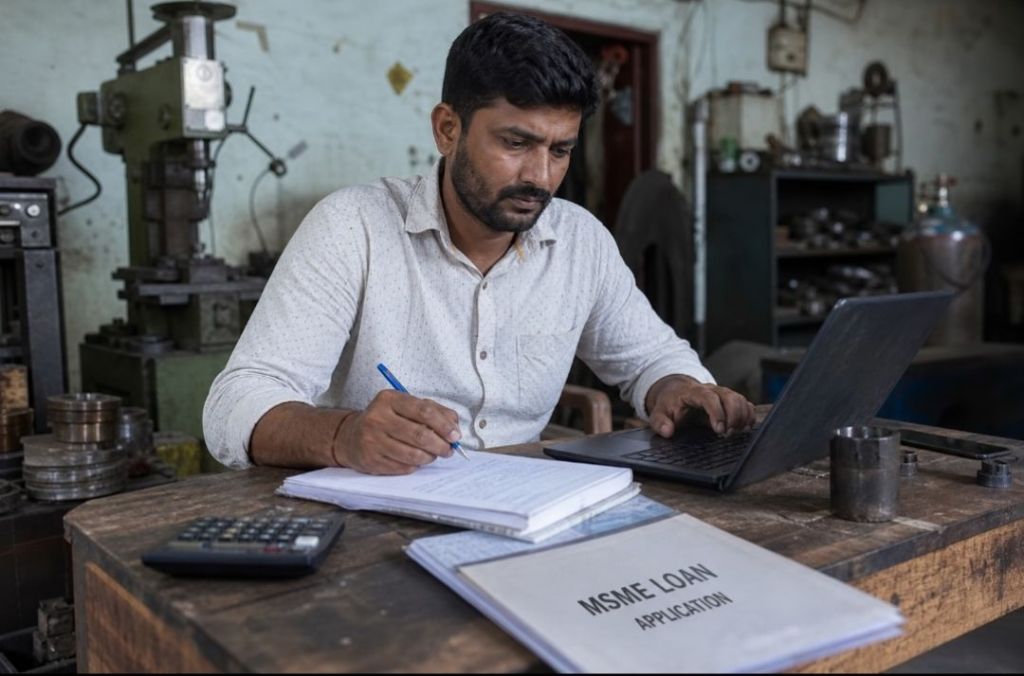
Historical Expansion but Structural Weakness
For decades, India has celebrated MSMEs as the backbone of its economy, contributing nearly 30 percent to GDP and employing over 110 million people. Yet, the story of credit to MSMEs has always been a story of intent without deep structural correction. From nationalisation of banks to priority sector lending norms, and from schemes like MUDRA to CGTMSE guarantees, the policy architecture has continuously expanded. But historically, credit systems in India have been designed for stability of banks, not for survival of small enterprises. This fundamental design bias continues to shape outcomes even today.
Credit Availability vs Real Accessibility
The Indian financial system often confuses availability of schemes with accessibility of credit. On paper, there are multiple channels: banks, NBFCs, fintech platforms, government-backed guarantees, and digital lending models. But at the ground level, a micro entrepreneur still struggles with documentation, collateral expectations, banking behaviour, and delays. The system demands GST records, formal accounts, and stable cash flows, while a large part of MSMEs operate in semi-formal or informal environments. This creates silent exclusion, where those who need credit the most remain outside the system.
The Micro Enterprise Reality
The most critical gap lies in the micro segment. These enterprises do not need large capital; they need small, timely, and flexible working capital. A street vendor, a small fabricator, a rural food processor, or an artisan cluster typically requires credit in the range of fifty thousand to a few lakh rupees. However, the system is structured for standardised loans with fixed EMIs, ignoring the irregular and seasonal nature of MSME cash flows. As a result, many micro enterprises continue to depend on informal lenders, even in an era of expanding formal finance.
Growth of Credit but Uneven Distribution
Recent data shows that MSME credit has expanded significantly, crossing tens of lakh crores in outstanding loans. However, this growth is skewed. Larger and more formalised MSMEs are capturing a disproportionate share of credit due to better documentation, digital footprints, and established banking relationships. Meanwhile, first-generation entrepreneurs, rural units, and informal enterprises continue to remain under-financed. This creates a dual structure within MSMEs themselves, where the gap between formal and informal enterprises is widening.
Credit Guarantee and Its Behavioural Limits
Credit guarantee schemes have played an important role in expanding collateral-free lending. The expansion of guarantee cover and increasing loan limits are positive steps. However, the behavioural aspect within banks remains unchanged. Many bank branches still approach MSME lending with caution and risk aversion, treating guarantee-backed loans as exceptions rather than mainstream products. Without changing the mindset and accountability of lending institutions, guarantee schemes alone cannot transform access.
Fintech Revolution: Inclusion with New Risks
The rise of fintech and NBFC-led lending has improved access, particularly for small-ticket loans. Digital cash-flow-based lending, quick approvals, and minimal documentation have made credit more accessible. However, this shift comes with its own risks. High interest rates, hidden charges, aggressive recovery mechanisms, and the risk of over-indebtedness are emerging concerns. What appears as inclusion may gradually convert into a debt trap for vulnerable enterprises.
Delayed Payments: The Hidden Credit Crisis
The most critical but often ignored issue is delayed payments. MSMEs do not just suffer from lack of credit; they suffer from lack of liquidity due to delayed receivables. Large corporations and government departments often delay payments beyond agreed timelines, forcing MSMEs to borrow for survival. This increases their cost of operations and erodes profitability. In reality, timely payments would act as the most efficient and cost-free credit system for MSMEs, but policy enforcement remains weak.
Social and Structural Exclusion
Credit access is also shaped by social realities. Women entrepreneurs, rural enterprises, artisan clusters, and socially disadvantaged groups face deeper barriers due to lack of collateral, property ownership, and formal documentation. The financial system continues to operate on assumptions of asset ownership and formal business behaviour, excluding a large segment of genuine economic activity.
The Need for Structural Redesign
India’s MSME credit system needs a fundamental redesign. Credit must move from a scheme-driven approach to a lifecycle-based approach. Micro enterprises need flexible working capital aligned with cash cycles. Small enterprises need access to invoice financing, cluster-based lending, and market-linked credit. Lending decisions must integrate cash flows, order books, digital transactions, and local business reputation rather than relying heavily on collateral.
Cluster-based financing models, where banks understand sector-specific risks and dynamics, can significantly improve credit delivery. At the same time, strict enforcement of payment timelines, especially for government and large buyers, is essential to reduce dependence on borrowing.
Futuristic Outlook: From Credit to Trust
The future of MSME finance lies not just in expanding credit but in building trust-based financial ecosystems. Digital public infrastructure, data-driven lending, and supply chain financing can reshape access, but only if designed inclusively. If current structural issues are not addressed, India risks creating a two-speed MSME economy, where a small formal segment thrives while a large informal base remains trapped in low productivity and high vulnerability.
A Human Reality Behind the Numbers
Behind every MSME is not just an enterprise but a family, a livelihood, and often a generational aspiration. When credit fails, it is not just a business failure; it becomes a social and economic setback. The real test of MSME credit policy is not how much is disbursed, but whether a small entrepreneur can access timely, fair, and respectful finance without losing dignity.
#MSMECredit #FinancialInclusion #MicroEnterprises #WorkingCapital #CreditGap #FintechLending #DelayedPayments #ClusterDevelopment #InclusiveFinance #EconomicResilience
 "Connecting communities, empowering nations: Unifying the Regional and Global Economy ."
Leave a comment