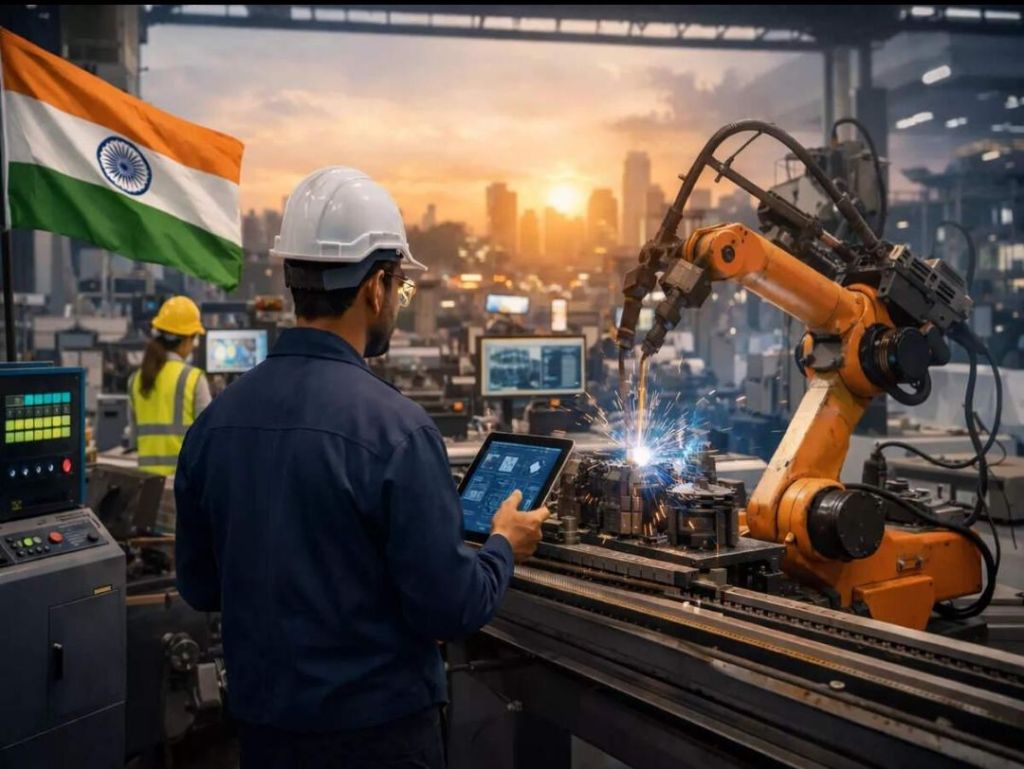
The story of defence manufacturing has quietly shifted from being a closed, state-driven activity to becoming a central pillar of industrial strategy, where national security, technological capability, export ambition, and high-skilled employment are deeply intertwined. Historically, countries treated defence production as a sovereign necessity, often insulated from market forces and innovation ecosystems. However, over the past three decades, especially after the end of the Cold War and the acceleration of globalisation, defence manufacturing has increasingly merged with civilian technology, creating what is now known as dual-use innovation systems. Today, this transition is even sharper. Defence is no longer only about protection; it is about positioning a country within the global technological and industrial hierarchy.
India’s Transition from Import Dependence to Strategic Capability
India’s journey reflects both ambition and constraint. For decades, the country remained one of the largest importers of defence equipment, relying heavily on external suppliers for critical systems, components, and technologies. This dependence was not merely a fiscal issue but a strategic vulnerability. In recent years, however, a visible shift has emerged. Policies promoting indigenisation, the development of defence corridors in states like Uttar Pradesh and Tamil Nadu, and the gradual opening of the sector to private players and startups are beginning to reshape the ecosystem. The entry of young technology firms into areas such as drones, artificial intelligence, and cyber defence indicates a deeper structural change, where innovation is no longer confined to traditional public sector units.
Yet, beneath this progress lies a persistent challenge. India continues to depend on imports for critical components such as semiconductors, advanced materials, propulsion systems, and high-end electronics. This creates a paradox. While final assembly and system integration may be happening domestically, the value chain remains externally anchored. The risk is that in times of geopolitical stress or supply disruptions, these dependencies can quickly translate into operational vulnerabilities. The challenge, therefore, is not just to produce more within India but to deepen technological sovereignty across the entire value chain.
Global Realignment and the Economics of Conflict
Globally, defence manufacturing is being reshaped by a new wave of geopolitical tensions. Conflicts in different parts of the world have led to a sharp increase in defence spending, reversing decades of relative decline in military budgets. Countries are now rethinking their supply chains, reducing dependence on adversarial or uncertain partners, and investing heavily in domestic capabilities. This has significant economic implications. Defence production is becoming a driver of industrial growth, innovation, and employment, particularly in advanced manufacturing sectors.
At the same time, access to technology is becoming more restricted. Export controls, sanctions, and strategic alliances are determining who gets access to advanced systems and who does not. Technologies such as semiconductors, artificial intelligence, space systems, and advanced weapons platforms are increasingly being controlled through geopolitical frameworks rather than market logic. This creates a fragmented global system, where technological ecosystems are divided along political lines. For countries like India, this presents both an opportunity and a risk. On one hand, supply chain realignment opens doors for new manufacturing hubs. On the other, restricted access to critical technologies can slow down capability building.
The Human Side of Defence Industrialisation
Beyond policy and strategy, there is a deeply human dimension to this transformation. Defence manufacturing is not just about machines and weapons; it is about people, skills, and aspirations. The expansion of this sector has the potential to create high-quality jobs for engineers, technicians, designers, and researchers. It can inspire a generation to engage with complex problem-solving and innovation. At the same time, it raises ethical questions about the purpose of production and the balance between security and development.
For a young engineer working in a defence startup, the sector represents an opportunity to contribute to national capability while building a career in cutting-edge technology. For policymakers, it represents a delicate balancing act between fostering growth and maintaining strategic autonomy. For society, it is a reminder that economic progress is often linked to global realities that are not always peaceful.
The Future: From Assembly to Innovation Leadership
Looking ahead, the future of defence manufacturing will depend on how effectively countries move from assembly-led growth to innovation-led leadership. For India, this means investing not only in infrastructure and production capacity but also in research and development, design capabilities, and intellectual property creation. It requires stronger linkages between academia, industry, and the defence establishment, as well as a long-term commitment to building capabilities in critical technologies.
The next phase of growth will likely be defined by convergence. Defence, space, digital technologies, and advanced manufacturing will increasingly overlap, creating new industrial ecosystems. Countries that can integrate these domains will have a significant advantage. For India, the opportunity is to position itself not just as a manufacturing base but as a hub of innovation and strategic capability.
At the same time, the risks cannot be ignored. Over-reliance on defence spending as an economic driver can create distortions, diverting resources from social sectors. Rapid militarisation can also intensify global tensions, creating a cycle that is difficult to break. Therefore, the challenge is to pursue defence industrialisation in a balanced and responsible manner, ensuring that it contributes to both security and sustainable development.
Strategy Beyond Security
Defence manufacturing today is no longer confined to the boundaries of national security. It is a reflection of a country’s industrial maturity, technological depth, and global positioning. For India, the path forward lies in converting intent into capability, and capability into competitiveness. The journey is complex, filled with structural challenges and geopolitical uncertainties, but it also holds the promise of transforming the country’s industrial landscape.
In the end, the real success of defence manufacturing will not be measured only by the strength of weapons produced, but by the strength of the ecosystem built around it—an ecosystem that empowers people, drives innovation, and positions the nation confidently in an increasingly uncertain world.
#DefenceManufacturing
#Indigenisation
#StrategicAutonomy
#SupplyChainResilience
#DualUseTechnology
#Geopolitics
#IndustrialPolicy
#InnovationEcosystem
#ExportCompetitiveness
#TechnologicalSovereignty


Leave a Reply