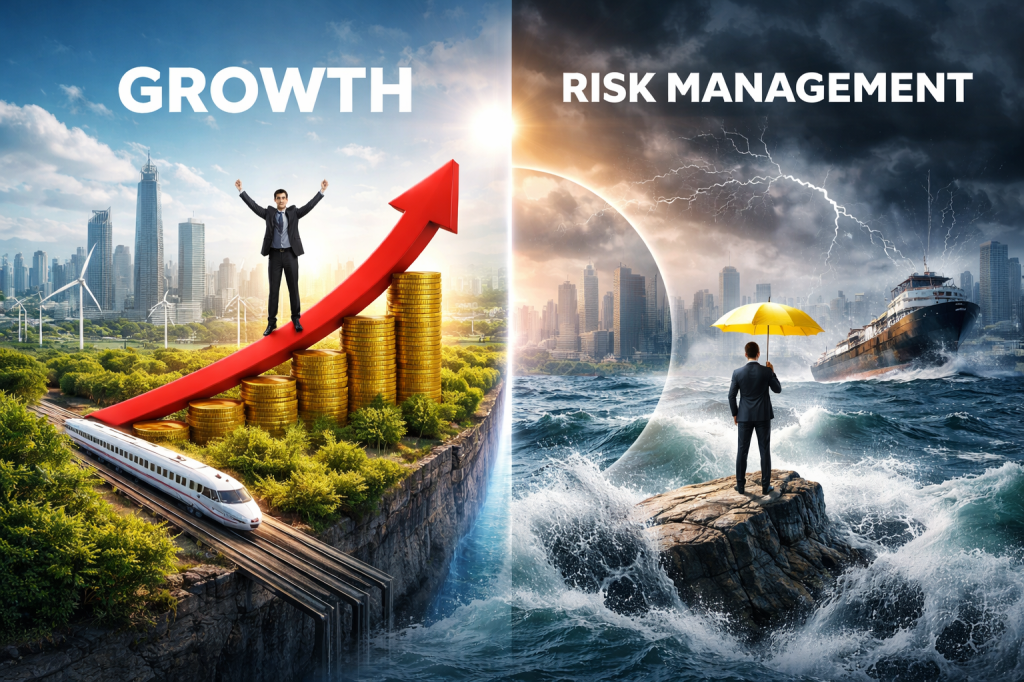
For decades, economic success was measured in terms of GDP growth rates, export performance, and industrial expansion. But the global reality has changed. Today, the real test of a nation’s strength lies in its ability to anticipate, absorb, and manage risks—whether they arise from financial crises, climate shocks, technological disruptions, or geopolitical conflicts. The idea of “insuring states” reflects this shift: countries must now function like risk managers, not just growth drivers.
India vs China: Speed vs Systemic Balance
The comparison between India and China is often framed in terms of growth rates, but the deeper difference lies in how risks are managed. China’s centralized governance allows it to act quickly—mobilizing capital, directing industries, and building infrastructure at scale. In many ways, China operates like a state-backed insurance system, where risks in one sector are absorbed and redistributed across the economy. This has enabled remarkable industrial expansion and global supply chain dominance.
India, on the other hand, functions within a democratic framework where decisions are distributed, debated, and often delayed. While this creates inefficiencies in execution, it also ensures transparency, institutional checks, and social acceptance. The real issue for India is not capability, but the absence of coordinated risk management systems, especially for MSMEs, agriculture, and employment-intensive sectors.
Yet, China’s apparent strength hides structural vulnerabilities—rising debt, demographic pressures, and opaque financial systems. India’s slower but more open system may actually provide long-term resilience, if supported by stronger institutions.
Russia vs China: Centralization Without Depth
Russia offers a cautionary contrast. Like China, it has a centralized political system, but unlike China, it has not built diversified economic structures or layered risk management mechanisms. Its heavy dependence on oil and gas exposes it to global price shocks and geopolitical sanctions.
This comparison makes one thing clear: centralized power alone does not ensure economic strength—what matters is institutional depth and diversification. China invested in ecosystems; Russia relied on resources. The outcomes are fundamentally different.
Singapore and UAE: Precision-Driven Risk Management
Smaller economies like Singapore and the UAE present a different model—highly efficient, state-driven governance with strong institutional discipline. Singapore has built a system where fiscal prudence, global integration, and long-term planning act as a comprehensive risk insurance framework. The UAE, meanwhile, has transformed oil wealth into diversified global investments, effectively hedging against future uncertainties.
These countries show that clarity of vision and institutional efficiency can substitute for political complexity, but their success is also tied to smaller populations, strategic geography, and administrative cohesion—conditions not easily replicable in large democracies like India.
The Democratic Trade-Off: Inclusion vs Efficiency
At the heart of the debate lies a fundamental trade-off. Democracies like India are designed to internalize risks—through public debate, social inclusion, and political negotiation. This makes them slower but more legitimate and stable. Non-democratic systems often externalize or suppress risks, enabling faster execution but potentially accumulating hidden fragilities.
The question, therefore, is not which system is better, but which system manages risks more sustainably over time.
The Way Forward: Building India’s Risk Architecture
India’s challenge is not to imitate China or Singapore, but to innovate within its democratic framework. This requires building a cohesive risk governance architecture—strong financial safety nets, cluster-based industrial ecosystems, responsive institutions, and effective public-private partnerships.
For MSMEs and clusters, this could mean creating sector-specific “insurance systems”—shared infrastructure, credit guarantees, market access platforms, and resilience funds that distribute risk across the ecosystem.
From Growth Models to Risk Models
The future global order will not be defined by who grows the fastest, but by who manages uncertainty the best. Countries that succeed will be those that build layered, adaptive, and transparent risk management systems—whether democratic or not.
India’s opportunity lies in turning its democratic strengths into a competitive advantage, creating a model where inclusion, transparency, and resilience come together to sustain long-term growth in an uncertain world.
#RiskGovernance #IndiaVsChina #EconomicResilience #DemocracyVsEfficiency #GlobalGrowth #MSMEClusters #PolicyReform #InstitutionalStrength #FutureEconomy #UncertaintyEconomics


Leave a Reply