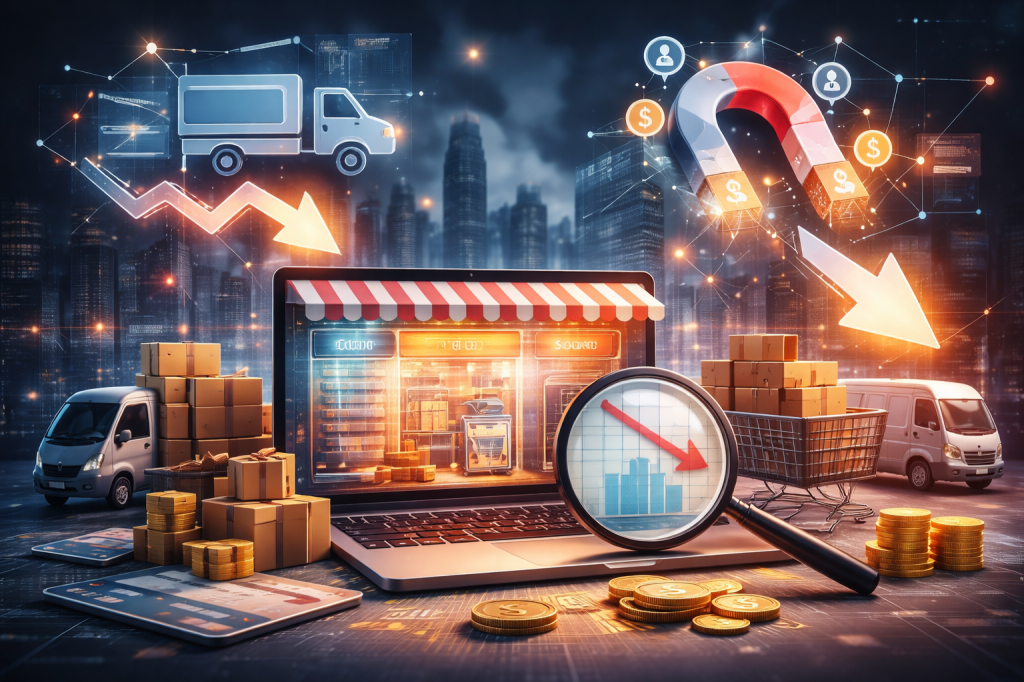
Commerce has historically been a game of margins disciplined by proximity. From traditional Indian mandis to medieval trade routes, profitability was anchored in localized demand, low customer acquisition costs, and relatively predictable logistics. The physical constraints of geography ensured that supply chains were short, trust-based, and cost-efficient. Even early retail modernisation—shopping malls and organized retail—retained a basic principle: customer acquisition was expensive but infrequent, and logistics were embedded within pricing structures. The arrival of digital commerce promised to dismantle these constraints, but in doing so, it also dismantled the very cost discipline that sustained profitability for centuries.
The Illusion of Scale: Growth Without Margin
The first decade of e-commerce expansion globally and in India was defined by a singular obsession—scale. Platforms subsidized both ends of the market: deep discounts for consumers and incentives for sellers. Venture capital and private equity funding allowed companies to operate under prolonged loss-making models, assuming that scale would eventually lead to profitability through network effects. However, the underlying arithmetic has proven stubborn. Customer acquisition costs (CAC) have risen sharply due to intense competition across platforms, digital advertising saturation, and declining marginal returns on performance marketing. Simultaneously, logistics costs—especially last-mile delivery—have remained structurally high, particularly in geographically dispersed and infrastructure-constrained markets like India. The result is a paradox: higher volumes are not translating into proportional profitability.
Logistics as the New Cost Frontier
Logistics, once considered a backend function, has emerged as the central battlefield of e-commerce economics. Unlike digital services, e-commerce is inherently a “phygital” model—combining digital interfaces with physical movement of goods. Warehousing, inventory holding, reverse logistics, and last-mile delivery together account for a significant share of operational expenditure. In India, where order values are often low and return rates in categories like fashion can exceed 25–30%, the cost per transaction escalates rapidly. Hyperlocal delivery expectations—same-day or even 10-minute deliveries—further strain unit economics. What was once a competitive differentiator has become a structural burden, raising the fundamental question: can convenience-driven logistics ever be truly profitable without passing costs back to consumers?
Customer Acquisition: The Rising Cost of Attention
If logistics represents the physical cost burden, customer acquisition reflects the digital side of the profitability challenge. The early promise of low-cost digital marketing has eroded as platforms compete aggressively for user attention. Advertising costs on major digital platforms have surged, influencer marketing has become commoditized, and brand loyalty remains fragile. Consumers, conditioned by years of discounting, exhibit low switching costs and high price sensitivity. This has transformed customer acquisition into a recurring rather than one-time cost, undermining lifetime value calculations. The more platforms chase growth, the more expensive each incremental user becomes, creating a self-reinforcing cycle of rising CAC and declining margins.
The Profitability Reset: From Growth to Discipline
The global shift in monetary conditions—higher interest rates and tighter funding environments—has forced a strategic reset in e-commerce. Investors are no longer willing to subsidize indefinite losses, pushing firms to focus on unit economics, operational efficiency, and profitability timelines. This transition is particularly visible in layoffs, cost rationalisation, reduction in discounting, and increased emphasis on private labels and higher-margin categories. In India, this shift aligns with broader economic trends where profitability and cash flow generation are regaining importance over valuation-driven growth narratives. However, the transition is neither smooth nor guaranteed; it requires a fundamental rethinking of business models rather than incremental adjustments.
The Platform Power Paradox: Control Without Profit
A critical paradox defines modern e-commerce platforms—they control vast ecosystems of data, sellers, and consumers, yet struggle to convert this control into sustainable profits. The reason lies in the inherent tension between platform neutrality and value capture. To maintain scale, platforms must keep entry barriers low for sellers and prices competitive for consumers, limiting their ability to extract higher margins. Attempts to increase commissions or reduce discounts often lead to seller dissatisfaction and customer churn. This creates a structural ceiling on profitability, raising questions about whether the current platform model is inherently flawed or simply in a prolonged transition phase.
The Emerging Future: AI, Supply Chains, and Profit Re-engineering
The future of e-commerce profitability will likely be shaped by technological and structural innovations rather than traditional scaling strategies. Artificial intelligence is expected to play a critical role in demand forecasting, inventory optimization, and personalized marketing, potentially reducing both logistics inefficiencies and customer acquisition costs. Supply chain integration—through owned logistics networks, dark stores, and localized warehousing—may help reduce delivery costs and improve margins. Additionally, the rise of direct-to-consumer (D2C) brands and social commerce models could reshape the competitive landscape by shortening value chains and enhancing customer engagement. However, these solutions come with their own capital and execution challenges, suggesting that the path to profitability remains complex.
A Structural Question: Can E-commerce Ever Be Highly Profitable?
The deeper issue is not merely operational but structural. E-commerce operates at the intersection of retail and logistics—two industries traditionally characterized by thin margins. Expecting tech-like profitability from such a model may be fundamentally unrealistic. The sector may eventually stabilize into a low-margin, high-volume business, similar to traditional retail but with higher efficiency and better consumer experience. Alternatively, profitability may concentrate in specific segments—premium products, private labels, or subscription-based services—rather than across the entire platform.
The End of Easy Growth, the Beginning of Real Economics
The current phase of e-commerce reflects a broader transition in the global economy—from liquidity-driven expansion to efficiency-driven sustainability. The era of “growth at any cost” is giving way to a more disciplined approach where profitability, resilience, and operational excellence define success. For India, with its unique combination of price-sensitive consumers, infrastructural challenges, and digital adoption, this transition will be particularly instructive. The winners will not be those who scale the fastest, but those who master the complex interplay of logistics, customer acquisition, and value creation. In that sense, the future of e-commerce may resemble its past more than its recent history—grounded in economics, not just technology.
#EcommerceEconomics #LogisticsCosts #CustomerAcquisition #UnitEconomics #DigitalRetail #PlatformEconomy #SupplyChain #ProfitabilityCrisis #D2CModels #FutureOfCommerce
 "Connecting communities, empowering nations: Unifying the Regional and Global Economy ."
Leave a comment