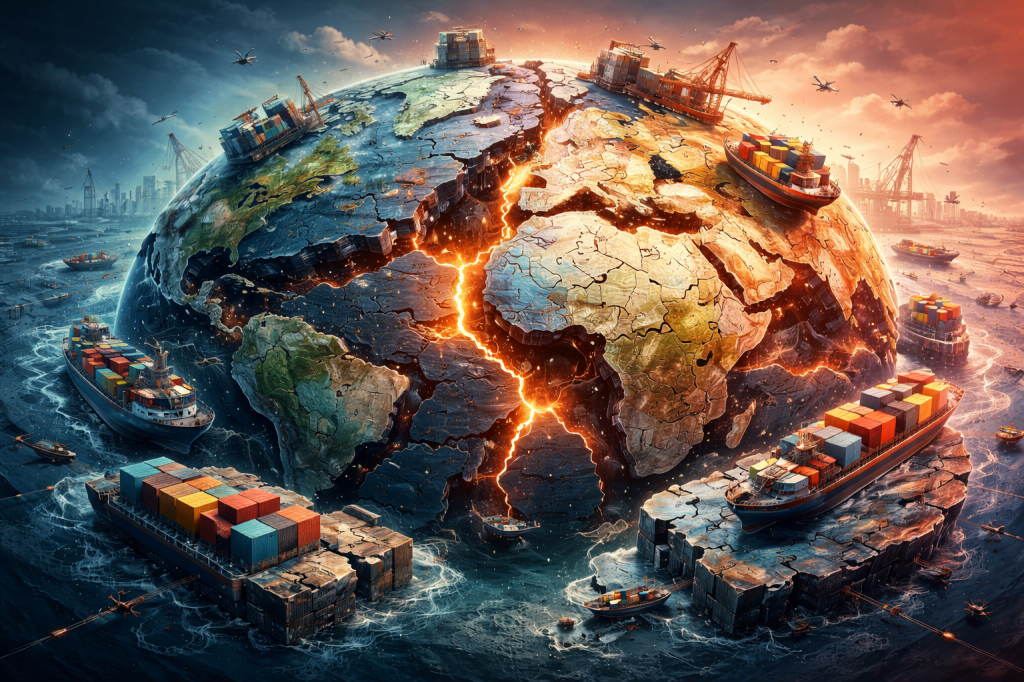
Over the past four decades, the world has become smaller in terms of communication, transportation, and information exchange. Digital platforms compress distances; logistics networks deliver goods overnight; and technologies such as AI and blockchain make cross-border collaboration seamless. However, paradoxically, global trade is becoming more distant, fragmented, and politically conditioned. This contradiction—a shrinking world but distancing trade—defines the new age of globalisation.
Historically, the fall of the Berlin Wall in 1989, the establishment of the WTO in 1995, and China’s entry into the WTO in 2001 marked the golden era of global trade. Trade as a share of global GDP rose from 39% in 1990 to 61% in 2008. But the 2008 financial crisis was the first major rupture. It was followed by the US-China trade war (2018), the pandemic (2020), the Russia–Ukraine war (2022), and the Red Sea crisis (2024–26). Each of these shocks pushed the world towards de-risking, near-shoring, and weaponisation of supply chains.
The New Age of Fragmentation
Global trade today is not slowing merely due to economics—it is slowing due to geopolitics. According to WTO data, global merchandise trade volume contracted by 1.7% in 2023 and recovered only modestly in 2024–26. However, the deeper trend is structural: the world is splitting into trade blocs.
The US relies increasingly on Mexico, Vietnam, and India rather than China.
Europe is pursuing strategic autonomy, CBAM, and strict sustainability regulations.
China is building parallel systems—BRI trade routes, digital yuan networks, and south-south partnerships.
The Global South is emerging as a major battleground for supply-chain influence.
This signals not de-globalisation but re-globalisation, where trade still happens but within trusted blocs rather than globally. The world is “shrinking” technologically but “distancing” politically.
Digital Integration vs Physical Disintegration
On one hand, technology is unifying the world:
AI cuts design-to-manufacture time by 70%.
Blockchain enables instant cross-border settlements.
Cloud and remote collaboration reduce geographic boundaries.
Yet physical trade—movement of goods—is becoming more expensive and risky due to wars, sanctions, tariffs, shipping attacks, and regulatory divergence. The Red Sea crisis increased shipping costs by 300–400% for some routes. Semiconductor supply chains remain vulnerable to Taiwan risks. Food and energy markets are constantly disrupted by geopolitical tensions.
Thus, digital globalisation is accelerating while physical globalisation is decoupling. The world is connecting in data but disconnecting in goods.
Protectionism in a Hyper-Connected World
Protectionist measures have surged globally. In 2010, there were fewer than 500 new trade-restrictive measures annually. By 2024, this number crossed 3,000, with major nations imposing tariff hikes, export controls, subsidies, and green-tech protection.
Examples include:
US tariffs of 25–50% on Chinese EVs, batteries, and solar panels.
EU’s CBAM taxing carbon-intensive imports.
India’s selective tariff hikes to promote domestic manufacturing.
China’s export controls on rare-earth minerals and gallium.
The irony is that while information flows freely, goods flow with more friction than at any time in the last 30 years.
Historical Perspective: From Globalisation 1.0 to 4.0
Globalisation 1.0 (1850–1914)
Steamships and telegraphs created the first wave of integrated trade—cut short by world wars.
Globalisation 2.0 (1950–1990)
Post-WWII reconstruction, GATT rounds, and containerisation revived global trade.
Globalisation 3.0 (1990–2008)
WTO, low tariffs, China’s rise, and just-in-time manufacturing created hyper-integration.
Globalisation 4.0 (2008–present)
Marked by fragmentation, national security concerns, and the rise of technology-infused globalisation. Trade is no longer just economics; it is strategy.
Why the World Is Shrinking Yet Trade Is Distancing
1. Security Over Efficiency
Economies are willing to pay more for “trusted supply chains.” Efficiency is no longer the sole driver; resilience and security matter.
2. Technology Reduces Dependency
Digital goods replace physical goods. Software, services, AI, digital payments, cloud infrastructure, and virtual experiences reduce the need for physical trade.
3. Rise of Nationalism and Voters’ Protectionist Preferences
Governments increasingly choose policies that protect domestic jobs.
4. Geo-Economic Weaponisation
Trade routes, commodities, critical minerals, semiconductors, and even chips design have become tools of power.
5. Environmental Regulations Split Markets
Green rules create separate markets for compliant and non-compliant nations.
The Future: Re-Globalisation, Not De-Globalisation
The world is not breaking apart; it is re-aligning.
1. New Supply Chain Corridors
India–Middle East–Europe Corridor (IMEC)
Indo-Pacific Economic Framework (IPEF)
Africa as the new manufacturing frontier
2. Friend-Shoring and Ally-Shoring
Partnerships will define trade more than price. Trust will be a trade currency.
3. Digital Trade Will Dominate
Digital trade (worth USD 5 trillion annually) will grow faster than goods trade.
4. AI Will Shorten Distance, But Increase Dependency
AI-driven manufacturing can shift production locally, but nations will compete for chips, data, and cloud infrastructure.
5. Climate Will Reshape Global Markets
Trade will be reorganized around green materials, green hydrogen, and low-carbon technologies.
What India Must Do
For India, the “distancing trade” world is an opportunity to reposition itself.
Become a trusted supply chain partner for the US, EU, and Japan.
Build capacity in electronics, rare earths, semiconductors, green tech, and digital identity solutions.
Lead Global South in trade standardization and digital public infrastructure.
Use FTAs strategically (EU, UK, EFTA) while protecting domestic MSMEs.
Invest in shipping, logistics corridors, and trade facilitation.
The next decade is India’s moment—if it navigates the fragmentation smartly.
A Smaller World, A Wider Distance
The shrinking world is not a promise of unity—it is a reminder of interdependence. As technology compresses time and space, geopolitics expands the distance between trading partners. The challenge of our era is to build bridges where the world is building walls, to design resilient supply chains, and to ensure that global trade remains a driver of shared prosperity, not a battlefield of political rivalry.
The future belongs to countries that can convert fragmentation into strategic advantage, and India is well-positioned to lead this new re-globalised order.
#GeopoliticalFragmentation
#ReGlobalisation
#SupplyChainResilience
#Protectionism
#DigitalGlobalisation
#TradeBlocEconomy
#StrategicAutonomy
#Nearshoring
#TradeSecurity
#GlobalTradeShift
 "Connecting communities, empowering nations: Unifying the Regional and Global Economy ."
Leave a comment