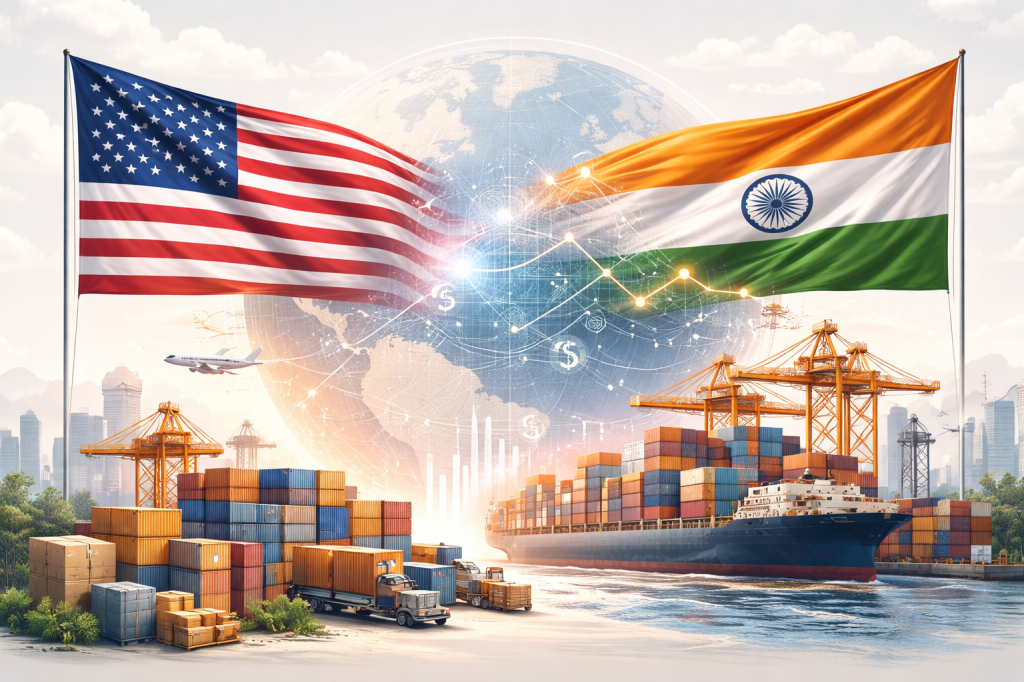
Despite dramatic headlines and political messaging, India and the United States still do not have a Free Trade Agreement (FTA) as of February 2026. What was announced between President Donald Trump and Prime Minister Narendra Modi is not an FTA but a “limited trade understanding”—a narrow, transactional arrangement designed to create short-term political and economic signaling, not a structural realignment of trade policy.
This truth matters because both countries strategically framed the announcement as a “historic deal,” even though the underlying commitments remain partial, reversible, and heavily conditional.
Historical Perspective: Decades of Talks, Minimal Outcomes
India–US trade negotiations have been trapped in a cycle for two decades:
- 2005–2015: optimism around a strategic partnership, but both sides protected sensitive sectors (agriculture for India, intellectual property and digital rules for the US).
- 2017–2020: the GSP withdrawal and rising US tariffs created friction.
- 2021–2024: geopolitical alignment improved, but tariff disputes persisted.
- 2025: talks broke down amid political accusations that India was unresponsive, which New Delhi denied.
- Early 2026: a political reset created space for the “mini-deal.”
Thus, the February 2026 announcement is not a breakthrough but a temporary easing of tension after years of tariff escalation and stalled dialogue.
What Was Actually Agreed? A Limited Tariff Relaxation
The most tangible outcome is:
- US reduced reciprocal tariffs on Indian exports from 25% to 18%.
This benefits sectors previously hurt by the Trump administration’s tariff hikes—particularly textiles, jewelry, processed foods, spices, and some labour-intensive goods.
But these tariff cuts do not apply across all sectors, and many punitive tariffs imposed earlier are still active or under review.
What India Accepted: A Supply-Chain Realignment
India’s commitments are more structural:
- A long-term purchase plan for US energy (oil, LNG, coal), agriculture, and technology.
- An expected shift away from Russian oil, redirecting supply chains towards the US and Venezuela.
- A gradual reduction of India’s tariffs and non-tariff barriers toward near-zero for certain US goods.
This is significant: India is effectively tilting parts of its energy and industrial input dependency toward Washington.
The True Strategic Insight: This Is a Geopolitical Deal Disguised as a Trade Deal
The February 2026 arrangement is not driven by pure economics. Instead, it reflects four deeper strategic realities:
1. US Wants Supply-Chain Dependability in a Fragmented World
Amid the Russia–Ukraine conflict, Middle East tensions, and tightening China rivalry, the US is realigning trade with “trusted partners.”
India’s vast market and geopolitical alignment makes it prime territory for energy and technology exports.
2. India Wants Market Access Without Sacrificing Agriculture
India has avoided a full FTA largely because:
- US demands steep opening of India’s farm sector
- India resists concessions on dairy, poultry, and grain
- Political costs in India would be severe
The “mini-deal” cleverly avoids these sensitive issues.
3. Both Countries Want to Manage China Without Saying So
Trade alignment is an indirect tool to strengthen Indo-Pacific cooperation and reduce China’s dominance in supply chains.
4. The Deal Helps Both Leaders Domestically
For President Trump, it is a “win” on tariffs and an anti-Russia energy signal.
For PM Modi, it is proof of global confidence in India ahead of key political milestones.
Real Economic Effects: Relief, Opportunity, and Risk
Short-Term Relief
Indian exporters see immediate savings on US-bound goods—critical after tariff shocks of previous years.
Medium-Term Opportunity
The reduction improves competitiveness for:
- textiles & apparel
- gems & jewelry
- spices & processed foods
- pharmaceutical intermediates
US remains India’s largest export destination, so even a partial tariff correction is meaningful.
Long-Term Risks
- Energy Dependence Shift
Moving away from Russian oil towards US supplies increases - Tariff-Free Access to India Over Time
Indian manufacturers may face tougher competition from US agricultural and industrial goods once India lowers tariffs. - Deal Is Reversible
- No Dispute Settlement Mechanism
Without an FTA framework, disputes will be settled politically, not legally.
Why There Is Still No Real FTA
A true FTA requires alignment on:
- intellectual property
- digital trade and data flows
- agriculture
- labour and environmental standards
- subsidies and industrial policy
- defence and strategic procurement
On each of these, India and the US have fundamentally divergent positions.
The February 2026 deal does not bridge these gaps—it sidesteps them.
The real truth:
This is a geopolitical balancing act dressed as a trade deal.
Futuristic Outlook: What Happens Next?
It offers immediate economic relief but embeds long-term strategic dependencies—and the real negotiation is still ahead.
1. Expect More “Mini-Deals,” Not a Mega-FTA
The world is shifting away from large FTAs toward modular, interest-based deals.
India and the US will likely adopt the same model.
2. Strategic Technology Will Move Faster Than Tariffs
AI, chips, defence technology, and supply-chain partnerships will advance much quicker than trade negotiations.
3. Conditionality Will Increase
Future US administrations may link tariff benefits to:
- India’s Russia policy
- India’s digital rules
- Data localization
- Carbon border adjustments
- Critical minerals cooperation
4. The True Long-Term Game Is Energy Security
If India ties itself too closely to US energy supplies, it may lose bargaining leverage globally.
5. The Global Trade Order Is Fragmenting
The India–US mini-deal must be seen in the context of:
- rising tariffs worldwide
- collapse of WTO dispute settlement
- weaponisation of supply chains
- energy alliances
- geopolitical blocs (Quad, I2U2, BRICS+)
This deal is one tile in a much larger mosaic of a world where economics and geopolitics are inseparable.
Conclusion: A Symbolic Reset, Not a Structural Breakthrough
The February 2026 announcement is best understood as:
✔ a political reset
✔ a partial tariff correction
✔ a shift towards US energy/technology dependence
✔ a strategic signaling tool in a multipolar world
✘ not a trade agreement
✘ not a market-opening reform
✘ not a transformative FTA
#TradeRealignment
#GeoeconomicShift
#TariffReduction
#EnergyDependence
#StrategicPartnership
#MarketAccess
#MiniTradeDeal
#SupplyChainPolitics
#USIndiaRelations
#ExportCompetitiveness
 "Connecting communities, empowering nations: Unifying the Regional and Global Economy ."
Leave a comment