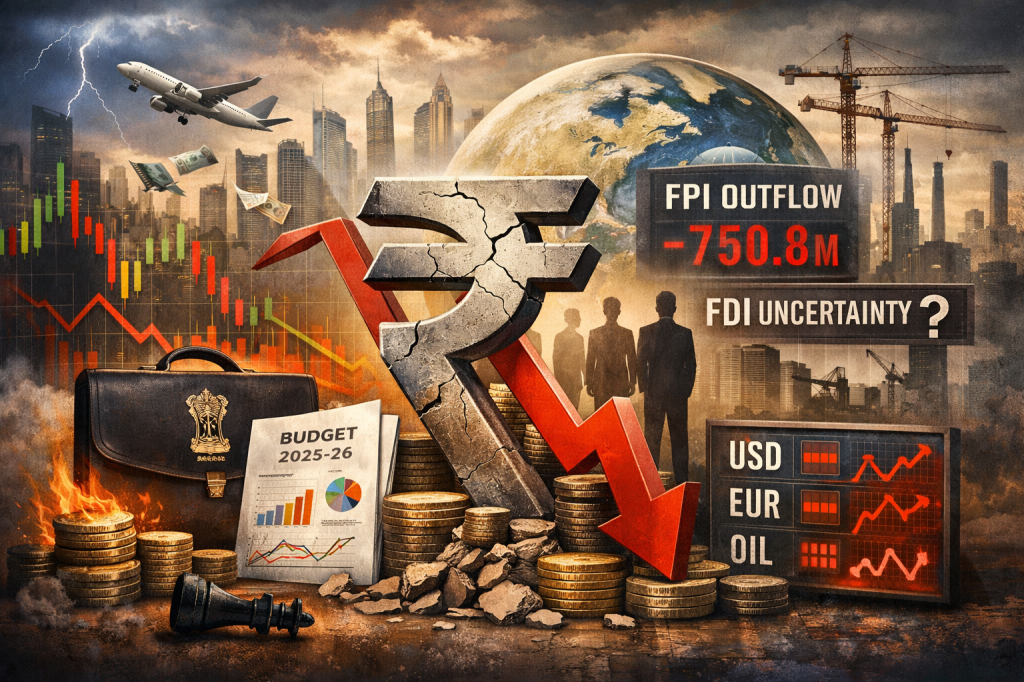
India’s Economic Survey 2025–26 presented a clear warning: the capital market is entering a structurally volatile phase, shaped by global financial fragmentation, rising protectionism, and India’s rapid domestic financialisation. Yet, the Union Budget 2025–26 largely avoided engaging with these vulnerabilities, focusing instead on borrowings, incremental financial sector reforms, and targeted sectoral incentives.
This gap has been strongly noted by critics, including former Finance Minister P. Chidambaram, who highlighted how the Budget “skirted” the Survey’s most urgent capital-market–related concerns.
Below is a critical examination of the three major issues flagged in the Survey—but not addressed in the Budget—and why they matter for India’s long-term economic and financial stability.
1. Volatile Capital Flows: The Most Important Risk No One Addressed
The Economic Survey 2025–26 was explicit: volatility in capital flows is India’s biggest external financial risk.
Despite a record ₹10.7 lakh crore raised in primary markets up to December 2025, the Survey warned that:
Global shocks
Fragmented financial systems
Rising risk premiums
Geopolitical uncertainty
are pushing India into an era of unpredictable capital inflows and sudden stops.
However, the Union Budget 2025–26 made no announcement on:
Stabilisation mechanisms for volatile flows
Capital account risk-management protocols
Counter-cyclical buffers for FPI cycles
Policies to reduce dependence on fickle portfolio inflows
Instead, the focus shifted to large market borrowings (₹11.54 lakh crore net), which may actually increase dependence on market cycles rather than insulating the economy from them.
Historical Perspective
India has repeatedly faced sharp reversals—
1997 Asian Crisis, 2008 Global Crisis, 2013 Taper Tantrum, 2020 Pandemic Shock.
The Survey’s warning echoed this history.
The Budget did not.
Futuristic Outlook
In an era of rising global fragmentation, India needs:
Macro-prudential buffers
Sovereign wealth mobilisation
Dynamic capital flow management rules
Without these, India’s markets remain exposed to a cycle of boom–bust capital availability.
2. Rupee Vulnerability: A Silent Risk Ignored in the Budget
The Survey strongly highlighted Rupee vulnerability as a structural challenge tied to capital markets.
Reasons include:
High structural import dependence (energy, electronics, critical minerals)
Currency mismatches in external borrowing
Rising global interest rates
Weakening export competitiveness despite high reserves
Yet, the Budget speech did not propose a rupee-defence strategy, nor:
Forex buffer expansion
Hedging incentives for corporates
Stabilisation funds for extreme volatility
Long-term rupee-internationalisation roadmap
This is particularly surprising, because the Survey explicitly connected rupee weakness to capital market risks, including:
stressed corporate balance sheets
higher hedging costs
reduced FPI confidence
imported inflation impacting retail investors
Historical Perspective
Even during periods of high reserves (e.g., 2009, 2017, 2022), India experienced sharp rupee depreciation phases.
Reserves alone do not ensure currency stability if capital markets are volatile.
Futuristic Outlook
A modern rupee-strategy requires:
Deepening onshore forex markets
Enabling rupee invoicing for energy and minerals
Building an Asia-wide settlement system
Creating a sovereign rupee swap facility
Without this, the currency remains India’s Achilles heel.
3. FPI Outflows and FDI Uncertainty: The Missing Structural Response
The Survey flagged a critical twin-trend:
1. Sustained FPI Outflows
2. Uncertain FDI inflows, with many global investors adopting a “wait-and-watch” posture.
This comes at a time when:
Private capex is stalled (around 30% of GFCF)
Global investment is shifting due to geopolitics
Competition from Southeast Asia is intensifying
India’s labour and regulatory reforms are incomplete
The Budget addressed only one partial aspect:
raising FDI in insurance to 100% and committing to a financial regulation review.
However, it did not directly engage with:
Why FPIs are exiting
How to revive long-term FDI pipelines
Incentives for pension funds, sovereign wealth funds, or long-horizon investors
Lowering capital-market transaction frictions
Addressing compliance unpredictability perceived by global investors
Historical Perspective
India’s capital markets have always been sensitive to:
global risk appetite
domestic policy uncertainty
episodic taxation changes
From MAT on FPIs (2015) to the LTCG change (2018), investor sentiment has often been shaped as much by policy signals as by market fundamentals.
Futuristic Outlook
India will need to:
Build a stable, predictable taxation system for FPIs
Offer long-term investment windows for foreign institutional investors
Reduce compliance costs for FDI-heavy sectors
Establish a sovereign “India Investment Dialogue Council” with global funds
Integrate the capital market strategy with industrial policy and supply chain goals
The Survey pointed to these structural issues; the Budget overlooked them.
A Budget of Continuity When the Markets Needed Strategy
The Economic Survey 2025–26 intended to spark a conversation about the new capital market risks emerging from:
global fragmentation
financial protectionism
India’s deepening exposure to global capital cycles
However, the Union Budget 2025–26 largely maintained a continuity posture, avoiding deeper systemic reforms.
In a decade where India aims to become a $10 trillion economy, capital-market resilience is not optional—it is foundational.
The missed opportunity lies not in what was budgeted, but in what remained unsaid.
India will need:
a capital-flow stabilisation framework
a long-term rupee strategy
a coherent FPI–FDI retention architecture
deeper domestic markets aligned with industrial and export strategies
predictable policy signaling
The Survey gave the roadmap. The Budget chose not to drive on it.
#CapitalMarketRisks
#VolatileCapitalFlows
#RupeeVulnerability
#FPIOutflows
#FDIUncertainty
#FinancialStability
#ExternalSectorPressure
#PolicyGaps
#Budget2025Analysis
#EconomicSurvey2026
 "Connecting communities, empowering nations: Unifying the Regional and Global Economy ."
Leave a comment