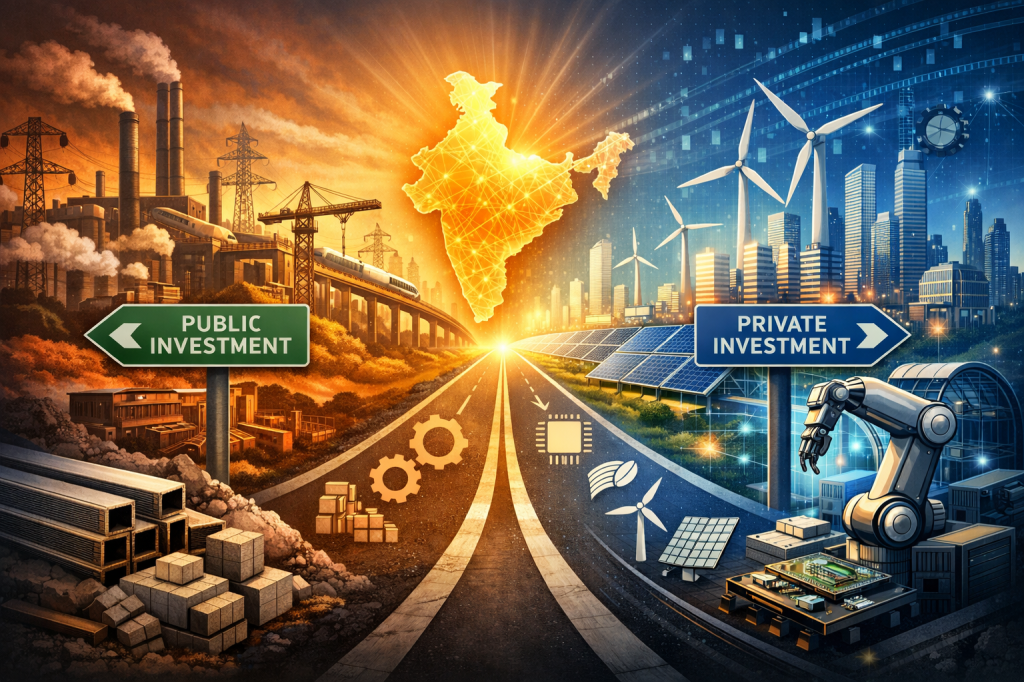
India’s manufacturing sector today stands at an inflection point, reflecting a familiar but important pattern in the country’s development journey. Industrial output growth has moderated, especially in consumer durables and export-oriented manufacturing, even as infrastructure-linked sectors such as steel, cement, and capital goods tied to public projects continue to show resilience. This divergence is not accidental; it is the outcome of how India’s investment cycle has historically evolved, and how it is being reshaped under present global and domestic constraints.
A Historical Lens on India’s Manufacturing Cycles
Historically, India’s manufacturing upswings have been closely linked to phases of public investment. From the heavy-industry push of the post-independence planning era to the infrastructure-driven growth of the 2000s, the state has repeatedly acted as the initial risk-bearer. Private investment typically follows with a lag, once demand visibility improves and balance sheets strengthen. The current phase appears to be repeating this pattern. Public capital expenditure—particularly in roads, railways, ports, energy, and urban infrastructure—continues to anchor industrial demand, providing steady orders for core industries even as consumer-facing segments slow.
Why Consumer and Export Manufacturing Are Softening
The moderation in consumer durables reflects both cyclical and structural factors. Urban demand remains uneven due to high living costs and cautious discretionary spending, while rural demand recovery is gradual and uneven across regions. Export-oriented manufacturing faces a more complex challenge: weak global demand, supply-chain realignments, and growing trade frictions are limiting order growth. India is not insulated from the broader global manufacturing slowdown, especially in goods-intensive sectors that depend on advanced economy consumption.
Public Capex as the Backbone of Industrial Stability
In contrast, infrastructure-linked sectors remain relatively strong because public capex has been maintained as a policy priority. Large government-led projects provide predictable demand, long execution timelines, and multiplier effects across steel, cement, engineering goods, and construction services. This has helped prevent a sharper industrial slowdown and has preserved employment and capacity utilisation in heavy industry. However, this strength also highlights an underlying imbalance: growth is being sustained more by fiscal impulse than by broad-based private investment confidence.
The Selective Nature of Private Investment
Private-sector capex has not disappeared; rather, it has become highly selective. Investment is flowing into areas aligned with long-term structural trends—renewables, electronics manufacturing, chemicals, logistics, and digital infrastructure. These sectors benefit from a combination of policy incentives, global supply-chain diversification, and future demand visibility. Electronics and renewables are closely linked to global decarbonisation and technology shifts, while logistics and digital infrastructure are essential enablers of efficiency across the economy. This selectivity signals rational capital allocation, but it also underscores caution: firms are investing where returns are clearer, not where demand remains uncertain.
A State-Led Cycle with Strategic Risks
The broader signal is clear: India’s investment cycle is alive, but it remains predominantly state-led rather than private-led. While this model can sustain growth in the medium term, it carries risks if private investment does not eventually broaden. Prolonged reliance on public capex can strain fiscal space and limit productivity gains if complementary private investment in manufacturing scale, innovation, and exports does not accelerate.
From State-Led to System-Led Growth
From a futuristic perspective, the challenge for India is not merely to increase investment volumes but to transition from a state-led cycle to a system-led one. This requires restoring private-sector confidence through stable policy signals, predictable trade regimes, deeper financial markets, and faster execution of reforms that reduce logistics costs and regulatory uncertainty. If public investment continues to crowd in private capital—rather than substitute for it—India’s manufacturing sector could enter a more durable expansion phase, capable of absorbing global shocks while building domestic demand and export competitiveness.
In essence, today’s mixed manufacturing signals are less a sign of weakness and more a reflection of transition. The direction of travel will depend on whether India can convert its public-investment momentum into a broad-based, private-led industrial resurgence over the coming decade.
#ManufacturingCycle
#PublicCapex
#PrivateInvestment
#InfrastructureGrowth
#ConsumerDemand
#ExportManufacturing
#IndustrialTransition
#CapexStrategy
#StateLedGrowth
#FutureIndustry
 "Connecting communities, empowering nations: Unifying the Regional and Global Economy ."
Leave a comment