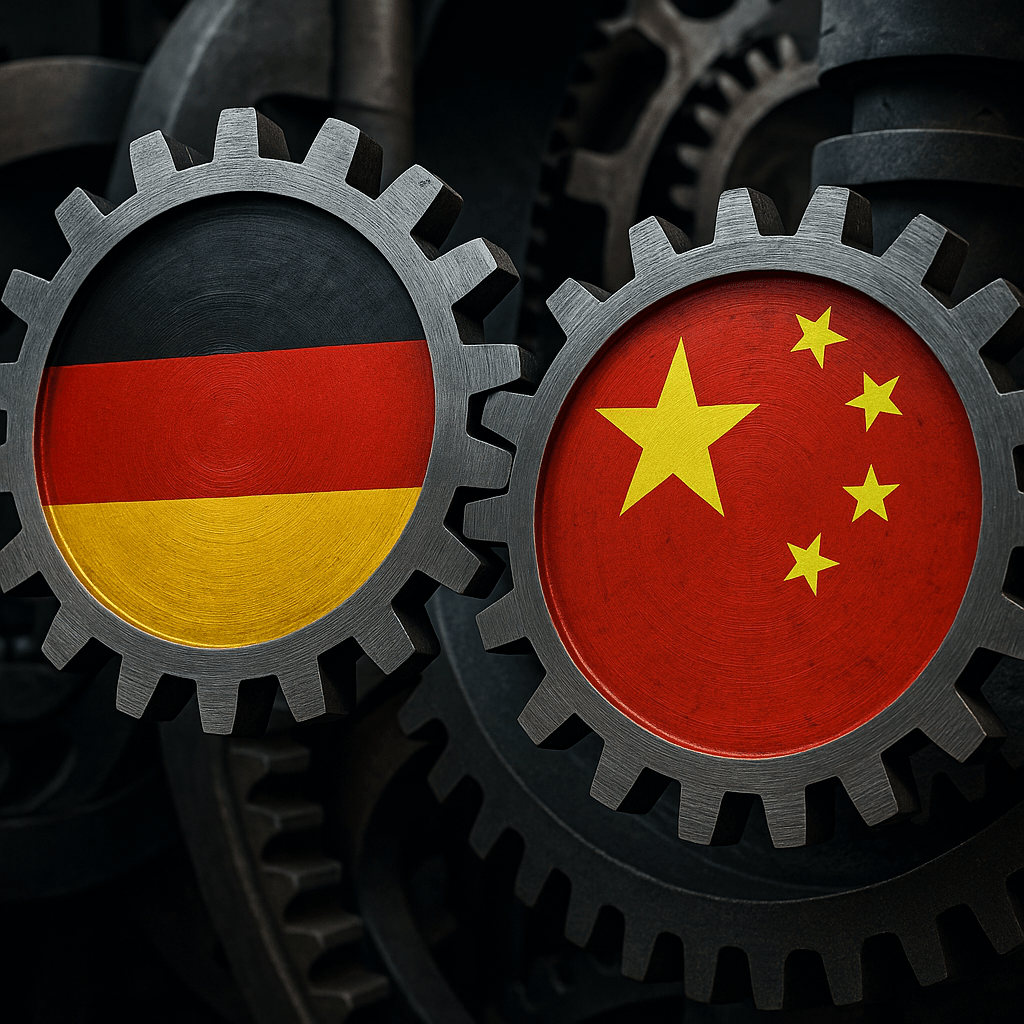
From Export Powerhouse to Competitive Crossroads
For decades, Germany stood as Europe’s industrial anchor — its machinery, automobiles, and engineering exports defining global standards of precision and reliability. The nation’s famed Mittelstand firms — small and medium industrial giants — formed the backbone of an export model built on quality, innovation, and disciplined manufacturing.
During the 2000s, when the first “China shock” hit global markets with surging low-cost exports, Germany largely escaped unscathed. Unlike the U.S. or Southern Europe, whose industries were overwhelmed by cheap Chinese goods, Germany’s specialization in high-tech capital goods and premium automobiles provided insulation. Chinese demand, in fact, became a source of growth — a lucrative market for BMW, Volkswagen, Siemens, and Bosch.
Yet, history appears to be turning full circle.
The New “China Shock”: Pressure from the Top, Not the Bottom
Today, Germany’s industrial core faces a very different kind of challenge. Chinese companies, once dependent on German machinery and technology, are now direct competitors.
The shift is not driven by low-cost manufacturing alone, but by technological convergence. Sectors like electric vehicles (EVs), machine tools, and green technologies — long Germany’s strongholds — are now being contested by advanced Chinese firms such as BYD, CATL, and NIO.
Automobiles: BYD has overtaken Volkswagen in China’s EV market, threatening the dominance of German automakers in their most important overseas market.
Machinery and industrial equipment: Firms like Sany and XCMG now rival or exceed some German exporters in emerging markets, particularly in Africa, Southeast Asia, and Latin America.
Renewable and digital tech: In solar and battery manufacturing, Germany’s once-pioneering industries have been hollowed out, with Chinese suppliers holding global cost and scale advantages.
This represents a qualitative shift in competition: no longer about cost, but capability.
Economic Reasoning: The Structural Imbalance in Europe-China Trade
The new trade dynamics expose structural vulnerabilities in Europe’s open market framework.
Chinese firms benefit from state-backed capital, subsidized energy, and protected home markets, while European firms operate under stringent environmental and competition laws.
Germany’s export-oriented growth model — designed for a world of open trade and balanced competition — is now being stress-tested by asymmetric industrial power.
This imbalance is already visible in trade data:
EU imports of Chinese electric vehicles surged 400% between 2020 and 2024.
China’s machinery exports to Europe grew 20% annually, even as German machinery exports stagnated.
Germany’s trade surplus with China turned into a deficit in 2023 — a historic reversal.
Policy Proposals: Strategic Reciprocity and Local Sourcing
In response, economists and policymakers propose a shift from naïve openness to strategic reciprocity.
One emerging idea — discussed in CEPR policy circles — suggests that European market access should be conditional on local value creation. Chinese firms could be required to form joint ventures, share technology, or source components locally to maintain a level playing field.
Such measures echo the path China itself used during its industrial rise — requiring foreign firms to partner locally to gain access to its vast domestic market.
For Europe, this would preserve critical capabilities in design, engineering, and high-value manufacturing, while still allowing global integration.
Europe at the Crossroads
The question is not simply about defending jobs but preserving technological sovereignty.
If Germany loses its competitive edge in machinery and automotive sectors — the twin pillars of its economy — the repercussions would reverberate across Europe’s economic architecture.
A decline in industrial exports could weaken the euro, erode fiscal stability, and accelerate regional inequalities.
Yet protectionism alone cannot be the answer. Europe must invest aggressively in innovation ecosystems, battery production, green hydrogen, and AI-driven manufacturing.
The real challenge is to balance openness with resilience, efficiency with security, and competition with fairness.
Redefining Industrial Europe in the Age of China
Looking ahead, Europe’s industrial future will depend on strategic adaptation, not resistance.
The “China shock” of the 2000s reshaped global supply chains; the “China shock 2.0” could redefine who leads the green and digital transformation.
Germany’s strength has always been reinvention — from post-war reconstruction to the digital shift.
Now, that same adaptability must be mobilized again, but this time under conditions of geopolitical rivalry and technological parity.
The coming decade will determine whether Germany — and by extension Europe — remains an industrial leader or becomes a technological follower.
Germany faces a technological rather than cost-based China shock.
The machinery and auto sectors are under increasing Chinese competition.
European policy must enforce reciprocity and local sourcing.
Future industrial strength will rely on innovation-led, resilient ecosystems.
#KeyWords: #ChinaShock #GermanyEconomy #IndustrialPolicy #EVMarket #TradeCompetition #EuropeanUnion #TechnologySovereignty #GreenTransition #GlobalTrade #IndustrialResilience
 "Connecting communities, empowering nations: Unifying the Regional and Global Economy ."
Leave a comment