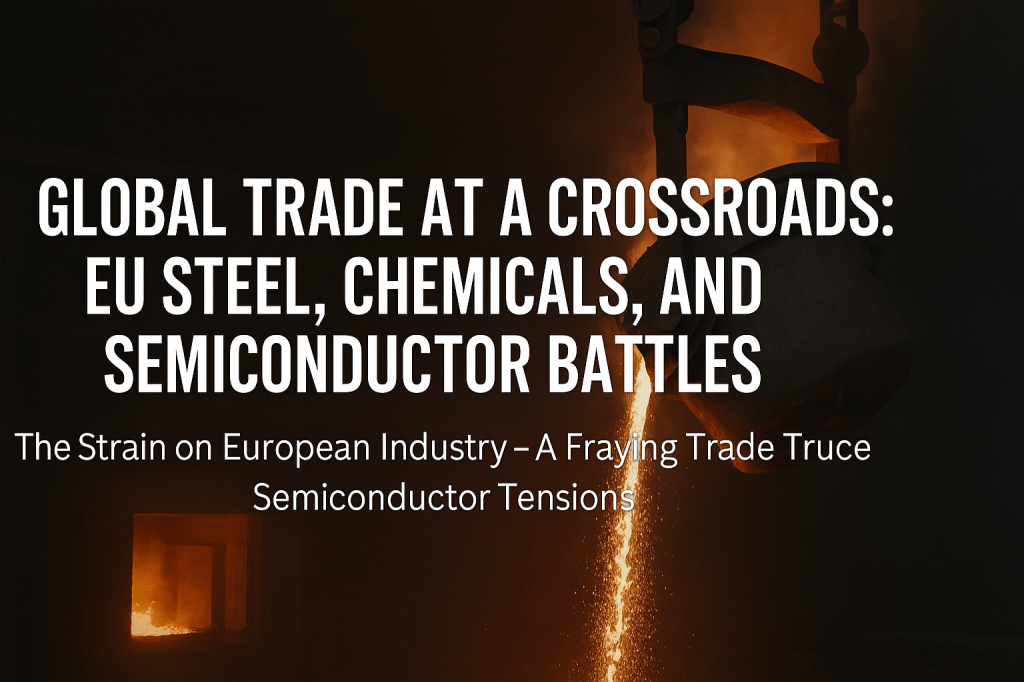
The Strain on European Industry
European heavy industries are once again on the defensive. Steelmakers such as Thyssenkrupp warn of structural collapse if the European Union does not impose stronger trade protections. Their plea echoes U.S. industrial policy, where import tariffs shield domestic producers from cheaper foreign steel. The European concern is not unfounded: global overcapacity, particularly from Asia, has squeezed margins and undermined competitiveness. Without decisive intervention, Europe risks losing not just factories, but also the high-skilled jobs and regional ecosystems tied to them.
Parallel to steel, the chemical sector faces a double shock. Already weakened by last year’s energy price surge—driven by geopolitical tensions and reduced Russian gas flows—European chemical firms must now absorb the impact of new U.S. tariffs. Washington has slapped a 15% levy on EU goods, making European exports less competitive in one of their most critical markets. The consequences are immediate: job reductions, scaled-down production, and delayed investments. Unlike luxury sectors, chemicals and steel form the backbone of countless downstream industries; their decline carries ripple effects for machinery, automotive, and construction.
A Fraying Trade Truce
The EU–U.S. trade truce, designed to stabilize transatlantic relations, is beginning to unravel. Expanded tariffs on steel-containing products, such as industrial machinery, are generating friction. European exporters, caught between rising costs and shrinking demand, face declining order books. At the same time, political backlash is growing within the bloc: policymakers find themselves under pressure to safeguard jobs without igniting a full-blown trade war with Washington. This balancing act—protection versus cooperation—defines the EU’s current dilemma.
Semiconductor Tensions: A U.S.–China Flashpoint
While Europe struggles with industrial tariffs, another fault line is widening across the Pacific. The U.S. has tightened export controls on semiconductors, revoking Taiwan Semiconductor Manufacturing Company’s (TSMC) license to sell chipmaking tools to China without special approval. Effective from the end of 2025, this policy signals Washington’s determination to curtail Beijing’s technological ascent in advanced computing.
Semiconductors are no longer just an economic product; they are a strategic resource. By limiting China’s access, the U.S. aims to secure its technological lead and protect its security interests. Yet this move carries risks: it may accelerate China’s drive toward self-sufficiency, potentially leading to a bifurcated global tech ecosystem. Meanwhile, companies like TSMC, caught in the middle, must navigate conflicting demands from their largest markets.
Takeaways
1. Europe’s Vulnerability: Heavy industries like steel and chemicals are exposed not only to global competition but also to energy shocks and trade disputes. Without protective measures, deindustrialization could accelerate.
2. Geopolitical Fragility: The EU–U.S. partnership, though historically strong, is increasingly transactional. Tariffs reveal fault lines that could complicate broader cooperation on climate, defense, and technology.
3. Semiconductors as Strategic Assets: The U.S.–China struggle underscores a broader truth: control over advanced technologies is as much about national security as economic growth.
4. Global Ripple Effects: These disputes are not isolated. The decline of European steel or chemicals reverberates across supply chains, while semiconductor restrictions reshape global innovation pathways.
The world economy is at a crossroads where trade, technology, and geopolitics intersect. For Europe, the challenge is to defend its industrial base without closing itself off. For the U.S., the task is to manage strategic competition with China while preserving alliances. For businesses, uncertainty has become the new constant—where policy decisions in Brussels, Washington, or Beijing can redefine global markets overnight. #EUTrade
#SteelIndustry
#ChemicalsSector
#USTariffs
#TradeTruce
#Deindustrialization
#GlobalSupplyChains
#SemiconductorControls
#USChinaTensions
#Geopolitics.
 "Connecting communities, empowering nations: Unifying the Regional and Global Economy ."
Leave a comment