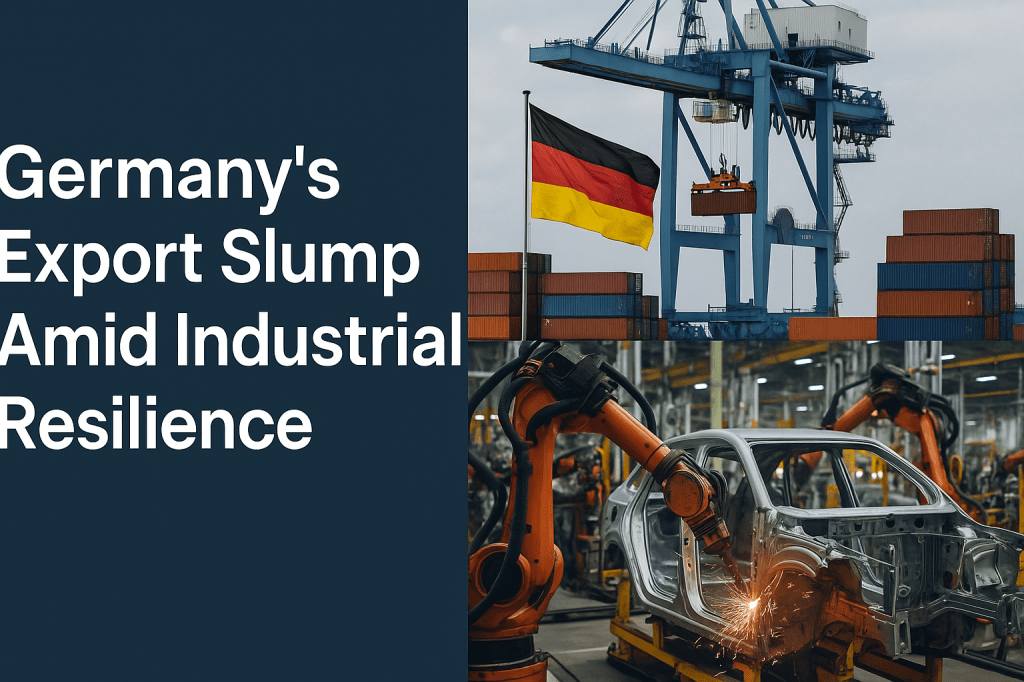
Germany’s economic pulse in July 2025 reflected a paradox: exports stumbled while industrial production showed fresh signs of life. This contrast highlights the dual pressures on Europe’s largest economy—external shocks weighing on trade and internal resilience sustaining industrial momentum.
Exports Falter Under Tariff Pressures
German exports declined 0.6% month-on-month in July, marking a clear setback for the trade-driven economy. The most striking weakness came from shipments to the United States, which dropped 7.9%—the fourth consecutive monthly contraction and the lowest level since 2021. This plunge was triggered by newly imposed U.S. tariffs, part of a broader “reciprocal” trade strategy targeting EU goods.
The tariffs, with rates up to 15% on manufactured products and even higher for strategic items such as automobiles and copper, directly hit Germany’s industrial backbone. Automakers and machinery producers, long pillars of German exports, had already accelerated deliveries earlier in the year to stay ahead of tariff deadlines. July’s slump therefore reflected both frontloaded trade and the chilling effect of new duties.
Germany’s trade relationship with the U.S. is crucial, as the U.S. ranks among its largest non-EU markets. Yet the weakness was not confined to America: exports to China fell 7.3% and to Russia by 12.4%, underscoring the fragility of global demand. By contrast, intra-EU trade provided a modest cushion, with exports to EU partners rising 2.5%, helping offset part of the global shortfall.
Industrial Production: A Tentative Rebound
While exports faltered, domestic industry surprised on the upside. Industrial production rose 1.3% in July, the first clear rebound after months of stagnation. Growth was strongest in machinery (+9.5%), pharmaceuticals (+8.4%), and the automotive sector (+2.3%). This suggests that German firms found support from domestic and intra-EU markets, or adjusted inventories to stabilize output.
Energy production declined, tempering the overall gain, but the figures still signal resilience in Germany’s industrial base. Analysts caution, however, that this uptick may not yet mark a sustained recovery. With tariffs clouding the export outlook and global demand uncertain, the rebound could prove cyclical rather than structural.
What This Means for Germany and the EU
The juxtaposition of shrinking exports and expanding output reveals the complexity of Germany’s current economic landscape:
External shocks dominate risk: Tariffs from the U.S. and soft demand from China and Russia expose German exporters to persistent headwinds.
Domestic and EU markets act as buffers: Rising shipments within the EU and steady local demand have prevented a sharper contraction.
Industry adapts—at least temporarily: Production gains suggest firms are rebalancing toward markets less affected by tariffs, though whether this can continue depends on policy stability and consumer demand.
The policy context also matters. The U.S. strategy of tariff escalation—framed as protecting domestic industries—has far-reaching consequences for Germany and the EU. It not only constrains export growth but also challenges the EU’s broader trade strategy. For Germany, heavily reliant on its export engine, this may prompt a greater emphasis on domestic investment, innovation, and EU-level integration to reduce vulnerability.
Outlook: Balancing Fragility and Resilience
Looking ahead, Germany faces a tightrope walk. Exports will remain sensitive to trade policy shifts, particularly in Washington. At the same time, industrial resilience, if reinforced by targeted domestic policies and EU solidarity, could provide a pathway to stability.
July’s data suggests that Germany’s economy is not collapsing under external pressures—but nor is it immune. The future will hinge on whether industrial momentum can outlast global headwinds, and whether policymakers can craft strategies that safeguard Europe’s industrial heart from further trade disruptions. #GermanyEconomy
#ExportSlump
#IndustrialResilience
#USTariffs
#GlobalTrade
#GermanManufacturing
#EUTrade
#EconomicOutlook
#IndustrialProduction
#TradePolicy.
 "Connecting communities, empowering nations: Unifying the Regional and Global Economy ."
Leave a comment