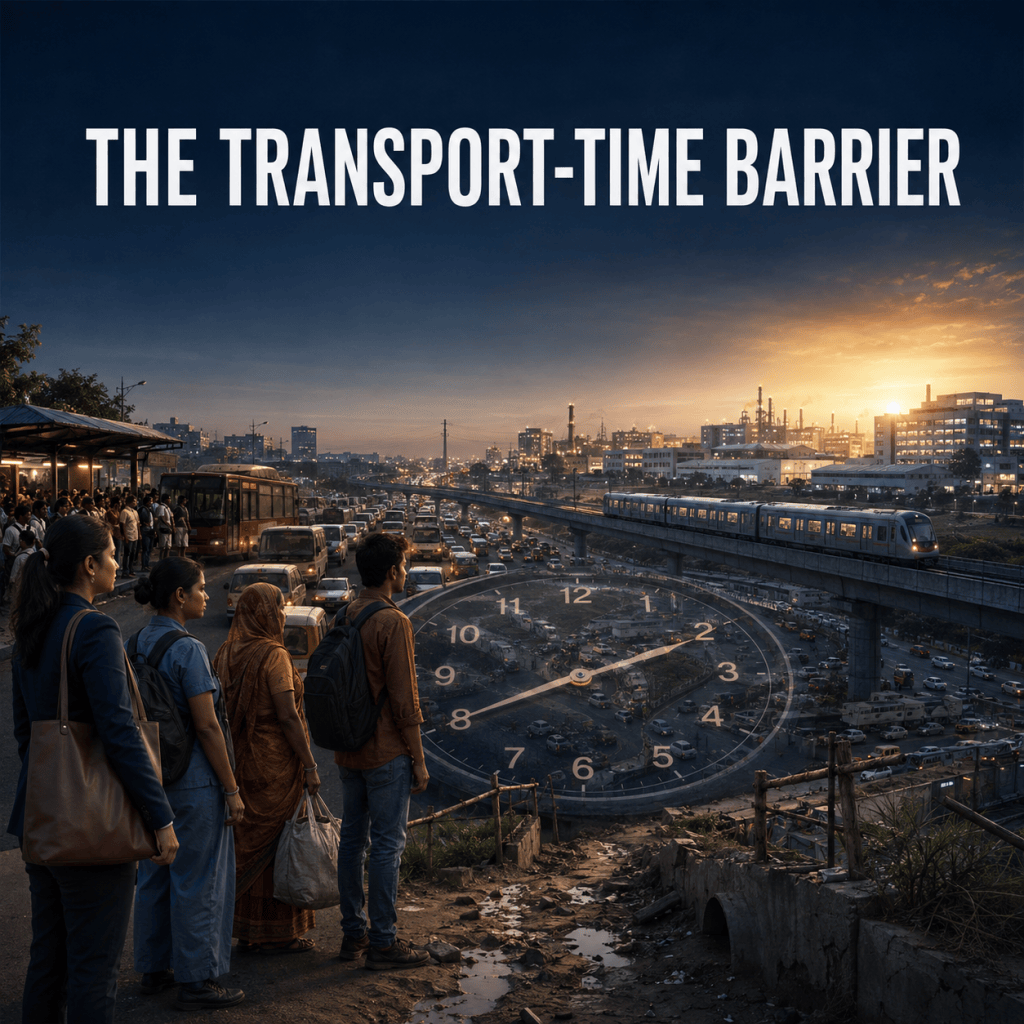
A job located 15 kilometres away may appear close on a map. But if reaching it requires walking to an unsafe bus stop, waiting for an uncertain service, changing vehicles twice and paying a large part of the daily wage in fares, that job is economically much farther away.
This is the Transport-Time Barrier. It emerges when employment and workers exist in the same city but remain separated by time, cost, safety and unreliable connectivity. Governments may count kilometres of roads, numbers of buses and length of metro lines, yet workers experience transport through a different measurement: how much of life must be surrendered simply to reach work.
Transport time is therefore not only a mobility issue. It is an employment barrier, a hidden wage deduction, a gender constraint and a productivity loss.
From the Industrial Township to the Expanding Metropolis
Historically, factories were often built close to worker settlements. Industrial townships such as Jamshedpur, Bhilai and Rourkela combined production, housing and basic services within a relatively concentrated area. The model had many limitations, but it recognised a fundamental economic relationship: workers must be able to reach the workplace.
Later, Indian cities expanded outward. Industries moved towards peripheral estates, logistics corridors and special economic zones, while affordable housing moved even farther away. Offices, malls, warehouses, hospitals and service centres appeared along highways and urban edges. Land-use planning and transport planning rarely moved together.
The city became larger, but economic opportunity did not become equally accessible.
A metro line may connect major commercial centres while the factory worker, security guard, nurse, delivery worker or domestic worker still depends on an unreliable bus, shared vehicle or long walk for the first and last part of the journey. The most modern transport system can therefore operate beside a deeply unequal mobility system.
The Commute as an Unpaid Extension of Work
A worker employed for eight hours may spend another three hours travelling. In practical terms, that person is giving eleven hours to employment but being paid for only eight. Transport expenses reduce the effective wage further.
For a well-paid professional, a long commute may be unpleasant. For a low-income worker, it may make employment financially irrational. If wages rise by ₹2,000 but additional travel costs ₹1,500 and consumes several more hours every month, the apparent promotion may produce almost no real improvement.
This is why workers sometimes reject jobs even during unemployment. It is easy to describe such decisions as lack of willingness, but the calculation may be entirely rational. A distant job can mean higher fares, irregular arrival, wage deductions for lateness, physical exhaustion and less time for childcare or household responsibilities.
The labour market generally records the offered wage. It rarely records the time-adjusted wage after travel.
Women Face a Smaller Economic Map
The Transport-Time Barrier is particularly severe for women. Their employment choices are frequently limited not only by qualifications and wages but also by whether the journey is safe, affordable and possible within family responsibilities.
In a Mumbai mobility study, 39 per cent of employed women reported walking as their main commuting mode in 2019, while another 32 per cent relied primarily on rail or public buses. Women were much less likely than men to use cars or two-wheelers. The same research found that women’s journeys were also more closely connected with shopping, childcare and school-related responsibilities. These patterns show that women are not simply travelling between home and work; many are managing several destinations within one constrained day. World Bank gender, transport and employment study
When transport is unreliable, the first opportunity sacrificed may be women’s paid employment. A woman may decline an evening shift because the return journey is unsafe. She may choose a nearby, lower-paid job because it allows her to collect a child from school. She may leave work entirely when commuting and care responsibilities become impossible to combine.
A Bengaluru study cited by the World Bank found that only 2 per cent of surveyed women commuters travelled after 9 p.m. This does not mean women have no interest in night-time employment. It shows how transport insecurity can quietly impose a curfew without any law being passed. World Bank analysis of women’s urban mobility
The city may legally offer equal employment opportunity while its transport system creates unequal access to that opportunity.
Peripheral Urbanisation and the Geography of Exclusion
Low-income households are increasingly pushed towards distant urban settlements because housing near employment centres is unaffordable. The worker saves on rent but pays through travel time, fares, fatigue and uncertainty.
This creates a harsh urban paradox. The people who build, clean, secure and operate the city are often forced to live farthest from its productive centres. Industrial estates struggle to recruit workers while nearby peripheral settlements experience unemployment. Employers complain about labour shortages, workers complain about the absence of jobs, and both may be correct.
International evidence suggests that in many large developing cities, fewer than 20 per cent of jobs can be reached within one hour using affordable transport. The problem is therefore not necessarily the absence of employment but the small number of opportunities that people can realistically reach. World Bank urban-mobility assessment
Informal workers face an additional disadvantage. Their workplaces and timings may change frequently. Construction workers move from site to site. Domestic workers travel between several homes. Street vendors carry goods. Security personnel and hospital staff work early or late shifts. Conventional transport systems designed around fixed office-hour journeys do not reflect these employment realities.
India Is Building Speed but Not Always Accessibility
India has invested heavily in metros, expressways, flyovers and urban infrastructure. These investments are important, but speed at the centre cannot compensate for disconnection at the edges.
A metro journey of twenty minutes has limited value if reaching the station takes forty minutes. A new industrial corridor does not automatically create inclusive employment if affordable housing, buses, walking routes and shift-based transport are missing. A smart mobility app cannot solve the problem when the service itself is infrequent.
The policy error lies in treating mobility as the movement of vehicles rather than the movement of people towards opportunity. Roads are often evaluated by traffic flow. Metro systems are evaluated by ridership. Bus systems are evaluated by fleet size. But transport should also be evaluated by the number of jobs, schools, hospitals and markets that an ordinary resident can reach safely within a reasonable time and cost.
The real unit of urban mobility should be accessible opportunity.
The Future May Deepen the Barrier
The next generation of economic activity may intensify this problem. Warehouses, data centres, advanced factories, logistics parks and fulfilment hubs are increasingly located on urban fringes where land is cheaper. Many operate continuously and require workers across multiple shifts. Affordable housing and dependable public transport often arrive much later, if at all.
Automation may reduce the total number of workers required at each facility, making employers less willing to fund dedicated transport. At the same time, the remaining jobs may become more specialised, forcing workers to travel farther to find suitable employment.
Climate change will add another layer. Heatwaves will make long walks to transport stops dangerous. Flooding will interrupt already fragile routes. Extreme weather will disproportionately affect workers who cannot work remotely and are penalised for arriving late.
Digital work will not eliminate this divide. Some professionals can avoid commuting, but cleaners, machine operators, drivers, nurses, technicians, construction workers and retail staff must remain physically present. Remote work may therefore reduce travel for privileged groups while leaving crowded and unreliable systems to those with the least bargaining power.
Transport Policy Must Become Labour-Market Policy
The solution is not merely to add more buses. India needs to connect transport planning with employment geography, housing policy, industrial development and care infrastructure.
Before approving a large industrial park, commercial centre or logistics hub, authorities should calculate how workers will reach it during every shift. Employers in concentrated industrial zones could jointly operate transport services instead of arranging fragmented company-wise fleets. Public buses should be planned around actual shift timings, including early mornings and late evenings. Safe walking routes, lighting, toilets, staffed stops and reliable last-mile services must be treated as core economic infrastructure.
Affordable rental housing near employment centres can sometimes produce greater mobility benefits than another flyover. Childcare facilities near transport nodes and workplaces can expand women’s employment radius. Integrated ticketing can reduce the financial penalty of changing between bus, metro and last-mile services.
Employers also need to recognise commuting as part of workforce strategy. High absenteeism and employee turnover may not always arise from weak worker commitment. They may reflect an impossible journey. Flexible shifts, transport allowances, predictable working hours and decentralised work locations can improve retention more effectively than repeated recruitment.
Most importantly, cities should publish accessibility maps showing how many jobs can be reached within 30, 45 and 60 minutes by different income groups, genders and modes of transport. Without such measurement, infrastructure can look impressive while exclusion remains invisible.
The Coming Labour Shortage May Actually Be a Mobility Shortage
India’s future employment crisis may not be a simple shortage of jobs or workers. It may be a shortage of workable connections between them.
A factory may have vacancies. A settlement may have unemployed youth. Women may be ready to work. Yet if the journey is unsafe, costly or consumes four hours a day, the labour market remains broken.
The Transport-Time Barrier teaches a basic but neglected lesson: an opportunity that cannot be reached is not a real opportunity.
A productive city is not one in which vehicles move fastest. It is one in which people, especially those with the fewest resources, can reach work without sacrificing safety, income, health and family life. Until transport time is recognised as an economic cost, India may continue building cities where employment expands on paper while opportunity moves steadily out of reach.
#TransportTimeBarrier #Employment #PublicTransport #UrbanIndia #WomenAtWork #InclusiveGrowth #LastMileConnectivity


Leave a comment