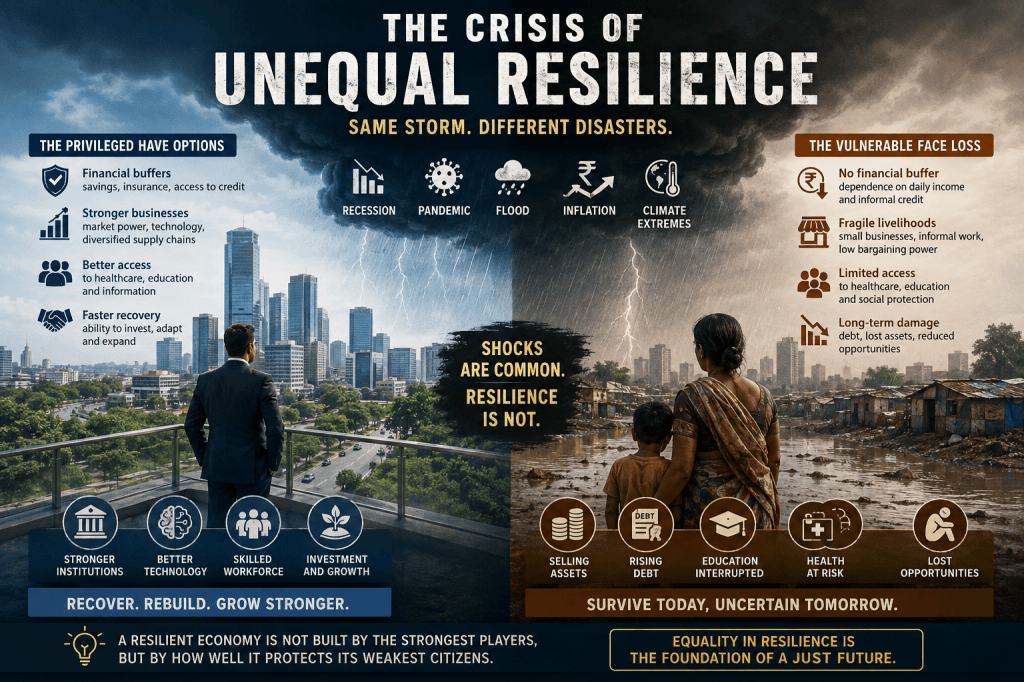
Economic shocks are usually described as if they fall equally on everyone. A recession affects the nation. A pandemic disrupts the economy. A flood damages a region. Inflation hurts consumers. This language creates the impression of shared suffering. But the storm may be common while the disaster is not.
A large company may lose profits for a few quarters and still survive. It may have cash reserves, insurance, access to banks, political influence, professional advisers and the ability to renegotiate contracts. A small enterprise facing the same disruption may lose its entire working capital, default on rent, delay wages and permanently close.
A wealthy household facing inflation may postpone a holiday, reduce luxury purchases or change its investment portfolio. A poor household facing the same inflation may reduce food consumption, avoid medical treatment, borrow from informal lenders or withdraw a child from school. The economic event is the same. The human outcome is completely different.
This is the crisis of unequal resilience. It is not only about who suffers more. It is about who can wait, who can borrow, who can negotiate and who has no option except surrender.
History Has Never Distributed Crisis Equally
Economic history is often written through national statistics. Growth declined. Production fell. Unemployment increased. Recovery began. But national averages hide the unequal social geography of every crisis.
During colonial famines, food sometimes continued to move through markets even while people starved. The problem was not always the complete absence of food. It was the collapse of purchasing power among those who needed it most. During industrial downturns, factory owners could reduce production, but workers lost wages immediately. During financial crises, institutions were often rescued because their collapse threatened the wider economy, while ordinary households were expected to absorb their losses privately.
The global financial crisis showed that losses could be socialised while recovery remained concentrated. The pandemic repeated the lesson. Many digitally connected firms expanded rapidly, while street vendors, domestic workers, small manufacturers, migrant labourers and neighbourhood businesses faced sudden income collapse.
History therefore gives us a disturbing message. Crises do not merely expose inequality. They frequently reorganise the economy in favour of those who already possess stronger financial and institutional protection.
Resilience Is Not a Personal Quality
The word resilience is often used as if survival is mainly a matter of attitude. People are advised to become adaptable, entrepreneurial and financially disciplined. Small firms are told to innovate. Workers are told to reskill. Farmers are told to diversify.
These suggestions may have value, but they can also hide the structural nature of resilience.
A person cannot save enough when wages barely cover living expenses. A migrant worker cannot work from home when employment requires physical presence. A small manufacturer cannot maintain six months of cash reserves when customers delay payments for several months. A farmer cannot diversify easily when water, credit, storage, insurance and market access are uncertain.
Resilience is built through savings, assets, insurance, public services, social networks, legal protection, affordable finance and access to reliable information. These resources are not equally distributed.
The rich are not always more resilient because they are wiser. They are more resilient because they have larger margins for error.
The poor are not always more vulnerable because they planned badly. They are vulnerable because one illness, one crop failure, one job loss or one delayed payment can destroy the balance of an entire household.
India and the Economy of Thin Margins
India’s growth story contains millions of households and enterprises operating on extremely thin margins. They are economically active but financially fragile.
A small workshop may employ ten workers and supply components to a larger company, yet it may have little bargaining power over prices or payment schedules. A street vendor may generate daily cash flow but have no formal insurance. A migrant worker may support an entire family but lack secure housing, paid leave and social protection at the place of work.
Women often carry an additional burden. During economic distress, they may lose paid work first while unpaid care responsibilities increase. Their jewellery, savings or small assets may become the household’s emergency financial buffer. Their nutrition and healthcare may be quietly reduced before other expenditure is cut.
Farmers face another form of unequal resilience. A large cultivator may absorb one season of crop loss, access formal credit or hold produce for better prices. A marginal farmer may be forced to sell immediately, borrow at high interest or dispose of livestock and equipment. The shock may last one season, but the debt may last for years.
The informal economy is often celebrated for flexibility. But flexibility without protection can become another name for insecurity. Workers can be hired quickly, but also dismissed quickly. Enterprises can enter markets easily, but they can disappear without institutional support. Informality allows the economy to adjust, but the cost of adjustment is pushed downward onto people with the least power.
The Recovery Gap Is More Dangerous Than the Shock
Public discussion usually focuses on the immediate impact of a crisis. How many jobs were lost? How much production declined? How much relief was announced?
The deeper issue is the recovery gap.
After a disruption, a large company may borrow cheaply, automate operations, acquire distressed competitors and expand into new markets. A small company may reopen with debt, reduced capacity and lost customers. A wealthy family may purchase financial assets when prices are low. A poor family may sell land, tools, jewellery or livestock merely to survive.
This means that the recovery period can deepen inequality even when the economy begins to grow again.
Two firms may experience the same fall in demand, but only one may survive long enough to benefit from the recovery. Two students may face the same school closure, but only one may have internet access, a separate room and educated parents. Two patients may face the same illness, but only one may have insurance and savings.
The crisis ends statistically before it ends socially.
Output may recover. Stock markets may rise. Corporate profits may improve. Yet household debt, learning loss, malnutrition, unemployment and business closures may continue for years.
Every Shock Can Increase Market Concentration
Economic shocks do not only destroy income. They can permanently change who controls markets.
When small firms close, their customers, workers and market share do not simply disappear. They are often absorbed by larger firms. Businesses with strong balance sheets can buy distressed assets, negotiate lower rents, attract skilled workers and expand when competitors are weak.
This produces a dangerous cycle.
The largest firms become stronger after every crisis. Smaller firms become more indebted or disappear. Suppliers lose bargaining power. Entry barriers rise. Workers face fewer employment alternatives. Consumers may initially benefit from scale and convenience, but eventually face reduced competition.
A crisis can therefore become an invisible merger process in which no formal acquisition is required. Thousands of small businesses close separately, while economic power quietly moves upward.
The future risk is not only inequality of income. It is inequality of economic survival.
If every major shock eliminates another layer of small producers, local traders, independent professionals and family enterprises, the economy may emerge more efficient in appearance but less diverse, less competitive and less democratic.
The Destruction of Productive Capacity Is Often Invisible
When a small enterprise closes, the loss is usually measured through unpaid loans, lost jobs or reduced output. But something deeper also disappears.
Years of technical knowledge may be lost. Supplier relationships may break. Skilled workers may leave the sector. Local production networks may weaken. A family may lose the confidence to start another business. A town may lose an employer that supported dozens of households.
This productive capacity cannot always be rebuilt through a new loan scheme.
Machines can be purchased again, but trust takes years to develop. Workers can be rehired, but specialised skills may have migrated. Markets can reopen, but customers may have shifted permanently to larger platforms or imported products.
Economies often underestimate the value of small productive systems until they disappear.
A closed factory is not only a failed business. It may represent the destruction of accumulated knowledge, local identity and future entrepreneurship.
Climate Change Will Make Unequal Resilience More Severe
The next generation of economic shocks may not arrive one at a time. Heatwaves, floods, droughts, disease outbreaks, energy disruptions, cyber failures and food price volatility may overlap.
Large companies may respond by relocating production, investing in backup systems, purchasing insurance and using predictive technologies. Wealthy households may move to safer neighbourhoods, install cooling systems, store water and access private healthcare.
Low-income households may remain trapped in climate-vulnerable locations because land and housing are cheaper there. Small firms may operate in flood-prone industrial areas without adequate drainage or insurance. Informal workers may lose wages during extreme heat while still facing higher electricity and food costs.
Climate resilience can therefore become a luxury product.
Safe housing, clean air, reliable water, cooling, insurance and disaster recovery may increasingly depend on income. The environmental crisis may gradually create two economies. One protected by technology and private infrastructure, and another exposed directly to every disruption.
This is not merely a climate issue. It is a question of economic citizenship.
Artificial Intelligence May Create a New Resilience Divide
Technology is often presented as a tool for managing future shocks. Artificial intelligence can improve forecasting, logistics, credit assessment, healthcare and disaster response. But access to these capabilities will not be equal.
Large firms will use data to predict demand, optimise inventories, automate decisions and detect risks before they become serious. Small firms may remain dependent on expensive digital platforms that control customer access, payments and market information.
Better technology can make powerful organisations more resilient while making weaker organisations more dependent.
A small retailer may use a digital platform to reach customers, but the platform controls visibility, data and fees. A small manufacturer may adopt digital finance, but an automated credit model may reject it during a temporary downturn. A worker may use an app to find employment, but the algorithm may reduce wages or deactivate access without meaningful explanation.
The future resilience gap may therefore be coded into technology.
Those who own data, computing capacity and digital infrastructure will not merely recover faster. They may predict the crisis, shape the market response and acquire the assets of those who fail.
Insurance for the Powerful, Uncertainty for Everyone Else
Modern economies are built around risk management. Yet risk protection remains deeply unequal.
Large corporations insure factories, cargo, machinery, credit and liability. Wealthy households insure health, property, vehicles and life. They also diversify savings across different assets.
Small firms often remain underinsured because premiums appear costly, policies are complex and claim settlement is uncertain. Informal workers may have no income protection. Farmers may be insured against specific crop losses but remain exposed to price collapse, input inflation and delayed compensation.
When formal insurance is absent, families become the insurance system. Women’s savings become emergency funds. Children leave school to support household income. Relatives provide loans. Productive assets are sold. Health expenditure is postponed.
This is a very expensive form of insurance because it protects immediate survival by destroying future opportunity.
A resilient economy should not require families to sacrifice education, nutrition and productive assets every time a shock occurs.
Welfare Must Protect Capability, Not Only Consumption
Relief programmes usually focus on immediate consumption. Food support, cash transfers and emergency subsidies are essential during crises. But they are often insufficient for preserving productive capacity.
A small business may need wage support, working capital, rent relief and protection from delayed payments. A worker may need income assistance, portable benefits and affordable housing near employment. A farmer may need debt restructuring, storage access and protection from sudden policy changes.
The objective should not only be to keep people alive during a crisis. It should be to prevent temporary disruption from becoming permanent economic decline.
This requires a shift from relief to resilience.
Relief asks how much support is needed today.
Resilience asks what must be protected so that people can recover tomorrow.
The difference is fundamental. A household receiving food support may survive, but it may still sell its tools. A business receiving a loan may reopen, but excessive debt may make future failure more likely. A worker may receive temporary cash, but without healthcare or childcare may still be unable to return to employment.
The State Is the Insurer of Last Resort
When shocks become large enough, private resilience is never sufficient. Even powerful corporations eventually depend on public infrastructure, financial stability, law, healthcare systems and emergency intervention.
The question is not whether the state should intervene. The real question is whose resilience the state protects first.
If financial institutions receive rapid liquidity while small enterprises wait months for support, the recovery will be unequal. If large infrastructure receives protection while informal settlements remain exposed, climate vulnerability will deepen. If digital systems support tax collection but not portable social security, administrative capacity will become one-sided.
Public policy often protects institutions considered systemically important. But millions of small firms, workers and farmers are also systemically important collectively, even when each appears individually replaceable.
A single small enterprise may not threaten the national economy when it closes. But the closure of hundreds of thousands of such enterprises can destroy employment, competition, skills and local demand.
Systemic importance must therefore be understood from the bottom upward, not only from the top downward.
We Need a Resilience Budget, Not Only a Growth Budget
Governments measure expenditure on roads, railways, defence, health, education and welfare. But resilience is scattered across departments and rarely measured as a unified economic objective.
A resilience budget would examine who has access to emergency savings, insurance, healthcare, digital connectivity, secure housing, credit and income protection. It would identify sectors and regions where one shock could destroy years of development.
Such a framework would assess whether MSMEs can survive three months of disruption, whether migrant workers can access benefits across states, whether urban settlements can withstand extreme heat and flooding, and whether farmers can recover without selling productive assets.
It would also measure concentration after crises. Which firms gained market share? How many small businesses disappeared? Which regions lost productive capacity? How many households increased debt or reduced education and health expenditure?
Growth figures alone cannot answer these questions.
An economy may grow rapidly while becoming increasingly unable to protect its weaker participants.
The Future May Belong to Those Who Can Survive Repeated Shocks
The old development model assumed that crises were exceptional interruptions between long periods of stability. The future may be very different.
Shocks may become recurring features of economic life. Climate events, financial volatility, technological disruption, trade conflicts and health emergencies may repeatedly test households and firms.
In such a world, success will not depend only on productivity. It will depend on the ability to absorb repeated disruption without permanent damage.
This creates a dangerous possibility. Wealth may become increasingly concentrated not only because the rich earn more, but because they can survive longer.
Those with cash reserves can wait. Those without reserves must sell.
Those with insurance can rebuild. Those without insurance must abandon.
Those with multiple sources of income can adjust. Those dependent on one job or crop can collapse.
Those with political and financial access can negotiate. Those without influence must accept whatever terms are offered.
The future economy may therefore be divided between shock absorbers and shock bearers.
Resilience Must Become a Public Good
A fair economy cannot promise that shocks will never occur. It must promise that one shock will not permanently destroy a person’s future.
Resilience should not depend entirely on private wealth. Basic financial protection, healthcare, education continuity, digital access, portable social security and disaster support must be treated as economic infrastructure.
Small enterprises require more than credit. They need fair payment systems, affordable insurance, shared technology facilities, market access and predictable regulation.
Workers require more than employment. They need income protection, healthcare, housing, childcare and opportunities to learn throughout their working lives.
Farmers require more than subsidies. They need stable markets, water security, climate information, storage, risk-sharing and stronger bargaining power.
Without these foundations, every crisis will act as a machine for transferring assets and opportunities upward.
The Real Test of an Economy
The strength of an economy should not be judged only by how fast it grows during good years. It should also be judged by who survives the bad years.
An economy is not resilient when stock markets recover while households remain indebted.
It is not resilient when large companies expand while small suppliers disappear.
It is not resilient when digital platforms grow while workers become more insecure.
It is not resilient when national income rises but millions remain one illness, one flood or one missed salary away from collapse.
The crisis of unequal resilience is ultimately a crisis of economic design. We have created systems that reward scale, assets and access, but leave vulnerability largely private.
The same storm will always produce different experiences. But it should not be allowed to produce permanently different futures.
The purpose of public policy must not simply be to restart economic growth after every crisis. It must prevent each crisis from becoming another round of economic concentration and social exclusion.
A society becomes truly resilient not when its strongest institutions remain standing, but when its weakest citizens are not forced to fall.
#UnequalResilience #EconomicInequality #MSMEs #InclusiveGrowth #SocialProtection #EconomicPolicy #ClimateResilience #FutureOfWork #IndiaEconomy #SustainableDevelopment
 "Connecting communities, empowering nations: Unifying the Regional and Global Economy ."
Leave a comment