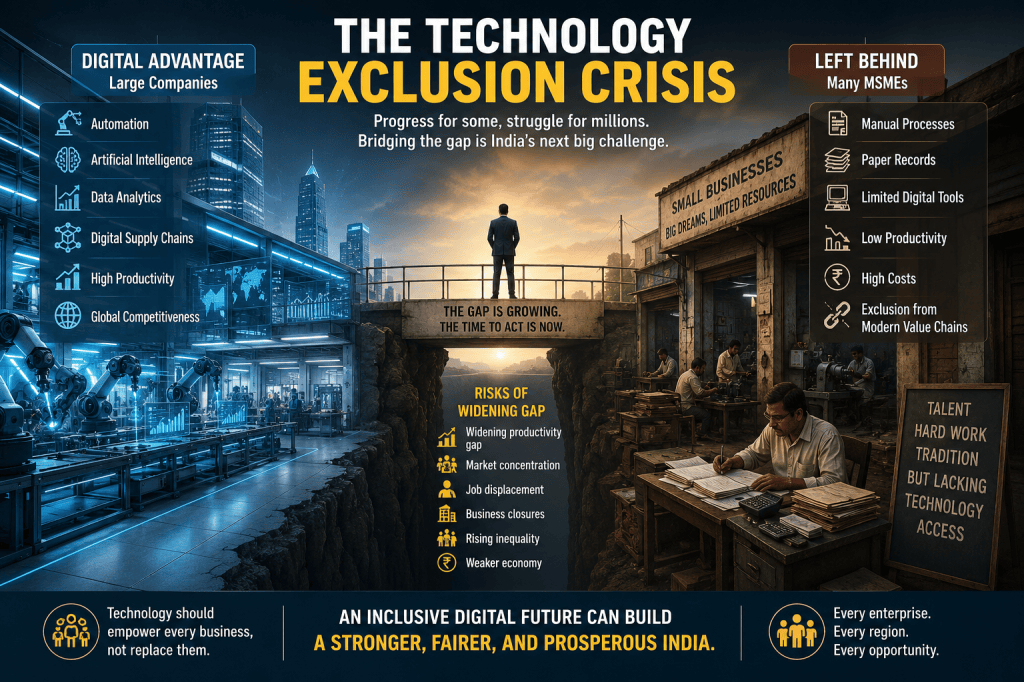
Technology has always changed the way economies grow. From the steam engine to electricity, from computers to the internet, every technological revolution has created new opportunities while making older ways of working less competitive. But history also teaches us an uncomfortable truth. Those who fail to adapt are often left behind. Today, India is entering another transformation driven by artificial intelligence, automation, robotics, cloud computing, and digital supply chains. The danger is not that technology is advancing too fast. The real danger is that millions of small businesses are unable to advance with it.
A New Divide in Indian Industry
India proudly celebrates its rise as a global digital economy. Large corporations are investing heavily in smart factories, predictive analytics, automated warehouses, and AI-driven decision making. Every new investment improves productivity, reduces costs, and increases competitiveness. At the same time, thousands of MSMEs still manage inventories on paper, depend on manual production systems, maintain handwritten accounts, and struggle to access affordable digital tools. The gap between these two worlds is becoming wider every year.
This is no longer just a technology issue. It is becoming an economic survival issue. When productivity rises rapidly in large companies but remains stagnant among smaller firms, competition becomes unequal. Small enterprises are not losing because they lack determination or skill. They are losing because they are fighting tomorrow’s battle with yesterday’s tools.
The Hidden Cost of Digital Exclusion
Technology exclusion rarely creates dramatic headlines. Factories do not close overnight. Instead, they slowly lose customers, fail to meet quality expectations, miss delivery schedules, and become less profitable. Buyers increasingly demand real-time tracking, digital quality records, automated compliance systems, and seamless integration into global supply chains. MSMEs without these capabilities gradually disappear from modern markets.
This silent exclusion weakens the entire industrial ecosystem. Suppliers shrink, local innovation slows, employment opportunities decline, and regional economies lose their competitive strength. The economy may appear technologically advanced on the surface while thousands of smaller enterprises quietly struggle underneath.
The Human Side of the Crisis
Behind every small enterprise is an entrepreneur who has spent years building relationships, creating jobs, and supporting families. Technology should empower these businesses, not replace them. Unfortunately, many business owners are not resisting change because they fear innovation. They simply cannot afford expensive software, modern machinery, skilled digital workers, or continuous technology upgrades. Many also lack access to practical guidance that can help them adopt digital solutions step by step.
Without support, technology becomes another barrier instead of becoming an opportunity.
Looking Towards 2040
If this gap continues over the next decade, India could face a future where a relatively small number of highly automated companies dominate production while millions of MSMEs struggle to survive outside modern value chains. Market concentration could increase, traditional skills may disappear, employment patterns could become more uncertain, and regional inequalities may deepen. Economic growth may continue, but its benefits could become increasingly uneven.
The future will not belong only to the companies that invent the best technology. It will belong to the countries that ensure every enterprise, regardless of size, has the opportunity to use it. Inclusive technology adoption will determine whether digital transformation becomes a bridge to shared prosperity or a wall that separates a few winners from millions of forgotten businesses.
India does not have a shortage of entrepreneurs. It has a shortage of equal access to technology. Closing this gap may become one of the most important economic reforms of the coming decade, because an economy cannot become truly digital if millions of its businesses remain disconnected from the future.
MSME #Technology #DigitalIndia #Innovation #ArtificialIntelligence #Manufacturing #EconomicGrowth #Entrepreneurship #InclusiveDevelopment #FutureOfWork


Leave a Reply