When a Home Becomes a Financial Burden
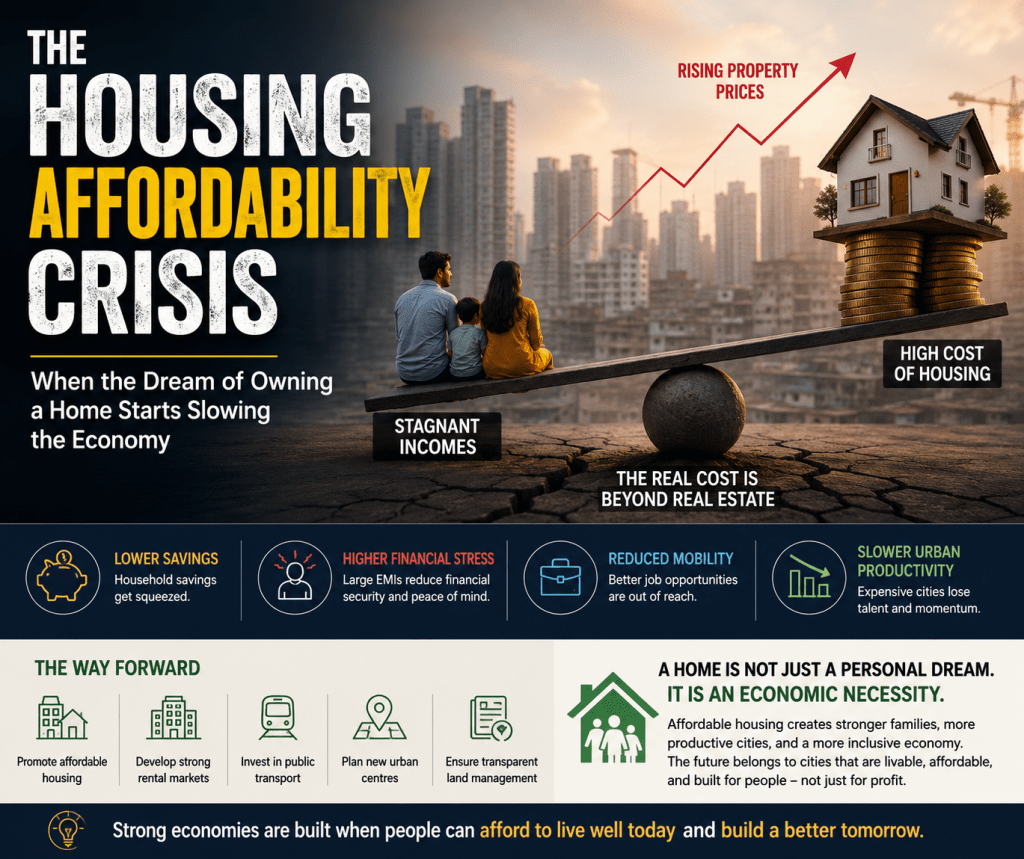
For generations, owning a home was seen as a symbol of security, stability, and progress. Today, for millions of families, it is slowly becoming a source of financial pressure. Across the world, house prices have increased much faster than incomes, turning the dream of home ownership into a distant goal for young people and middle-income households. Housing is no longer only a social issue. It has become one of the biggest economic challenges because the money locked into expensive homes is money that cannot be spent on education, healthcare, entrepreneurship, or improving quality of life. An economy cannot become truly prosperous if its citizens spend most of their income simply trying to keep a roof over their heads.
India at a Crossroads
India stands at an important stage of urban development. Every year, millions of people move to cities in search of better jobs, education, and opportunities. This migration creates enormous demand for affordable housing. However, the supply has struggled to keep pace. Urban land prices continue to rise, construction costs have increased, and housing projects often take years to complete. As a result, many families either purchase homes beyond their financial capacity or continue living in overcrowded and inadequate housing. At the same time, rental housing remains poorly developed in many cities, leaving people with limited choices and reducing labour mobility.
The Hidden Cost of Expensive Cities
The housing crisis is not just about buying a house. It changes the entire behaviour of an economy. Families burdened by large home loans reduce spending on consumer goods, travel, education, and small businesses. Savings that could have created new investments become tied up in property repayments. Young professionals may reject better job opportunities simply because affordable housing is unavailable in growing economic centres. Businesses also struggle to attract skilled workers when living costs become too high. Slowly, expensive cities begin to lose the very talent that helped them grow.
Lessons from History
History shows that every major housing boom eventually faces difficult adjustments. From Japan in the early 1990s to the United States during the global financial crisis of 2008, excessive dependence on rising property values created long-term economic instability. These experiences remind us that housing should support economic development rather than become an engine of financial speculation. A healthy housing market is one where ordinary families can afford decent homes without sacrificing their financial future.
The Future Will Reward Affordable Cities
The cities that succeed in the coming decades will not necessarily be the ones with the tallest buildings or the most expensive neighbourhoods. They will be the cities where teachers, engineers, healthcare workers, factory employees, entrepreneurs, and young professionals can all find affordable and quality housing close to their workplaces. Governments will need to encourage affordable housing projects, improve public transport, develop balanced rental markets, and create new urban centres instead of allowing excessive concentration in a few metropolitan areas. Technology, better urban planning, and transparent land management can become powerful tools for solving the housing challenge.
Beyond Real Estate Towards Economic Stability
The housing affordability crisis is ultimately a question of economic balance and social justice. If homes continue to become investment assets rather than places to live, inequality will deepen and economic growth will become weaker. India has the opportunity to avoid this future by making housing more accessible, rental markets more efficient, and urban development more inclusive. The strongest economies of the future will not simply build more houses. They will build cities where people can live with dignity, work with confidence, save for the future, and contribute fully to national growth. A nation becomes truly developed not when property prices keep rising, but when every hardworking family can afford to call a place their own.
HousingAffordability #AffordableHousing #IndianEconomy #UrbanDevelopment #MSME #EconomicGrowth #PublicPolicy #SmartCities #RealEstate #FutureOfIndia
 "Connecting communities, empowering nations: Unifying the Regional and Global Economy ."
Leave a comment