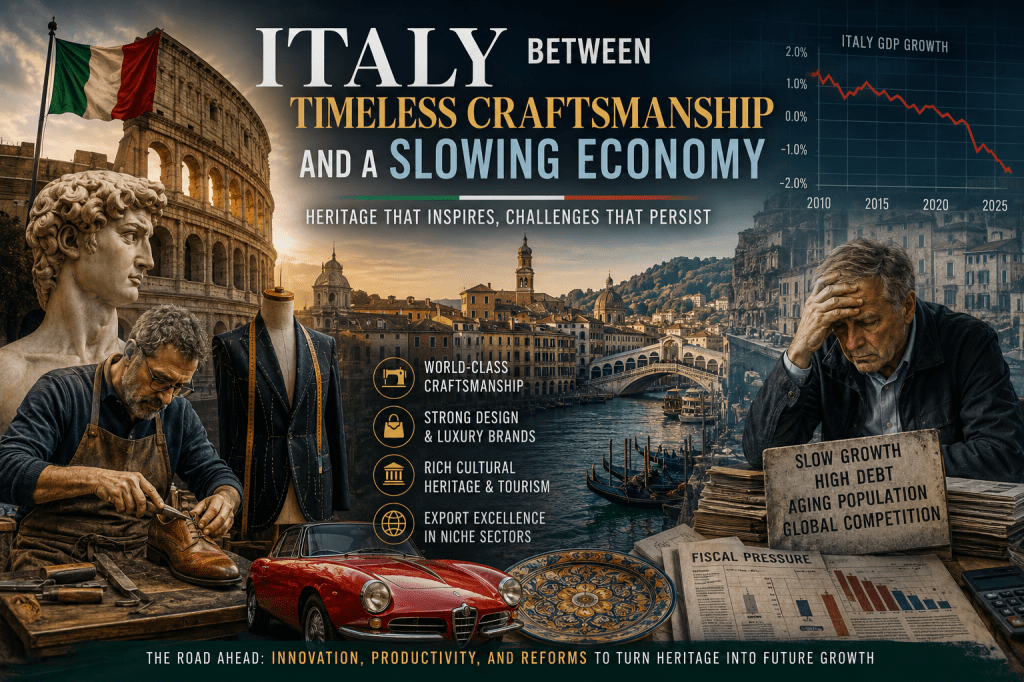
When History Becomes Both an Advantage and a Burden
Italy is one of the few countries where history still produces wealth. Every city, every industrial district and every family business carries generations of knowledge. Italian machines build factories across the world. Italian fashion shapes global luxury markets. Italian food has become part of everyday life on every continent. Yet behind this global reputation lies an economy that has been struggling to generate enough momentum for decades.
The contradiction is striking. Italy produces products admired across the world, but its economy has found it difficult to produce sustained productivity growth. This is the difference between creating excellent products and creating an economy that continuously becomes more efficient. History has given Italy a powerful industrial base, but the future demands continuous innovation rather than dependence on past success.
The Power of Small Businesses and Industrial Clusters
Italy has built one of the world’s strongest networks of small and medium enterprises. Unlike economies dominated by giant corporations, Italy depends on thousands of specialised family-owned firms that focus on quality instead of quantity. These companies have created globally recognised strengths in machinery, precision engineering, luxury fashion, furniture, food processing and specialised manufacturing.
This industrial model has survived because cooperation within regional manufacturing clusters has allowed businesses to specialise while remaining globally competitive. Local suppliers, skilled workers and technical institutions have worked together for generations, creating industrial ecosystems that are difficult to replicate elsewhere.
However, the same structure that once created flexibility now presents new challenges. Many businesses remain too small to invest heavily in digital technologies, artificial intelligence, advanced automation or international expansion. Success built on craftsmanship alone is becoming increasingly difficult in a world driven by scale, speed and continuous technological change.
Productivity Is the Invisible Engine of National Prosperity
Economic growth is not determined only by how many people work. It also depends on how efficiently they work. Productivity allows workers to produce more value without working longer hours. Countries with rising productivity generate higher wages, stronger exports and greater public revenues.
Italy has experienced only modest productivity growth over many years. Businesses continue to produce high-quality goods, but improvements in efficiency have been slower than many competing economies. Rising labour costs without matching productivity gains gradually weaken international competitiveness. This silent decline rarely attracts headlines, but over time it shapes national prosperity more than short-term economic cycles.
The challenge is not a lack of talent. Italy has engineers, designers, researchers and entrepreneurs of global reputation. The real issue is transforming this talent into widespread technological adoption across millions of businesses.
Public Debt Limits Economic Choices
Italy also carries one of the largest public debt burdens among advanced economies. High debt does not immediately create a crisis, but it steadily reduces policy flexibility. Governments facing large interest payments have fewer resources available for infrastructure, education, healthcare, research and industrial modernisation.
When economic shocks arrive, countries with healthier public finances can respond quickly through public investment or fiscal support. Highly indebted economies have far less room to act. Every new challenge therefore becomes more expensive to manage.
Debt is not simply an accounting figure. It represents future commitments that reduce present choices.
Demography May Become the Bigger Crisis
Perhaps the greatest long-term challenge is not financial but demographic. Italy’s population is ageing rapidly while birth rates remain among the lowest in the world. Fewer young workers are entering the labour market even as more citizens retire.
This creates multiple pressures simultaneously. Businesses struggle to find skilled workers. Pension systems become increasingly expensive. Healthcare costs rise steadily. Domestic consumption weakens as the working-age population declines.
No amount of financial engineering can permanently solve a shortage of people. Economic vitality ultimately depends on human capital.
Can Tradition and Technology Work Together
Italy now stands at an important crossroads. Its future will not be secured by abandoning traditional industries, nor by relying only on digital technologies. The real opportunity lies in combining centuries of manufacturing excellence with modern innovation.
Artificial intelligence, robotics, advanced manufacturing, green production and digital supply chains can strengthen rather than replace Italy’s traditional industrial strengths. Family businesses that successfully embrace technology could become even more competitive in global markets.
The challenge is not choosing between heritage and innovation. It is making both work together.
The Future Will Reward Adaptation Rather Than Reputation
Italy reminds the world that economic reputation cannot guarantee future prosperity. Countries that once led global manufacturing must continue reinventing themselves as technology, demographics and international competition evolve.
The next phase of Italian growth will depend less on its famous past and more on its willingness to modernise thousands of small enterprises, improve productivity, strengthen public finances and prepare for demographic realities.
Italy has already shown that craftsmanship can survive centuries. The real question is whether its economic institutions can evolve quickly enough to ensure that the next generation inherits not only a rich history but also a stronger future.
#ItalyEconomy #Productivity #PublicDebt #Manufacturing #SMEs #IndustrialClusters #Innovation #AgingPopulation #EconomicCompetitiveness #FutureGrowth


Leave a Reply