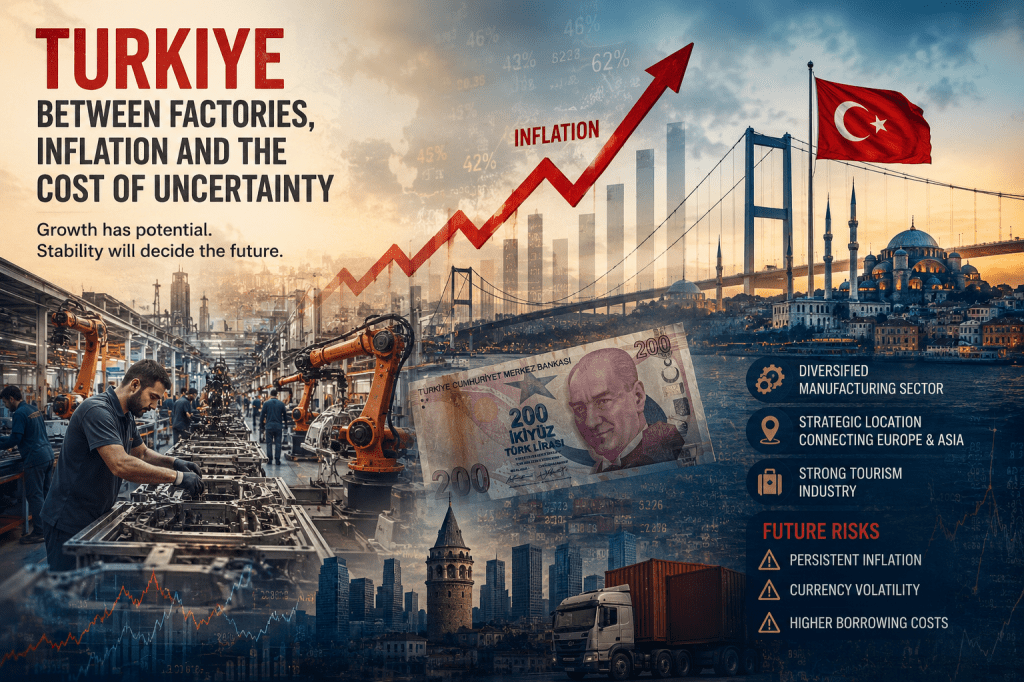
There are countries that struggle because they lack industries. Then there are countries that struggle despite having industries. Türkiye belongs to the second category. It has modern factories, a vibrant tourism sector, a young entrepreneurial population and one of the most strategic geographical positions in the world. Sitting between Europe and Asia, it has every reason to become a long-term manufacturing and logistics powerhouse. Yet one economic force has repeatedly challenged these strengths. Inflation has become more than an economic indicator. It has become part of daily life, influencing every household, every business decision and every investment plan.
When Prices Rise Faster Than Hope
Inflation is not simply about paying more for food or fuel. It quietly changes how people think. Families stop planning for the future because tomorrow may be more expensive than today. Businesses hesitate to invest because production costs keep changing. Workers demand higher wages while employers struggle to maintain profitability. Over time, the economy shifts from creating wealth to merely trying to protect existing income. The greatest danger is that uncertainty becomes normal and confidence slowly disappears.
A Manufacturing Nation Searching for Stability
Türkiye has spent decades building a diversified industrial base. Its automotive, machinery, textiles, electronics and food processing industries compete in international markets. Its factories connect European supply chains with Asian production networks, making the country an attractive manufacturing destination. However, manufacturing depends on stable prices, affordable finance and predictable exchange rates. When inflation remains high, companies spend more time managing financial risks than improving technology, innovation and productivity. Industrial strength alone cannot overcome persistent macroeconomic instability.
Currency Becomes a Second Battlefield
A strong economy depends not only on producing goods but also on maintaining confidence in its currency. Frequent exchange-rate fluctuations increase the cost of imported raw materials, machinery and energy. Exporters may temporarily benefit from a weaker currency, but long-term volatility creates uncertainty for contracts, pricing and investment decisions. Businesses begin to focus on surviving currency movements rather than expanding production. Economic energy is diverted from growth to damage control.
Tourism Brings Income but Cannot Carry the Entire Economy
Türkiye remains one of the world’s most attractive tourism destinations. Millions of visitors support hotels, restaurants, transport and local businesses every year. Tourism generates valuable foreign exchange and creates employment across many regions. Yet tourism alone cannot guarantee long-term economic resilience. Global recessions, geopolitical tensions, health emergencies or climate-related disruptions can quickly reduce visitor numbers. A balanced economy requires manufacturing, exports, innovation and domestic consumption to move together rather than relying heavily on one successful sector.
The Hidden Cost Paid by Ordinary Families
The real impact of inflation is not measured only by economic statistics. It is reflected in everyday decisions. Parents postpone education expenses, young people delay buying homes, small businesses reduce hiring and retirees see their savings lose value. Economic instability slowly changes social behaviour. People spend less time building wealth and more time protecting themselves from rising prices. The emotional cost of uncertainty often remains invisible, but it affects society as deeply as financial losses.
The Future Will Reward Credibility More Than Growth
The coming decade may redefine economic success. Investors will increasingly choose countries where policy remains predictable, institutions remain credible and inflation remains under control. Manufacturing competitiveness will depend not only on labour costs but also on financial stability, digital infrastructure, green technologies and skilled human capital. Türkiye has the industrial capability to remain an important global production hub, but sustainable growth will require rebuilding confidence in macroeconomic management as much as expanding industrial capacity.
The Real Lesson Beyond Türkiye
Türkiye reminds the world that economic geography, industrial capability and entrepreneurial talent are powerful assets, but they cannot fully compensate for prolonged inflation and currency instability. Nations do not lose competitiveness overnight. They lose it gradually when uncertainty becomes permanent. The future will belong to economies that combine industrial ambition with financial discipline, innovation with policy credibility and growth with stability. The strongest economies of tomorrow may not be those that grow the fastest, but those that create the greatest confidence in their future.
Türkiye #Inflation #Manufacturing #CurrencyStability #EconomicReforms #InvestmentClimate #BusinessConfidence #GlobalTrade #Macroeconomics #FutureEconomy


Leave a comment