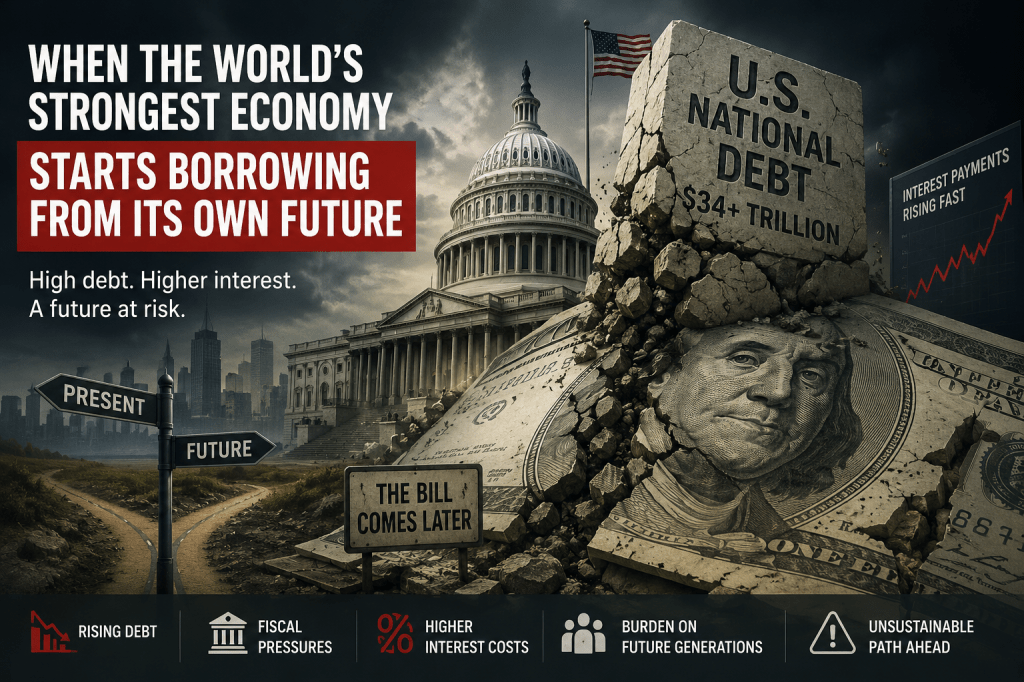
The Economy That Changed the World Is Now Testing Its Own Limits
For more than a century, the United States has been the engine of the global economy. It led the industrial revolution in modern manufacturing, built the world’s largest consumer market, created breakthrough technologies, and made the US dollar the backbone of international finance. Every major financial crisis was met with American innovation, investment, and policy action. Yet a quieter challenge has been growing beneath this remarkable success. The country is borrowing at a pace that raises an uncomfortable question. Can even the world’s richest economy continue spending faster than it earns forever?
Growth Powered by Innovation But Supported by Borrowing
America still possesses extraordinary strengths. It remains the global leader in artificial intelligence, biotechnology, aerospace, digital platforms, financial markets, and advanced research. Its universities attract talent from across the world, while entrepreneurs continue to build companies that reshape industries. Consumer spending remains the heartbeat of the American economy, supported by a large middle class and deep financial markets.
However, this growth increasingly coexists with rising government borrowing. Every year, the gap between government income and expenditure widens, forcing the country to issue more debt. Borrowing has become not just a response to emergencies but a structural feature of the economy. As debt grows, interest payments also rise, consuming a larger share of government resources that could otherwise be invested in education, infrastructure, healthcare, or scientific research.
The Cost of Debt Is Becoming the Real Challenge
Debt itself is not always dangerous. Governments often borrow to finance long-term development or to stabilize economies during crises. The real concern emerges when the cost of servicing that debt grows faster than the economy itself. Higher interest rates mean that each new dollar borrowed becomes more expensive. Over time, interest payments begin to compete with essential public spending, reducing the government’s financial flexibility.
If this trend continues, future generations may inherit fewer opportunities because a growing share of national income will be committed simply to paying for yesterday’s borrowing rather than building tomorrow’s prosperity.
Politics May Become a Bigger Risk Than Economics
America has overcome financial challenges before, but today’s environment presents a different obstacle. Political polarization often delays difficult fiscal decisions, making long-term planning increasingly difficult. Budget negotiations regularly become political battles instead of opportunities for structural reform. Markets may tolerate rising debt for some time because of confidence in the US economy, but confidence ultimately depends on credible governance as much as economic strength.
History shows that nations rarely face financial crises overnight. Most weaken gradually as difficult decisions are repeatedly postponed.
The Dollar Still Rules But Confidence Cannot Be Taken for Granted
The global financial system continues to rely heavily on the US dollar. Governments, central banks, and investors around the world hold American Treasury securities because they are viewed as among the safest financial assets. This unique position gives the United States greater borrowing capacity than almost any other nation.
Yet even reserve currency status depends on long-term confidence. If debt continues to expand while political uncertainty increases, global investors may gradually diversify their holdings. Such a shift would not happen suddenly, but even a slow change could increase borrowing costs and reshape international financial markets.
The Future Will Depend on Choices Made Today
America is unlikely to lose its economic leadership because of one recession or one budget deficit. Its greatest strengths remain innovation, entrepreneurship, scientific leadership, and the ability to attract global talent. But these strengths cannot permanently compensate for an unchecked fiscal imbalance.
The real challenge is not whether the United States can borrow more. It is whether borrowing continues to create future wealth or merely finances present consumption. The answer will influence not only the American economy but also every nation connected to global trade, finance, investment, and the international monetary system.
The next chapter of the American economy will therefore not be written only in laboratories, technology companies, or financial markets. It will also be written in budget decisions, fiscal discipline, and political willingness to balance today’s ambitions with tomorrow’s responsibilities. The world’s largest economy is no longer simply managing debt. It is managing confidence, and confidence remains the most valuable currency in global economics.
#UnitedStates #FiscalDebt #PublicDebt #BudgetDeficit #InterestPayments #USDollar #GlobalEconomy #ConsumerSpending #FiscalPolicy #EconomicOutlook


Leave a comment