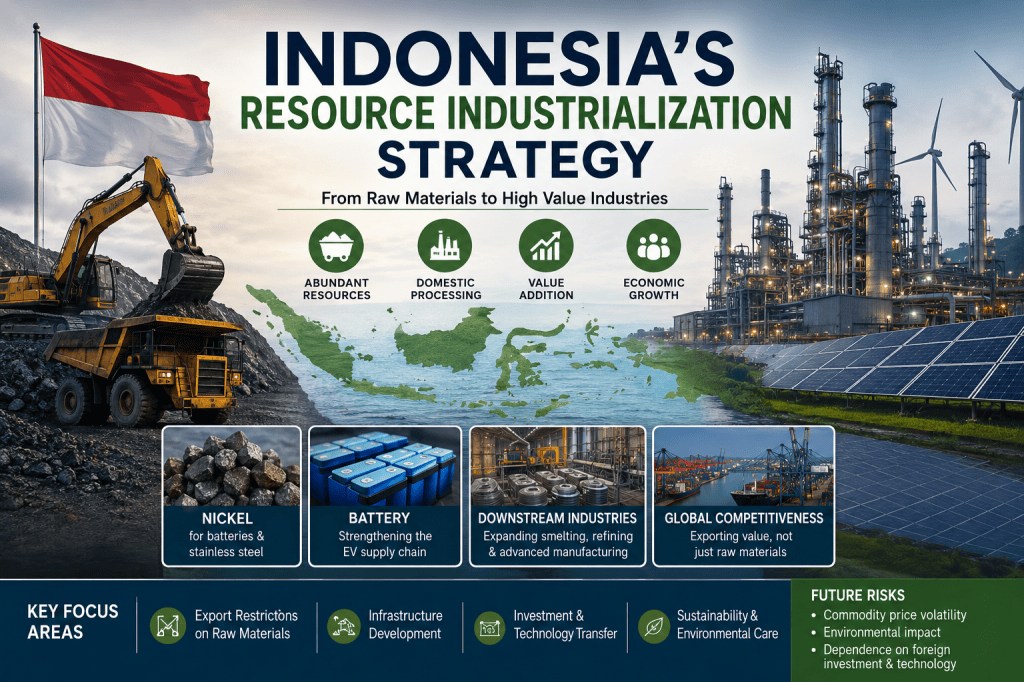
The Real Wealth Lies Beyond the Mine
For decades, many resource-rich countries believed that exporting minerals was enough to become prosperous. Ships carrying coal, copper, nickel and other valuable minerals left their ports every day, yet much of the real wealth was created somewhere else. The countries that bought these raw materials processed them into advanced products, created new industries, generated high-paying jobs and built global brands. Indonesia has decided that this old model no longer serves its long-term interests. It wants to keep more value within its own borders by transforming raw minerals into finished industrial products before they reach global markets.
From Resource Supplier to Industrial Nation
Indonesia possesses some of the world’s largest nickel reserves, a mineral that has become increasingly important in the age of electric vehicles and energy storage. Instead of allowing raw nickel to leave the country, the government has encouraged companies to establish processing facilities, refineries and battery manufacturing plants within Indonesia. The goal is not simply to sell minerals but to become an essential part of the global battery and clean energy supply chain. This represents a shift from resource extraction to resource industrialization, where every stage of processing creates additional economic value, technology, employment and industrial capability.
Export Restrictions as an Industrial Policy
Indonesia’s decision to restrict exports of selected raw minerals has attracted global attention. While these policies have generated debate in international trade, they also reflect a larger economic strategy. The country wants investors to build industries locally rather than purchase cheap raw materials and process them elsewhere. Such policies signal that natural resources are not just commodities but strategic national assets that can shape industrial development for decades. This approach may temporarily disrupt global supply chains, but it also encourages domestic manufacturing, technology transfer and infrastructure development.
Building an Entire Industrial Ecosystem
Processing minerals is only the beginning. Around every refinery emerge transport networks, engineering services, equipment suppliers, research institutions, logistics providers and skilled workers. A mining project gradually evolves into an industrial ecosystem. Indonesia hopes that this transformation will reduce dependence on commodity exports and build a stronger manufacturing base. If successful, the country may create thousands of new jobs while expanding its technological capabilities and increasing the value generated from every tonne of mineral extracted.
The Hidden Risks Behind the Opportunity
Industrialization built on natural resources is never free from uncertainty. Commodity prices continue to rise and fall with changes in the global economy. A sudden decline in nickel prices can reduce investment and slow industrial expansion. Environmental pressures also continue to grow. Mining, refining and heavy industries consume significant amounts of energy and water while creating waste that requires responsible management. If environmental safeguards fail to keep pace with industrial growth, economic gains may come at a high ecological cost.
Another challenge lies in dependence on foreign investment, technology and expertise. While international partnerships bring capital and advanced knowledge, excessive dependence may reduce national control over strategic industries. Long-term industrial success will depend not only on attracting foreign investors but also on developing local engineers, researchers, entrepreneurs and technology companies capable of leading future innovation.
Lessons for the Future
Indonesia’s strategy highlights a broader lesson for developing economies. The future may belong less to countries that simply own natural resources and more to those that know how to transform them into sophisticated products. The greatest economic value is increasingly created through innovation, manufacturing and technology rather than extraction alone.
History has repeatedly shown that natural resources can become either a blessing or a missed opportunity. The countries that invested in processing industries, research and skilled people generally captured greater long-term prosperity than those that relied only on exporting raw materials. Indonesia is attempting to rewrite this history by moving higher in global value chains.
The Next Global Competition
The coming decades may witness intense competition not only for access to minerals but also for control over processing technologies, battery manufacturing and green industrial ecosystems. Countries that master the complete value chain will influence global trade, industrial policy and technological leadership. Those that remain suppliers of raw materials may continue to earn export revenues but miss the larger opportunity to shape the industries of the future.
Indonesia’s experiment is therefore much larger than nickel. It is a test of whether a developing economy can convert natural wealth into industrial strength. If it succeeds, it could become a model for many resource-rich nations. If it fails, it will remind the world that natural resources alone never guarantee prosperity. Sustainable growth ultimately depends on institutions, innovation, skilled people and the ability to continuously create value beyond what nature provides.
Indonesia #Nickel #BatteryEconomy #ResourceIndustrialization #ValueAddition #DownstreamIndustries #Manufacturing #IndustrialPolicy #GreenEconomy #GlobalValueChains


Leave a comment