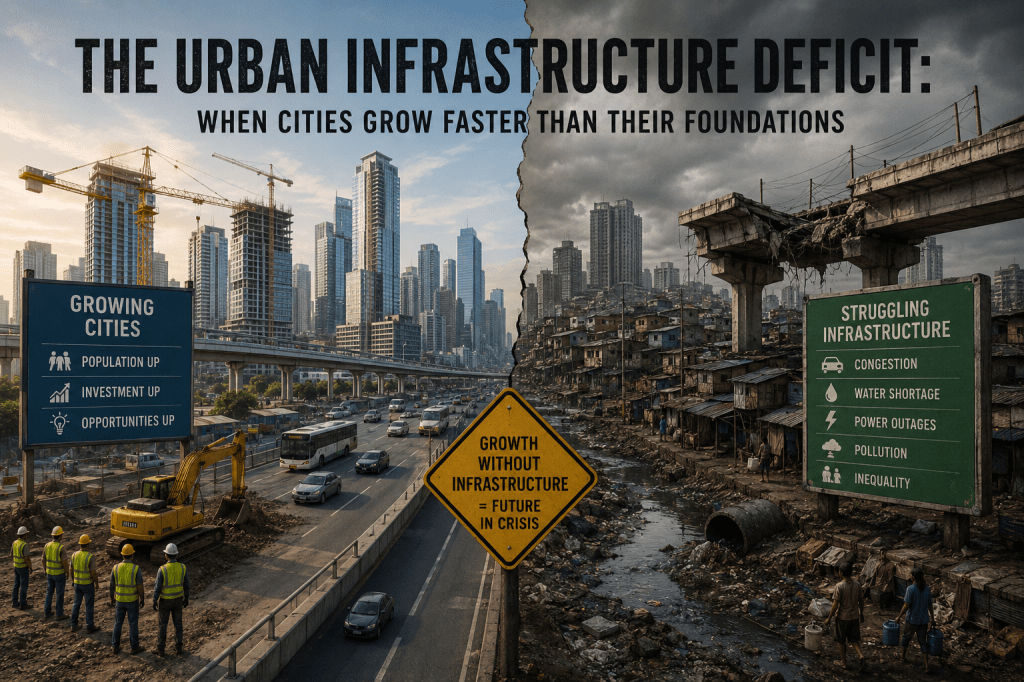
India often celebrates the rise of its cities. From Mumbai to Bengaluru, from Delhi to Hyderabad, urban centres have become the engines of economic growth. They generate a large share of national income, attract investment, create jobs, and shape the aspirations of millions. Yet beneath the shining skylines and expanding metro networks lies a deeper reality. Many Indian cities are growing faster than their infrastructure can support. The result is a silent urban crisis that rarely makes headlines until it becomes impossible to ignore.
Cities That Create Wealth But Struggle To Function
History shows that successful economies have always depended on strong cities. London supported the Industrial Revolution. New York powered American finance and innovation. Shanghai became a symbol of China’s economic transformation. In every case, economic growth was accompanied by massive investments in roads, housing, sanitation, transport, utilities, and urban governance.
India’s urban story is different. Economic activity has expanded rapidly, but infrastructure creation has often struggled to keep pace. As millions migrate to cities seeking opportunities, roads become congested, housing becomes expensive, public services become overstretched, and urban planning falls behind reality. Cities continue to generate wealth while simultaneously becoming harder places in which to live and do business.
The Cost Of Congestion Is Larger Than We Think
Traffic jams are often treated as a daily inconvenience. In reality, they represent a significant economic loss. Hours spent in traffic reduce productivity, increase fuel consumption, raise logistics costs, and create stress for workers and businesses alike.
For manufacturers, delayed transportation increases operating expenses. For service industries, employee efficiency declines. For citizens, valuable time that could be spent working, learning, or resting disappears on overcrowded roads. Congestion is not merely a transport problem. It is an economic problem hidden in plain sight.
Pollution Is Becoming An Economic Variable
For decades, pollution was viewed primarily as an environmental issue. Today it is increasingly becoming a business issue. Poor air quality affects worker health, increases healthcare costs, reduces labour productivity, and influences investment decisions.
Global investors now consider quality of life when selecting locations. Skilled professionals often choose cities that offer cleaner environments and better public services. If urban pollution continues to worsen, cities may find themselves competing for talent with one hand tied behind their backs.
The Housing Challenge Nobody Has Solved
Urban growth requires affordable housing. Yet in many cities, housing prices have grown much faster than incomes. This creates long commuting distances, informal settlements, overcrowding, and social inequality.
The paradox is striking. Cities need workers to sustain economic growth, but many workers cannot afford to live close to where opportunities exist. As housing affordability declines, cities become less efficient and less inclusive. The future risk is not only social tension but also reduced economic competitiveness.
The Municipal Finance Trap
One of the least discussed challenges is the financial weakness of urban local bodies. Cities are expected to provide roads, drainage, sanitation, transport systems, parks, and public services, yet many municipalities operate with limited financial resources.
Without strong revenue systems, cities become dependent on state and central government support. Infrastructure projects are delayed, maintenance suffers, and long-term planning becomes difficult. A city cannot function like a global economic hub if its finances resemble those of a struggling institution.
Public Transport Will Decide Urban Success
The future of Indian cities may depend less on flyovers and more on public transport. Expanding metro systems, bus networks, integrated mobility platforms, and last-mile connectivity can dramatically improve productivity and quality of life.
Around the world, the most successful cities are not those with the most cars but those that move people efficiently. If public transport expansion fails to keep pace with urbanisation, congestion and pollution will continue to grow regardless of how many roads are constructed.
The Next Urban Crisis May Be Competitiveness
The discussion around infrastructure is often framed as a citizen welfare issue. It is equally a competitiveness issue. Investors compare cities globally. Businesses compare logistics costs. Skilled workers compare quality of life.
If urban infrastructure continues to lag behind economic growth, the cost of doing business will rise steadily. Investment attractiveness may weaken. Productivity gains may slow. Economic growth could become increasingly constrained by physical bottlenecks rather than lack of entrepreneurial energy.
Looking Towards 2040
By 2040, India is expected to have hundreds of millions more urban residents. The question is not whether cities will grow. The question is whether infrastructure will grow with them.
The future city will need intelligent transport systems, climate-resilient infrastructure, affordable housing, digital governance, efficient utilities, and financially strong municipal institutions. Cities that achieve this transition will become magnets for talent and investment. Those that fail may experience rising congestion, declining efficiency, and increasing social pressure.
The Real Urban Deficit
The real deficit is not simply roads, housing, or transport. The real deficit is the gap between economic ambition and urban preparedness. India has built world-class companies, world-class entrepreneurs, and world-class aspirations. The next challenge is building world-class cities capable of supporting them.
The future of the Indian economy may ultimately depend not only on what happens in factories, offices, and financial markets, but on whether its cities can function as efficiently as the growth they are expected to generate.
#UrbanInfrastructure #SmartCities #UrbanEconomics #MunicipalFinance #PublicTransport #AffordableHousing #UrbanGrowth #CityCompetitiveness #InfrastructureGap #FutureOfCities


Leave a comment