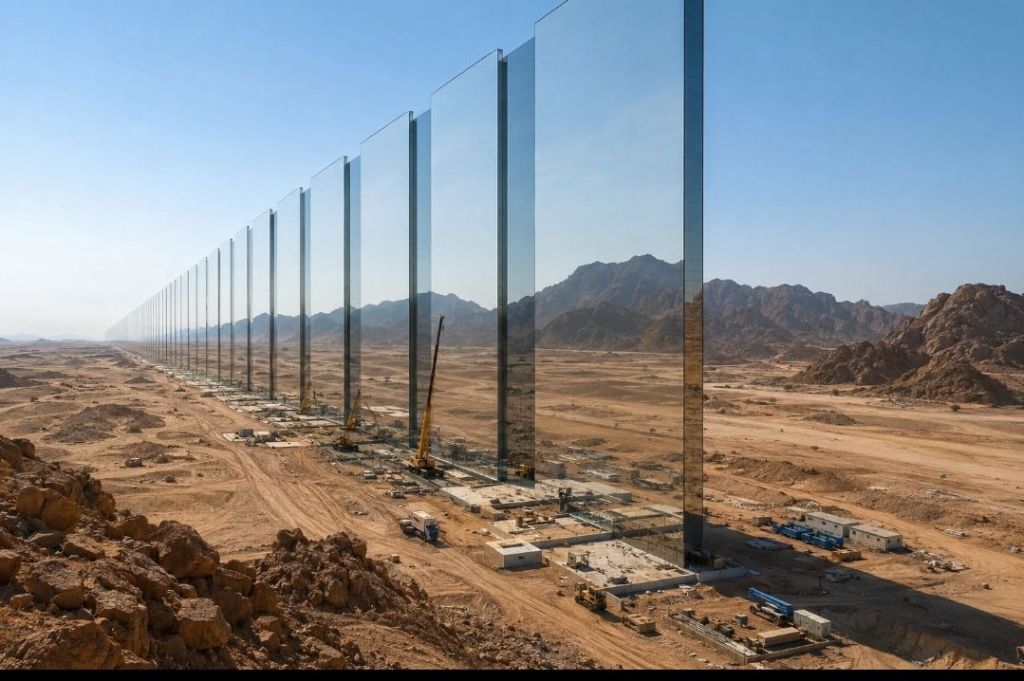
The twenty first century has become an age of spectacle infrastructure where nations increasingly attempt to build monuments not only for economic growth but also for geopolitical branding, global visibility, and political legitimacy. In this race for futuristic symbolism, Saudi Arabia’s The Line emerged as perhaps the most dramatic urban experiment ever proposed. Conceived as a 170-kilometre mirrored linear city cutting through the desert under the larger NEOM project and linked to Mohammed bin Salman’s Vision 2030 agenda, The Line promised a world without cars, roads, emissions, and congestion. It was marketed as the future of humanity itself. Yet within only a few years, the project has increasingly become a global case study in what may be called failure infrastructure where ambition outruns economic logic, engineering practicality, ecological sensitivity, and human realities.
Historically, nations have often used giant infrastructure projects to demonstrate power and modernity. From the Soviet Union’s oversized industrial complexes to China’s ghost cities and Gulf mega-towers, governments have repeatedly believed that scale itself could create development. Saudi Arabia’s oil wealth gave it the confidence to think beyond conventional urban planning. The Line was therefore not merely a city. It was intended to become a civilizational statement that the kingdom could redefine how humans live. The mirrored walls stretching hundreds of meters high across the desert were designed to symbolize technological supremacy and environmental consciousness simultaneously. But the deeper contradiction emerged quickly. The project attempted to solve urban sustainability through one of the most resource-intensive construction exercises ever imagined.
At the conceptual level, The Line reveals the dangers of designing cities as engineering diagrams instead of living social ecosystems. Human cities throughout history evolved organically through trade routes, communities, geography, markets, culture, and adaptation. Whether one studies Delhi, Istanbul, or London, successful urban systems emerged through flexibility and decentralised growth. The Line, by contrast, attempted to impose a rigid geometric vision on human behaviour. A single narrow corridor extending 170 kilometres assumes that mobility patterns, social interactions, emergency systems, logistics, and even psychology can be centrally programmed. Such thinking treats human beings as data points rather than unpredictable social actors.
The mirrored design itself became one of the most criticised elements. In the harsh desert climate, enormous reflective surfaces risk intensifying heat effects, disturbing local ecosystems, and creating dangerous bird migration disruptions. Environmentalists increasingly questioned whether a project marketed as green could require such massive carbon-intensive material extraction involving steel, glass, concrete, desalination, and energy infrastructure. This exposed one of the major contradictions of modern sustainability politics where projects use the language of environmentalism while depending upon deeply unsustainable construction practices. The Line therefore reflected a broader global phenomenon in which green branding increasingly becomes a tool of political image management rather than ecological realism.
Economically, the project demonstrates how sovereign wealth can sometimes weaken financial discipline rather than strengthen it. Initial cost estimates appeared enormous even at the planning stage, but later internal assessments suggested costs potentially approaching one trillion dollars over time. Such figures are historically unprecedented for a single urban experiment. As global oil markets fluctuate and fiscal pressures rise, even wealthy states cannot endlessly sustain projects without visible economic returns. Infrastructure ultimately survives not because it looks futuristic but because it generates productivity, jobs, trade efficiency, industrial competitiveness, or human welfare improvements. Critics increasingly argued that The Line lacked a credible pathway toward revenue generation proportional to its scale.
This becomes especially important when one examines opportunity costs. Every dollar absorbed by symbolic mega-projects is a dollar unavailable for broader economic diversification. Saudi Arabia simultaneously requires investments in manufacturing capability, logistics integration, education systems, water security, industrial ecosystems, SME development, and employment generation for a young population. Economists increasingly questioned whether The Line represented productive infrastructure or prestige infrastructure. The distinction matters deeply because history shows that nations rarely industrialise sustainably through isolated architectural spectacles. They industrialise through dense ecosystems of suppliers, skilled labour, institutions, research capability, and scalable production systems.
Construction realities further exposed the distance between visual imagination and physical execution. Satellite images and engineering reports suggested that actual progress remained far behind the original narrative. Several highly ambitious internal concepts reportedly failed technical evaluations related to structural stability, airflow behaviour, and energy management. The project’s extreme height and narrowness raised fears of dangerous wind tunnel effects and climate-control complexities beyond normal urban engineering experience. Modern engineering can achieve extraordinary things, but physics still imposes limits. The Line increasingly appeared to many experts not as an inevitable future city but as an architectural rendering struggling to survive contact with reality.
The political and social dimensions of the project perhaps reveal the deepest concerns. Infrastructure is never only about concrete and steel. It is also about who pays, who benefits, and who gets displaced. Reports surrounding the relocation of the Huwaitat tribe and allegations concerning labour conditions created a darker narrative beneath the polished promotional campaigns. Migrant workers form the invisible backbone of many Gulf mega-projects, yet discussions about futuristic cities often exclude questions of labour dignity, worker rights, and social justice. A city marketed as the future of humanity cannot ignore the humanity of those building it.
The Line also illustrates the risks of excessively centralized planning systems. In environments where political prestige becomes attached to mega-projects, independent scrutiny often weakens. Engineers, planners, financiers, and administrators may hesitate to openly challenge unrealistic assumptions. This creates an echo chamber where visionary rhetoric suppresses practical caution. History offers many examples where authoritarian modernisation projects produced visually impressive announcements but weak long-term economic outcomes. Infrastructure succeeds not merely because leaders dream big but because institutions allow criticism, course correction, transparency, and phased implementation.
From a global policy perspective, The Line may ultimately become one of the defining lessons of twenty first century infrastructure planning. Around the world, governments are increasingly attracted toward giant symbolic projects including smart cities, AI cities, floating cities, climate cities, and carbon-neutral megastructures. Yet the deeper developmental challenge for most nations remains far more basic: affordable housing, reliable transport, employment-intensive industrialisation, water systems, waste management, energy reliability, and social inclusion. The danger is that spectacular infrastructure distracts political systems from solving ordinary but essential problems.
For countries like India, the lessons are especially relevant. Infrastructure linked to industrial corridors, logistics networks, manufacturing clusters, MSME ecosystems, and regional connectivity may appear less glamorous than mirrored desert megacities, but they often produce stronger economic multipliers. India’s long-term competitiveness will likely emerge from distributed economic ecosystems rather than isolated futuristic monuments. Pragmatic infrastructure that evolves incrementally, adapts locally, and generates productive employment may ultimately prove more sustainable than infrastructure designed primarily for global headlines.
The future of urbanisation will certainly involve technology, sustainability, and smarter systems. But the future cannot be built only through architectural imagination detached from social, economic, ecological, and institutional realities. The story of The Line increasingly suggests that development cannot be manufactured through visual spectacle alone. Cities are not products to be marketed globally. They are living systems shaped by human complexity, economic resilience, institutional credibility, and social trust.
The tragedy of failure infrastructure is not simply wasted money. It is the belief that modernity can be engineered through symbolism while bypassing the slow and difficult work of institution building, productive diversification, and human-centred development. In that sense, The Line may ultimately stand not as the city of the future, but as a mirror reflecting the limitations of spectacle-driven development itself.
#TheLine #SaudiArabia #NEOM #Infrastructure #UrbanPlanning #Megaprojects #EconomicPolicy #Sustainability #FutureCities #IndustrialDevelopment


Leave a comment