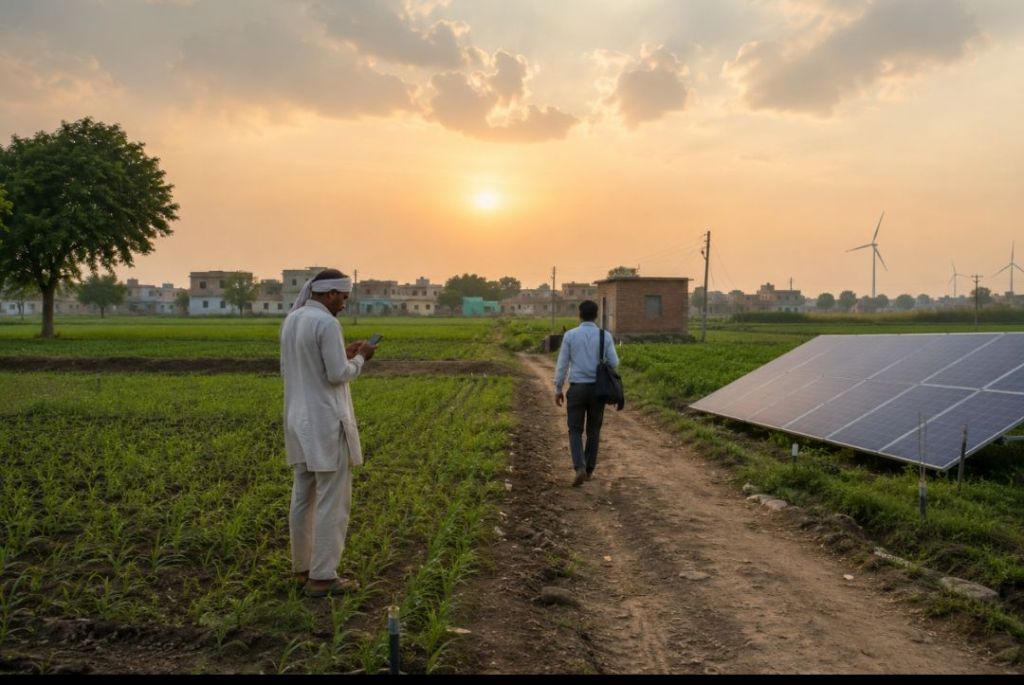
For centuries, the rural economy in India was built around agriculture as the center of livelihood, culture, and social identity. Farming was not only an economic activity but also the foundation of village society. Land ownership determined status, food security depended on monsoons, and rural prosperity was closely tied to crop cycles. Yet the rural economy of today is slowly moving away from this agriculture-only dependence toward a far more diversified and uncertain structure where migration, services, dairy, fisheries, poultry, food processing, transport, digital commerce, and small enterprises are becoming equally important sources of survival. This transition appears progressive on the surface, but underneath it lies a deep structural stress that may define the future of India’s social and economic stability.
The shift has not happened suddenly. It is the result of decades of pressure building inside the agricultural system. Rising population, fragmentation of landholdings, declining profitability of small farms, increasing climate risks, and the aspirations of younger generations have gradually weakened the traditional farming model. In many parts of India, agriculture is no longer capable of supporting an entire family through cultivation alone. A farmer who once depended only on wheat or paddy now sends one son to the city for work, runs a dairy unit at home, leases part of the land, and supplements income through government schemes or seasonal employment. Rural India is increasingly becoming a multi-income economy rather than a purely agricultural one.
This transformation is historically significant because India’s development model after independence was heavily dependent on agriculture-led rural stability. The Green Revolution of the 1960s and 1970s increased food production dramatically and protected India from famine-like conditions. Punjab, Haryana, and western Uttar Pradesh became symbols of agricultural modernization. But the Green Revolution also created regional inequalities, groundwater depletion, monoculture dependence, and excessive reliance on chemical inputs. Over time, the productivity gains slowed while costs continued to rise. Small and marginal farmers, who constitute the majority of India’s agricultural households today, struggled to survive in a system increasingly dominated by scale, mechanisation, and market volatility.
The current rural transition is therefore less about prosperity and more about adaptation. Rural households are diversifying because they are being pushed by necessity rather than pulled by opportunity. Dairy, poultry, fisheries, and agro-processing are emerging as supplementary income sources because crop farming alone cannot ensure economic resilience. India has become one of the world’s largest milk producers, and sectors like fisheries and poultry have shown strong growth over the last decade. Food processing clusters, cold chains, rural logistics, and local packaging industries are slowly expanding into semi-urban and rural regions. These sectors create employment beyond traditional cultivation and reduce some dependence on unpredictable harvests.
Yet this diversification also exposes a hidden inequality within rural India. States with better infrastructure, stronger cooperative systems, and greater market access are recovering faster in terms of rural consumption. States with weak connectivity, poor irrigation, and low industrial linkages continue to lag behind. Rural consumption patterns across India reveal an uneven recovery where some regions are witnessing rising demand for consumer goods, construction materials, and services, while others remain trapped in debt and underemployment. This growing divergence between rural regions may become one of India’s biggest long-term economic challenges.
One of the most visible consequences of this transformation is youth migration. Rural youth increasingly view farming as economically uncertain and socially limiting. Cities, despite their hardships, offer the possibility of cash income, exposure, mobility, and aspiration. Millions of young workers migrate seasonally or permanently to urban centers for jobs in construction, delivery services, retail, transport, hospitality, and platform-based work. Villages are slowly losing their younger workforce while the elderly remain dependent on fragmented agricultural holdings. In many regions, agriculture is becoming an occupation of survival rather than ambition.
This migration trend is reshaping rural social structures in profound ways. Traditional joint farming systems are weakening. Land fragmentation is making cultivation economically inefficient. The average landholding size in India has continued to decline over decades, making mechanisation costly and profitability difficult. Smaller farms struggle to adopt advanced irrigation systems, precision farming technologies, or modern storage infrastructure. At the same time, rural indebtedness continues to rise because income growth has not kept pace with rising costs of seeds, fertilizers, fuel, electricity, and healthcare.
Climate change is further intensifying this crisis. Agriculture globally is entering an era of uncertainty where rainfall patterns are becoming erratic, heatwaves are increasing, and water stress is worsening. India’s rural economy remains highly climate-sensitive despite decades of development planning. A delayed monsoon, unexpected flood, or prolonged drought can destroy household incomes across entire regions. Climate instability is no longer only an environmental issue. It is becoming a major economic risk affecting inflation, food security, migration, and social stability.
Globally, food systems are also under pressure. Climate-induced agricultural instability in major producing countries is creating international supply shocks. Disruptions in grain exports, fertilizer availability, and energy prices directly affect domestic food inflation in countries like India. The interconnected nature of global food systems means that a war, drought, or trade restriction thousands of kilometers away can influence the price of edible oil, wheat, or pulses in Indian households. This dependence on volatile international markets makes food security increasingly fragile.
Mechanisation is adding another layer of complexity. While agricultural machines improve productivity and reduce labour shortages, they also reduce demand for low-skilled farm employment. This creates a paradox where agricultural efficiency rises but rural employment opportunities decline. In developed economies, mechanisation occurred alongside industrial expansion that absorbed displaced workers. India faces a more difficult situation because manufacturing growth has not been strong enough to absorb the large rural workforce leaving agriculture. As a result, many workers enter low-income informal service sectors instead of productive industrial employment.
The future rural economy may therefore look very different from the village economy imagined during India’s early development years. Villages may evolve into hybrid economic zones connected digitally to cities, dependent on logistics and service networks, and integrated with food processing and rural tourism ecosystems. Technology, e-commerce, digital payments, telemedicine, online education, and rural entrepreneurship could create new opportunities. But this optimistic future will only emerge if structural issues are addressed seriously.
The real challenge is not whether agriculture declines in relative importance. That transition is natural in most developing economies. The challenge is whether India can create a dignified and resilient rural transition. If diversification happens without strong institutions, quality education, healthcare, market access, climate adaptation, and rural industrialization, then the rural economy may become more vulnerable despite appearing more modern.
Historically, agriculture provided social stability even when incomes were low because communities remained rooted in local production systems. The emerging rural economy is more monetised, market-linked, and globally exposed. This increases both opportunity and insecurity. A climate shock, digital disruption, supply chain crisis, or food inflation wave can rapidly destabilize millions of rural households.
India therefore stands at a defining moment. The rural economy is no longer simply about farming. It is becoming the battlefield where climate change, migration, technology, inequality, food security, and employment transitions intersect simultaneously. The success or failure of this transformation will not only shape India’s villages but also determine the future stability of the Indian economy itself.
#RuralEconomy #AgricultureTransition #FoodSecurity #ClimateChange #RuralMigration #AgroProcessing #IndianEconomy #FarmCrisis #RuralEmployment #EconomicTransformation


Leave a comment