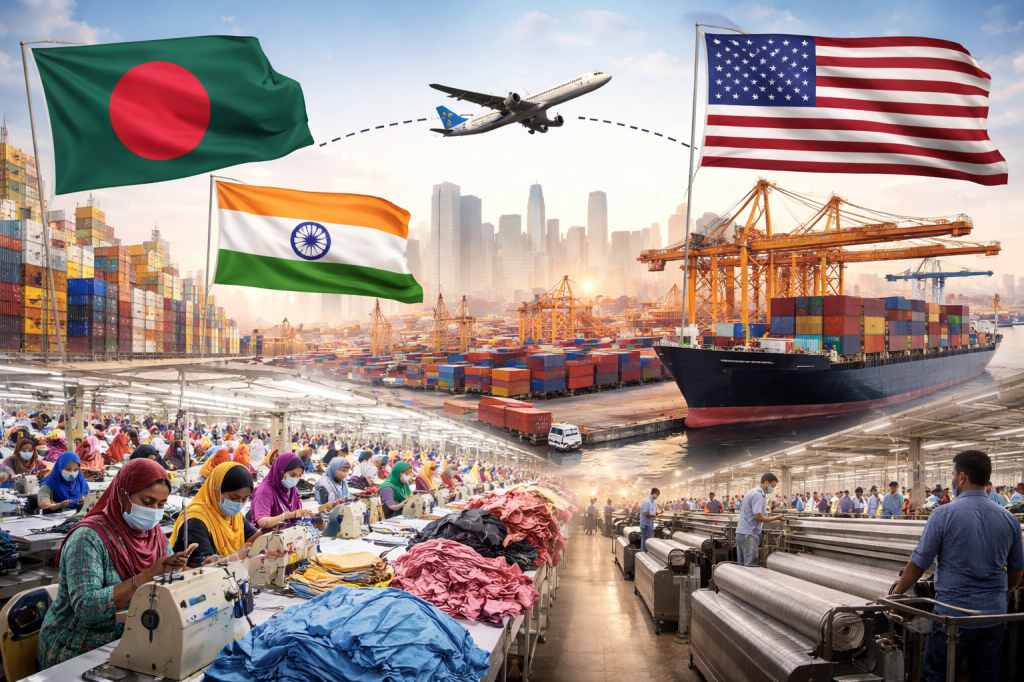
Historical Context: How Bangladesh Built a Tariff-Led Export Model
The rise of Bangladesh as a global apparel powerhouse is not accidental; it is deeply rooted in a historical combination of preferential trade access, low-cost labor, and policy clarity. Since the 1990s, Bangladesh leveraged its Least Developed Country (LDC) status to gain duty-free or preferential access in key markets like the EU under GSP schemes. This created a structural arbitrage—global buyers sourced from Bangladesh not merely for cost efficiency but for tariff advantages embedded in trade regimes. Over time, this tariff cushion became as critical as productivity itself, allowing Bangladesh to scale exports to over $45–50 billion annually in garments, making it the world’s second-largest apparel exporter after China.
The New Trade Logic: Conditional Zero-Duty as a Strategic Tool
The recent development of conditional zero-duty access to the US market marks a shift from broad-based preferences to tightly negotiated, supply-chain-linked incentives. Instead of blanket tariff elimination, Bangladesh has secured a targeted arrangement where apparel exports can enter the US market at zero duty—but only if they use US-origin cotton or man-made fibers. This is not a concession in the traditional sense; it is a strategic alignment tool for the US to rewire global textile supply chains in its favor. It ensures backward linkage dependence on US raw materials while offering Bangladesh a competitive edge in finished goods.
This model reflects a broader global trend: trade agreements are no longer about lowering tariffs universally but about controlling value chains selectively. The zero-duty benefit is therefore not “free access”—it is conditional integration into a US-centric supply ecosystem.
Why India Has Not Secured a Similar Arrangement
India’s absence from such a zero-duty framework is not due to incapacity but due to structural and strategic differences. First, India operates with a diversified raw material base and a relatively stronger domestic value chain, including cotton, yarn, and fabric production. Accepting conditional zero-duty linked to US inputs would dilute its domestic upstream sectors, particularly spinning and fiber industries. Second, India’s trade policy has historically been cautious in bilateral concessions with the US, especially where reciprocity or strategic dependence is implied.
Moreover, India’s approach has shifted toward broader Free Trade Agreements (FTAs), such as its evolving engagement with the European Union, where it is expected to gain duty-free access for apparel by 2027. This reflects a long-term market diversification strategy rather than a product-specific, conditional concession model. In essence, India is negotiating systemic access, while Bangladesh is leveraging tactical advantages.
The Hidden Cost of Bangladesh’s Advantage: Dependency and Margin Pressure
While the zero-duty window appears advantageous, it introduces a new form of dependency. Bangladesh traditionally sources cotton from cost-efficient suppliers like India and Brazil. Shifting to US cotton—often priced higher—raises input costs, compressing margins unless offset by tariff savings. This creates a delicate balance: the benefit of zero-duty access must exceed the additional cost of sourcing US inputs.
Further, this model restricts flexibility. Manufacturers cannot freely optimize sourcing based on global price signals; they must align with US-origin requirements. This reduces Bangladesh’s agility in responding to market fluctuations, a critical factor in the highly competitive apparel sector.
Structural Limitations: Beyond Tariffs
Bangladesh’s apparel success also faces deeper structural constraints. The country remains heavily concentrated in low- to mid-value segments of the apparel chain, with limited capabilities in design, branding, and technical textiles. Its infrastructure, though improving, still faces bottlenecks in logistics and energy reliability. Compliance pressures—especially environmental and labor standards—are rising, increasing operational costs.
Another emerging limitation is its impending graduation from LDC status. As Bangladesh transitions to a developing country, it will gradually lose many of its preferential trade benefits, particularly in markets like the EU. This will erode one of its core competitive pillars, forcing a shift toward productivity and value addition rather than tariff arbitrage.
India’s Strategic Position: Constraint or Opportunity?
India’s higher tariff exposure in the US market—often around 16–18% for apparel—does place it at a relative disadvantage in price-sensitive segments. However, this constraint may also be an opportunity. Unlike Bangladesh, India has a more integrated textile ecosystem, spanning fibers to fashion, and is better positioned to move into higher-value segments such as technical textiles, sustainable fabrics, and branded apparel.
India’s challenge is not merely tariff-related; it is structural—fragmentation in MSMEs, outdated machinery in weaving and processing, and gaps in scale and logistics. Addressing these issues could yield competitiveness gains that outweigh tariff disadvantages.
Futuristic Outlook: The End of Pure Tariff Competition
The Bangladesh-US arrangement signals the future of global trade: tariffs will increasingly be used as instruments to shape supply chains rather than simply to protect markets. Countries that align with major economies’ strategic interests—whether in raw materials, technology, or sustainability—will gain preferential access.
For Bangladesh, the next decade will test whether it can transition from a tariff-driven model to a value-driven one. For India, the imperative is to accelerate structural reforms and leverage its scale to become a full-spectrum textile powerhouse rather than competing only on cost.
Two Paths in a Changing Trade Order
The divergence between Bangladesh and India in apparel trade policy reflects two distinct development trajectories. Bangladesh has mastered the art of leveraging external preferences to build export scale, but now faces the risk of over-dependence on conditional access. India, while slower in securing immediate tariff advantages, retains greater strategic autonomy and potential for value-chain upgrading.
In the evolving global trade architecture, the real competition will not be about who gets zero duty—but about who controls the value chain, technology, and market narrative.
#ApparelTrade #ZeroDutyAccess #GlobalValueChains #BangladeshExports #IndiaTextiles #USCottonLinkage #TradeStrategy #TariffArbitrage #SupplyChainDependency #LDCGraduation
 "Connecting communities, empowering nations: Unifying the Regional and Global Economy ."
Leave a comment